
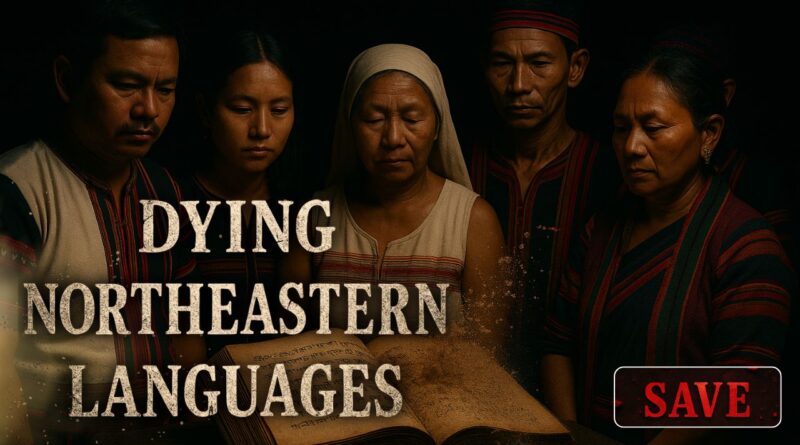
Northeast India’s Vanishing Tongues: A Crisis of Identity and Heritage
In Arunachal Pradesh, the linguistic landscape is both rich and fragile, woven from a stunning diversity of languages such as Koro, Idu Mishmi, Miju Mishmi, Meyor, Sherdukpen, Bugun, Sartang, Nocte, and Wancho. These languages are not merely tools for communication — they are living repositories of ancient myths, local knowledge systems, community memory, and spiritual wisdom. Each one holds the identity of a people, mapping their relationships with the forest, rivers, ancestors, and each other. However, this invaluable heritage is under immense threat. The reasons are many and deeply interwoven: No written scripts or standardized orthography; Extreme geographical isolation; Lack of inclusion in education; Elder-only usage with little intergenerational transmission; Influence of Hindi, English, and Assamese; Migration and urban drift; No digital or print media representation. Most of these languages are passed down orally, with no written scripts or formalized grammar, making them highly vulnerable when the chain of transmission between generations breaks. In the absence of inclusion in school curricula, children grow up learning state or national languages like Hindi, English, or Assamese, while their mother tongues are confined to ceremonial or household use — if at all. The effects of migration and urbanization further intensify the crisis. As young people move to cities for education and work, they adapt to dominant languages for survival and integration, leaving behind their native languages as relics of the past. In many cases, there is also a sense of social stigma attached to these indigenous tongues — they are seen as markers of backwardness rather than heritage, prompting even families to stop speaking them at home. The absence of governmental and institutional support — such as teacher training, printed textbooks, broadcast media, or digital content — ensures that these languages are not only forgotten but erased from the cultural imagination. If no comprehensive documentation or revival strategies are undertaken soon, many of these languages will not survive another generation, and with them will go an irreplaceable part of India’s cultural and intellectual diversity. To preserve these languages, we must implement urgent and community-centered solutions. These include developing orthographies and publishing dictionaries where needed, introducing mother tongue instruction at the foundational level of schooling, training teachers from within local communities, and sponsoring cultural programs and storytelling festivals. Oral histories should be recorded in multimedia formats, and modern technology must be harnessed through apps, podcasts, and YouTube channels to engage younger speakers. Government and NGOs must partner with tribal leaders, educators, and linguists to integrate these languages into mainstream platforms and ensure their survival and revival in the digital age.
In Assam, the linguistic landscape is both rich and fragile, woven from a stunning diversity of languages such as Tai Aiton, Tai Phake, Tai Khamti, Tai Khamyang, Ahom, Deori, Mising, Singpho, and Moran. These languages are not merely tools for communication — they are living repositories of ancient myths, local knowledge systems, community memory, and spiritual wisdom. Each one holds the identity of a people, mapping their relationships with the forest, rivers, ancestors, and each other. However, this invaluable heritage is under immense threat. The reasons are many and deeply interwoven: Shift to Assamese and English due to schooling and state policies; Neglect of tribal and royal heritage in formal curricula; Erosion of ceremonial and religious language use; Cultural stigma attached to speaking tribal dialects; Loss of community rituals and traditions that preserved the language. Most of these languages are passed down orally, with no written scripts or formalized grammar, making them highly vulnerable when the chain of transmission between generations breaks. In the absence of inclusion in school curricula, children grow up learning state or national languages like Hindi, English, or Assamese, while their mother tongues are confined to ceremonial or household use — if at all. The effects of migration and urbanization further intensify the crisis. As young people move to cities for education and work, they adapt to dominant languages for survival and integration, leaving behind their native languages as relics of the past. In many cases, there is also a sense of social stigma attached to these indigenous tongues — they are seen as markers of backwardness rather than heritage, prompting even families to stop speaking them at home. The absence of governmental and institutional support — such as teacher training, printed textbooks, broadcast media, or digital content — ensures that these languages are not only forgotten but erased from the cultural imagination. If no comprehensive documentation or revival strategies are undertaken soon, many of these languages will not survive another generation, and with them will go an irreplaceable part of India’s cultural and intellectual diversity. To preserve these languages, we must implement urgent and community-centered solutions. These include developing orthographies and publishing dictionaries where needed, introducing mother tongue instruction at the foundational level of schooling, training teachers from within local communities, and sponsoring cultural programs and storytelling festivals. Oral histories should be recorded in multimedia formats, and modern technology must be harnessed through apps, podcasts, and YouTube channels to engage younger speakers. Government and NGOs must partner with tribal leaders, educators, and linguists to integrate these languages into mainstream platforms and ensure their survival and revival in the digital age.
In Manipur, the linguistic landscape is both rich and fragile, woven from a stunning diversity of languages such as Purum, Chiru, Aimol, Tarao, Koireng, Monsang, Moyon, Anal, Lamkang, Zou, Poumai, and Maram. These languages are not merely tools for communication — they are living repositories of ancient myths, local knowledge systems, community memory, and spiritual wisdom. Each one holds the identity of a people, mapping their relationships with the forest, rivers, ancestors, and each other. However, this invaluable heritage is under immense threat. The reasons are many and deeply interwoven: Preference for Meitei and English in education and administration; No literature or standardization efforts; Lack of funding for tribal language promotion; Religious conversion led to loss of oral traditions; Language seen as irrelevant for modern life. Most of these languages are passed down orally, with no written scripts or formalized grammar, making them highly vulnerable when the chain of transmission between generations breaks. In the absence of inclusion in school curricula, children grow up learning state or national languages like Hindi, English, or Assamese, while their mother tongues are confined to ceremonial or household use — if at all. The effects of migration and urbanization further intensify the crisis. As young people move to cities for education and work, they adapt to dominant languages for survival and integration, leaving behind their native languages as relics of the past. In many cases, there is also a sense of social stigma attached to these indigenous tongues — they are seen as markers of backwardness rather than heritage, prompting even families to stop speaking them at home. The absence of governmental and institutional support — such as teacher training, printed textbooks, broadcast media, or digital content — ensures that these languages are not only forgotten but erased from the cultural imagination. If no comprehensive documentation or revival strategies are undertaken soon, many of these languages will not survive another generation, and with them will go an irreplaceable part of India’s cultural and intellectual diversity. To preserve these languages, we must implement urgent and community-centered solutions. These include developing orthographies and publishing dictionaries where needed, introducing mother tongue instruction at the foundational level of schooling, training teachers from within local communities, and sponsoring cultural programs and storytelling festivals. Oral histories should be recorded in multimedia formats, and modern technology must be harnessed through apps, podcasts, and YouTube channels to engage younger speakers. Government and NGOs must partner with tribal leaders, educators, and linguists to integrate these languages into mainstream platforms and ensure their survival and revival in the digital age.
In Meghalaya, the linguistic landscape is both rich and fragile, woven from a stunning diversity of languages such as Ruga, Biate, War, Pnar, Lyngngam, and Hajong. These languages are not merely tools for communication — they are living repositories of ancient myths, local knowledge systems, community memory, and spiritual wisdom. Each one holds the identity of a people, mapping their relationships with the forest, rivers, ancestors, and each other. However, this invaluable heritage is under immense threat. The reasons are many and deeply interwoven: Dialectal overshadowing within dominant groups (Khasi, Garo); No place in public media, no publication in dialects; Ceremonial-only use of endangered dialects; Urban schooling discourages native language use; Peer pressure to speak Khasi or English. Most of these languages are passed down orally, with no written scripts or formalized grammar, making them highly vulnerable when the chain of transmission between generations breaks. In the absence of inclusion in school curricula, children grow up learning state or national languages like Hindi, English, or Assamese, while their mother tongues are confined to ceremonial or household use — if at all. The effects of migration and urbanization further intensify the crisis. As young people move to cities for education and work, they adapt to dominant languages for survival and integration, leaving behind their native languages as relics of the past. In many cases, there is also a sense of social stigma attached to these indigenous tongues — they are seen as markers of backwardness rather than heritage, prompting even families to stop speaking them at home. The absence of governmental and institutional support — such as teacher training, printed textbooks, broadcast media, or digital content — ensures that these languages are not only forgotten but erased from the cultural imagination. If no comprehensive documentation or revival strategies are undertaken soon, many of these languages will not survive another generation, and with them will go an irreplaceable part of India’s cultural and intellectual diversity. To preserve these languages, we must implement urgent and community-centered solutions. These include developing orthographies and publishing dictionaries where needed, introducing mother tongue instruction at the foundational level of schooling, training teachers from within local communities, and sponsoring cultural programs and storytelling festivals. Oral histories should be recorded in multimedia formats, and modern technology must be harnessed through apps, podcasts, and YouTube channels to engage younger speakers. Government and NGOs must partner with tribal leaders, educators, and linguists to integrate these languages into mainstream platforms and ensure their survival and revival in the digital age.
In Mizoram, the linguistic landscape is both rich and fragile, woven from a stunning diversity of languages such as Bawm, Pangkhua, Ralte, Paite, Thado, Hmar, and Lai. These languages are not merely tools for communication — they are living repositories of ancient myths, local knowledge systems, community memory, and spiritual wisdom. Each one holds the identity of a people, mapping their relationships with the forest, rivers, ancestors, and each other. However, this invaluable heritage is under immense threat. The reasons are many and deeply interwoven: State policy centered around Mizo only; Churches promoting Mizo liturgy; Children discouraged from using minority tongues; No funding for textbooks or learning material in tribal dialects; Outmigration and generational language abandonment. Most of these languages are passed down orally, with no written scripts or formalized grammar, making them highly vulnerable when the chain of transmission between generations breaks. In the absence of inclusion in school curricula, children grow up learning state or national languages like Hindi, English, or Assamese, while their mother tongues are confined to ceremonial or household use — if at all. The effects of migration and urbanization further intensify the crisis. As young people move to cities for education and work, they adapt to dominant languages for survival and integration, leaving behind their native languages as relics of the past. In many cases, there is also a sense of social stigma attached to these indigenous tongues — they are seen as markers of backwardness rather than heritage, prompting even families to stop speaking them at home. The absence of governmental and institutional support — such as teacher training, printed textbooks, broadcast media, or digital content — ensures that these languages are not only forgotten but erased from the cultural imagination. If no comprehensive documentation or revival strategies are undertaken soon, many of these languages will not survive another generation, and with them will go an irreplaceable part of India’s cultural and intellectual diversity. To preserve these languages, we must implement urgent and community-centered solutions. These include developing orthographies and publishing dictionaries where needed, introducing mother tongue instruction at the foundational level of schooling, training teachers from within local communities, and sponsoring cultural programs and storytelling festivals. Oral histories should be recorded in multimedia formats, and modern technology must be harnessed through apps, podcasts, and YouTube channels to engage younger speakers. Government and NGOs must partner with tribal leaders, educators, and linguists to integrate these languages into mainstream platforms and ensure their survival and revival in the digital age.
In Nagaland, the linguistic landscape is both rich and fragile, woven from a stunning diversity of languages such as Tikhir, Chokri, Sangtam, Yimchungru, Phom, Chang, Khiamniungan, Zeme, and Lotha. These languages are not merely tools for communication — they are living repositories of ancient myths, local knowledge systems, community memory, and spiritual wisdom. Each one holds the identity of a people, mapping their relationships with the forest, rivers, ancestors, and each other. However, this invaluable heritage is under immense threat. The reasons are many and deeply interwoven: English-medium schooling in all districts; Nagamese overtaking mother tongue in homes; Young generation unable to speak or understand heritage language; Lack of teacher training and language documentation; No policy support for indigenous scripts or teaching. Most of these languages are passed down orally, with no written scripts or formalized grammar, making them highly vulnerable when the chain of transmission between generations breaks. In the absence of inclusion in school curricula, children grow up learning state or national languages like Hindi, English, or Assamese, while their mother tongues are confined to ceremonial or household use — if at all. The effects of migration and urbanization further intensify the crisis. As young people move to cities for education and work, they adapt to dominant languages for survival and integration, leaving behind their native languages as relics of the past. In many cases, there is also a sense of social stigma attached to these indigenous tongues — they are seen as markers of backwardness rather than heritage, prompting even families to stop speaking them at home. The absence of governmental and institutional support — such as teacher training, printed textbooks, broadcast media, or digital content — ensures that these languages are not only forgotten but erased from the cultural imagination. If no comprehensive documentation or revival strategies are undertaken soon, many of these languages will not survive another generation, and with them will go an irreplaceable part of India’s cultural and intellectual diversity. To preserve these languages, we must implement urgent and community-centered solutions. These include developing orthographies and publishing dictionaries where needed, introducing mother tongue instruction at the foundational level of schooling, training teachers from within local communities, and sponsoring cultural programs and storytelling festivals. Oral histories should be recorded in multimedia formats, and modern technology must be harnessed through apps, podcasts, and YouTube channels to engage younger speakers. Government and NGOs must partner with tribal leaders, educators, and linguists to integrate these languages into mainstream platforms and ensure their survival and revival in the digital age.
In Sikkim, the linguistic landscape is both rich and fragile, woven from a stunning diversity of languages such as Lepcha, Limbu, and Bhutia. These languages are not merely tools for communication — they are living repositories of ancient myths, local knowledge systems, community memory, and spiritual wisdom. Each one holds the identity of a people, mapping their relationships with the forest, rivers, ancestors, and each other. However, this invaluable heritage is under immense threat. The reasons are many and deeply interwoven: Dominance of Nepali in every walk of life; Reduced family-level transmission of language; Lack of practical use in digital or professional spaces; Failure to link cultural identity with modern benefits; Partial and underfunded educational programs. Most of these languages are passed down orally, with no written scripts or formalized grammar, making them highly vulnerable when the chain of transmission between generations breaks. In the absence of inclusion in school curricula, children grow up learning state or national languages like Hindi, English, or Assamese, while their mother tongues are confined to ceremonial or household use — if at all. The effects of migration and urbanization further intensify the crisis. As young people move to cities for education and work, they adapt to dominant languages for survival and integration, leaving behind their native languages as relics of the past. In many cases, there is also a sense of social stigma attached to these indigenous tongues — they are seen as markers of backwardness rather than heritage, prompting even families to stop speaking them at home. The absence of governmental and institutional support — such as teacher training, printed textbooks, broadcast media, or digital content — ensures that these languages are not only forgotten but erased from the cultural imagination. If no comprehensive documentation or revival strategies are undertaken soon, many of these languages will not survive another generation, and with them will go an irreplaceable part of India’s cultural and intellectual diversity. To preserve these languages, we must implement urgent and community-centered solutions. These include developing orthographies and publishing dictionaries where needed, introducing mother tongue instruction at the foundational level of schooling, training teachers from within local communities, and sponsoring cultural programs and storytelling festivals. Oral histories should be recorded in multimedia formats, and modern technology must be harnessed through apps, podcasts, and YouTube channels to engage younger speakers. Government and NGOs must partner with tribal leaders, educators, and linguists to integrate these languages into mainstream platforms and ensure their survival and revival in the digital age.
In Tripura, the linguistic landscape is both rich and fragile, woven from a stunning diversity of languages such as Riang (Bru), Uchoi, Halam, Mog, and Chakma. These languages are not merely tools for communication — they are living repositories of ancient myths, local knowledge systems, community memory, and spiritual wisdom. Each one holds the identity of a people, mapping their relationships with the forest, rivers, ancestors, and each other. However, this invaluable heritage is under immense threat. The reasons are many and deeply interwoven: Displacement and refugee camp trauma; No media, literature or radio support; Children growing up with Bengali/Kokborok instead; Political marginalization and social insecurity; Loss of traditional ecological and ritual knowledge systems. Most of these languages are passed down orally, with no written scripts or formalized grammar, making them highly vulnerable when the chain of transmission between generations breaks. In the absence of inclusion in school curricula, children grow up learning state or national languages like Hindi, English, or Assamese, while their mother tongues are confined to ceremonial or household use — if at all. The effects of migration and urbanization further intensify the crisis. As young people move to cities for education and work, they adapt to dominant languages for survival and integration, leaving behind their native languages as relics of the past. In many cases, there is also a sense of social stigma attached to these indigenous tongues — they are seen as markers of backwardness rather than heritage, prompting even families to stop speaking them at home. The absence of governmental and institutional support — such as teacher training, printed textbooks, broadcast media, or digital content — ensures that these languages are not only forgotten but erased from the cultural imagination. If no comprehensive documentation or revival strategies are undertaken soon, many of these languages will not survive another generation, and with them will go an irreplaceable part of India’s cultural and intellectual diversity. To preserve these languages, we must implement urgent and community-centered solutions. These include developing orthographies and publishing dictionaries where needed, introducing mother tongue instruction at the foundational level of schooling, training teachers from within local communities, and sponsoring cultural programs and storytelling festivals. Oral histories should be recorded in multimedia formats, and modern technology must be harnessed through apps, podcasts, and YouTube channels to engage younger speakers. Government and NGOs must partner with tribal leaders, educators, and linguists to integrate these languages into mainstream platforms and ensure their survival and revival in the digital age.