
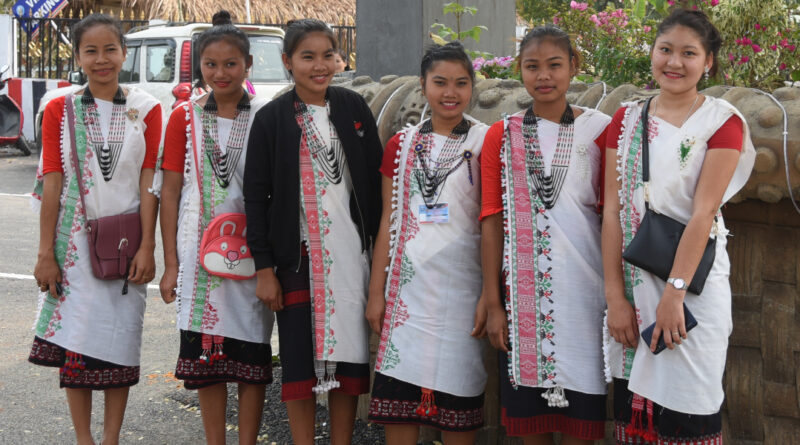
The Karbi Ethnos: Understanding the Karbi Tribe: Origins, Sixth Schedule, and Article 244A
The Karbi people, historically identified in colonial administrative records by the exonym “Mikir,” constitute one of the most significant and ancient indigenous ethnic communities in Northeast India. Primarily inhabiting the rugged hill tracts of the Karbi Anglong and West Karbi Anglong districts in Assam, their presence also extends into the plains of Nagaon, Kamrup, Morigaon, and Golaghat, as well as the neighboring states of Meghalaya, Nagaland, and Arunachal Pradesh.
This comprehensive analysis delineates the multifaceted identity of the Karbi tribe, tracing their migratory origins, the evolution of their complex social clan systems, their history of anti-colonial resistance, and the contemporary political struggle for self-determination under the constitutional framework of Article 244A.
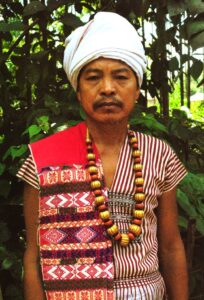
Ethnohistorical Origins and Migratory Trajectories
The history of the Karbi people is a saga of long-distance migration and adaptation, preserved largely through oral traditions and epic narratives rather than written chronicles. Linguistically and racially, the Karbis are classified within the Tibeto-Burman branch of the Mongoloid group, specifically linked to the Kuki-Chin subgroup.
Ancestral Homeland and Initial Migration
Scholarly consensus and oral epics such as Môsēra—which literally translates to “recounting the past from memories”—suggest that the Karbis originated in central Asia, near the Yangtze and Yellow rivers in present-day western China. Their southward migration followed the courses of the Brahmaputra, Chindwin, and Irrawaddy rivers. The Môsēra narrative re-enacts the ordeal of this migration from the “earth’s navel” (lônglè acheté), describing a path through Tibet and Myanmar before reaching the hills of Northeast India.
Historical evidence suggests that the Karbis entered Assam via northern Manipur and southwestern Nagaland. Southern Nagaland provided a land route for tribes migrating from Myanmar via the Manipur hills. During this early period, the Karbis flourished in the plains, particularly along the banks of the Kalang and Kopili rivers, with their traditional territory encompassing the entirety of what is now Kaziranga National Park. The presence of monolithic and megalithic structures scattered throughout West Karbi Anglong serves as silent testimony to these ancient settlements.
Pre-Colonial Kingdom Relations and the Retreat to the Hills
The political geography of the Karbi people was significantly shaped by their interactions with the Ahom, Jaintia, and Kachari kingdoms. In the 17th century, large sections of the Karbi population resided in the Jaintia kingdom, where they faced systemic harassment and oppression. This led to a northward migration toward Ahom territory, where they sought protection from the Borphukan (Ahom governor) at Raha.
The Karbis’ relationship with the Ahoms was recorded in the Ahom Buranjis (historical chronicles), providing the first written glimpses of the tribe’s political life. However, the late 18th and early 19th centuries brought catastrophic disruptions. The Burmese invasion of Assam perpetrated severe atrocities, forcing the Karbis to abandon their sub-mountainous homes and take refuge in deep jungles and high hills. This demographic shift solidified their identity as “hill people,” a status that continues to define their political and social standing.
Etymological Hypotheses
The transition from the term “Mikir” to “Karbi” represents a significant shift in the community’s self-assertion. While British officials and Ahom chronicles frequently used “Mikir,” the people have always called themselves Arleng (meaning “man”) or Karbi. Several folk hypotheses exist regarding the origin of these names:
-
The Cat Theory (Mengkiri): One legend suggests that when Karbi forefathers first arrived in Assam, they were searching for a lost cat (mengkiri). When asked for their identity by locals, they replied they were looking for “Mengkiri,” which was misunderstood and corrupted into “Mikir.”
-
The Fire Theory (Me-Akar-Bi): Another folk narrative tells of a forefather who left his home after lighting a fire (Me-Akar). His wife’s warning about the fire was shortened to “Karbi” over generations.
-
The Deity Theory (Thekar Kibi Aso): Some believe the name derives from Thekar Kibi Aso, a term used during a feast for the deity Hemphu where food was offered to a hidden demoness.
Socio-Cultural Architecture: The Clan and Kinship System
Karbi society is built upon a foundation of strict patrilineal descent and an intricate clan system known as Kur. This system regulates kinship, marriage, and ritualistic duties, ensuring social cohesion across geographically dispersed populations.
The Five Major Clans (Kur) and Sub-Clans (Kur-so)
The community is divided into five primary clans, which are socially egalitarian yet functionally distinct in their traditional roles. Each clan is further divided into numerous sub-clans, providing a granular structure to Karbi identity.
These clans are strictly exogamous; marriage within the same clan is considered a severe taboo equivalent to incest and was traditionally punishable by ex-communication or heavy fines. Children always inherit the father’s clan name. Daughters retain their father’s clan name even after marriage, appending the feminine suffix “pi”.
Social Norms and Gender Dynamics
The Karbi follow a unitary family system where brothers typically start separate households upon marriage, though limited joint families still exist. While the society is patriarchal and the father is the head of the household, women occupy a central position in the family’s economic and spiritual life.
In the past, Karbi women were distinguished by the Duk, a vertical facial tattoo running from the forehead to the chin. This tradition originated during the Burmese invasions when young girls were tattooed to make them appear unappealing to the invaders, thereby protecting them from abduction.
Spiritual Beliefs and the Ritual Cycle
The indigenous faith of the Karbis, often referred to as Honghari, is a complex system of animism, ancestor worship, and the veneration of household and territorial deities. The universe is believed to have been created by the divine duo Hemphu and Mukrang, who remain the most prominent figures in the Karbi pantheon.
Life Cycle Rituals: Birth and Marriage
The Karbi belief system is deeply rooted in the concept of reincarnation, viewing a newborn as the rebirth of a deceased ancestor from the same clan.
-
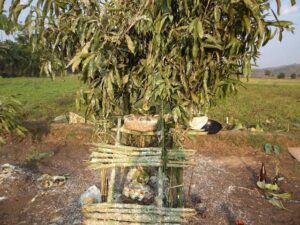
Birth (Bir Kilut / Klangklo Athekar): This purification ritual occurs about a month after birth. The village priest (Kurusar) performs prayers, the child is named after an ancestor, and symbolic offerings of rice beer and meat are made.
-
Marriage (Adam-Asar): Karbi marriage laws prioritize clan exogamy and strongly favor cross-cousin marriages, specifically a man marrying his mother’s brother’s daughter. There is no system of bride price or dowry, reflecting the community’s egalitarian values.
Death Rituals and the Chomangkan
Death is considered a transition rather than an end, requiring elaborate ceremonies to guide the soul to the kingdom of the deceased, Chom-Arong.
The initial rites involve ritually bathing the body (Lang Kepanglu) and offering a final meal (Rong Kepado) before cremation at clan-specific grounds (Thiri). The Chomangkan is the most significant socio-religious event for the Karbis. It is a grand funeral festival performed at a later date to ensure the soul’s eternal peace. Lasting four days and nights, it involves professional dirge singers (Kecharhe) who narrate the soul’s journey, traditional dances, and the display of the Jambili Athon—the sacred wooden symbol of clan unity.
Community Festivals: Rongker
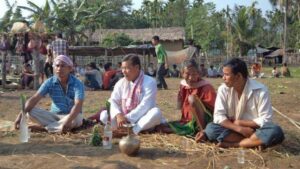
Rongker is an annual spring festival held to appease the deities for the protection of the village from natural calamities and diseases. It is a male-exclusive ritual where the village priest performs sacrifices to twelve deities. During the festival, strict taboos are observed: no agricultural work is allowed, and no one may cross the village boundary.
Resistance Against Colonial Rule and Legendary Heroes
The arrival of the British after 1826 brought significant disruption to the traditional autonomy of the Karbi people. The colonial administration introduced heavy land revenue and taxes on indigenous products, leading to localized uprisings.
The Phulaguri Dhawa (1861)
The Phulaguri Dhawa is remembered as one of the earliest organized peasant resistances against British rule in Assam. Triggered by the colonial government’s ban on private opium cultivation and the introduction of taxes on betel nut (tamul) and pan, thousands of peasants, including Karbis and Tiwas, gathered at Phulaguri in October 1861.
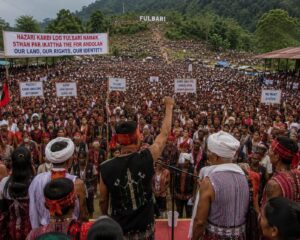
The situation turned violent when the Deputy Commissioner attempted to disperse the crowd by force, resulting in the death of a British official, Lt. Singer. The British responded with a brutal military crackdown, resulting in multiple executions and deportations, yet the event remains a cornerstone of Karbi historical pride.
Legendary Figures of Resistance
Karbi oral history is populated by heroes who fought against external oppressors, including Jaintia, Kachari, and British forces:
-
Thong Nokbe: A legendary hero who became the commander of the Jaintia armed forces and later led a resistance against Jaintia officials who humiliated Karbi workers.
-
Rongpherpi Rongbe: A bold woman celebrated for killing soldiers of a Kachari king when they demanded milk from her breast to feed the king’s tiger—a powerful symbol of the community’s refusal to submit to dehumanizing exploitation.
-
Waisong: A great warrior who repelled regional raids and worked to establish a liberal framework for the Karbis.
-
Semsonsing Ingti: Regarded as the “Father of the Karbi Nation,” Ingti was a missionary-educated leader who unified the Karbis in the early 20th century, laying the foundation for modern political consciousness and the demand for a separate administrative district.
The Insurgency and the Struggle for Autonomy
The post-independence history of Karbi Anglong has been characterized by a persistent demand for self-determination. While the creation of the Mikir Hills District Council in 1951 was a milestone, many Karbis viewed it as administrative tokenism rather than substantive empowerment.
Rise of Militancy
In the 1980s and 1990s, the movement for statehood took a militant turn. Several armed groups emerged to fight for Karbi self-determination (Hemprek Kangthim):
-
United People’s Democratic Solidarity (UPDS): Formed in 1999 through the merger of the Karbi National Volunteers (KNV) and Karbi People’s Front (KPF).
-
Karbi Longri North Cachar Hills Liberation Front (KLNLF): An anti-talk faction that split from the UPDS in 2004.
-
Karbi People’s Liberation Tiger (KPLT): A later group that continued the armed struggle after previous factions entered peace talks.
These insurgencies were marked by periods of intense ethnic violence, including clashes with the Kuki and Dimasa communities between 2003 and 2005, as well as widespread extortion and abductions. The violence deeply scarred the region’s social fabric and hindered developmental progress.
The Peace Accords (2011 and 2021)
Efforts to resolve the conflict led to two major peace agreements:
-
2011 UPDS Accord: This tripartite agreement led to the reorganization of the Karbi Anglong Autonomous Council (KAAC) and promised greater financial and administrative powers.
-
2021 Karbi Anglong Agreement: Signed on September 4, 2021, this landmark accord involved five insurgent groups surrendering over 1,000 armed cadres. The government committed to a special development package of ₹1,000 crore and the further devolution of autonomy to the KAAC.
Contemporary Scenario: Land Rights and Protection
The current situation in Karbi Anglong remains complex, with land rights emerging as the primary point of contention between indigenous tribes and non-tribal settlers.
PGR and VGR Land Disputes
A significant source of unrest has been the occupation of Professional Grazing Reserves (PGR) and Village Grazing Reserves (VGR). These lands are vital for traditional tribal livelihoods but have been subject to encroachment by migrant communities over several decades.
Tensions escalated into localized violence in West Karbi Anglong following a hunger strike by Karbi youths demanding the eviction of illegal settlers from these reserves. The clashes resulted in casualties and the burning of property, leading to a high-level judicial inquiry and calls for the institutional protection of tribal grazing lands.
Development vs. Displacement: The Solar Project Conflict
Indigenous communities successfully protested a massive 1,000-megawatt solar project funded by the Asian Development Bank (ADB). Protesters argued that the acquisition of 18,000 bighas of land would displace 20,000 people from 23 villages, directly violating Sixth Schedule protections. Following a sustained grassroots campaign, the funding was cancelled, highlighting the community’s power to resist top-down developmental projects that threaten their land security.
Constitutional Rights and the Article 244A Movement
The central political aspiration of the Karbi people today is the implementation of Article 244A of the Indian Constitution, which allows for the creation of an autonomous state within the state of Assam.
Sixth Schedule vs. Article 244A
While Karbi Anglong is currently governed under the Sixth Schedule, which provides an Autonomous District Council, Article 244A offers a much higher degree of structural autonomy.
Legislative Developments
The introduction of the Assam Reorganisation (Karbi Dimanchal) Bill aims to provide for the formation of an autonomous state within Assam comprising Karbi Anglong and Dima Hasao. This bill seeks to vest executive power in the Governor and create a dedicated Legislative Assembly, fulfilling the decades-old demand for “Karbi Dimanchal.” Additionally, the Karbi Welfare Autonomous Council Bill aims to protect the rights of Karbis living outside the autonomous districts, ensuring focused development for the entire ethnic community.
Socio-Economic Status and Future Outlook
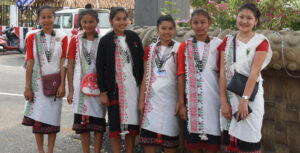
The Karbi region, while rich in natural beauty and resources, has historically lagged behind the plains of Assam in terms of infrastructure and economic opportunities. The primary occupation remains agriculture, traditionally through shifting slash-and-burn cultivation (Ret Kinong), though modern terrace farming is steadily increasing.
Demographic Indicator Summary
-
Administrative Area: 10,434 km²
-
Primary Language: Karbi (Tibeto-Burman); Assamese serves as the regional lingua franca.
-
Religious Affiliation: Predominantly the Indigenous Faith (Honghari), with approximately 15% identifying as Christian.
-
Economic Base: Heavily agrarian, transitioning toward structured cultivation and plantation economies.
The transition from active insurgency to peace, marked by the systemic reintegration programs implemented over the last few years, has fostered a massive turnaround in the district’s security environment. However, the persistence of land disputes and the “state within a state” demand indicate that the path to permanent stability requires addressing the core issues of indigenous identity, land security, and equitable development.
The successful implementation of the Karbi Anglong Peace Accord and the ongoing legislative debates represent the current frontier of the Karbi people’s long journey toward self-determination and structural dignity within the Indian Union.