
Why 1 Million Speakers Isn’t Enough to Save Kokborok
Defining Kokborok and the Tripuri Identity
Kokborok, also referred to as Tripuri, is a foundational element of the cultural and historical identity of the indigenous people of Tripura. The name itself is a compound derived from kók meaning “verbal” or “language” and borok meaning “people” or “human,” signifying “the language of the Borok people.” This Tibeto-Burman language belongs to the larger Sino-Tibetan family and is recognized as one of the ancient languages of Northeast India.
Kokborok serves as the native language for nine principal tribes within Tripura, including the Debbarma, Reang (Bru), Jamatia, Noatia, Kalai, Murasing, Rupini, and Uchoi. Despite tribal variations, these groups share a common linguistic ancestry, making Kokborok a unifying cultural force. Historically, it was also the royal language of the Twipra Kingdom, indicating its deep connection to governance, culture, and heritage in the region.
Current Vitality Status and Official Recognition
The vitality of Kokborok is monitored by UNESCO, which classifies the language as Vulnerable. This classification means that while the language is still spoken and transmitted to children, it is mostly confined to domestic or community settings. Such limitation highlights the risk of gradual decline in public, educational, and economic domains.
Kokborok was officially declared one of the state languages of Tripura in 1979, and Kokborok Day is celebrated every year on January 19. Despite this official recognition, the Vulnerable status underscores that policy acknowledgment alone is insufficient without strong implementation across education, media, administration, and cultural institutions.
Demographic Trends and Speaker Base
The 2011 Indian Census recorded 1,011,294 Tripuri language speakers, with 917,900 speaking Kokborok specifically. This marked an increase from 2001, when Kokborok speakers numbered 761,964. In terms of population share, Kokborok speakers form approximately 23.97% of the population of Tripura.
However, this increase must be understood alongside the state’s population growth. While the speaker base has grown numerically, demographic changes over decades—especially migration—have reduced the proportional space available for Kokborok in public and institutional environments, reinforcing its vulnerability.
The Foundational Crisis: Demographic Shift and Linguistic Dominance
The most significant historical factor responsible for the vulnerability of Kokborok is the demographic transformation that occurred in Tripura during the mid-20th century.
Historical Migration and Demographic Reversal
Large-scale immigration from erstwhile East Pakistan began affecting Tripura in the 1940s. This continued after the Partition of Bengal in 1947 and escalated during the Bangladesh Liberation War in 1971. Social and linguistic similarities eased the movement of populations across the border.
Before this influx, indigenous tribal communities were the demographic majority. Earlier, Tripuri kings had encouraged Bengali peasants to settle for administrative and agricultural purposes, but the post-independence migration fundamentally altered the demographic composition. Indigenous groups became minorities in their own homeland, setting the stage for linguistic and cultural marginalization.
Institutionalization of Bengali Dominance
With demographic changes came a structural linguistic shift. Bengali had already been used in administration during British rule, and this dominance solidified after independence. As Bengali-speaking populations became the majority, Bengali became the language of education, governance, media, and daily communication.
Indigenous languages, including Kokborok, were gradually pushed to private and informal domains. Since Kokborok-speaking communities often face socio-economic marginalisation, the dominance of Bengali also created strong incentives for younger generations to adopt the majority language for social mobility. This aligns closely with UNESCO’s categorization of Kokborok as Vulnerable.
Educational Policy and the Script Stalemate
Although Kokborok has received official recognition, weak implementation in educational institutions continues to hinder its vitality and prestige.
The Failure of Implementation: Official Recognition vs Classroom Reality
Kokborok was introduced at the primary level in 1981 and later expanded to higher education, including master’s degree programs. Government bodies like the Tribal Research and Cultural Institute have created primers, dictionaries, and journals to promote the language.
However, the availability of standardized textbooks, grammar materials, digital content, and qualified faculty remains limited. This gap is especially stark in urban areas, where the language is already less used. As a result, Kokborok lacks the academic prestige of English and Bengali, weakening its institutional presence and making it difficult for younger speakers to engage with their linguistic heritage.
The Script Controversy: An Institutionalized Barrier
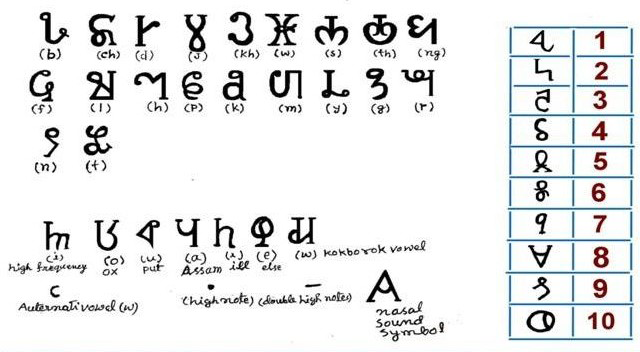
Kokborok faces a long-standing conflict over which script to use. Historically, it has been written in Bengali script under state policy. However, a strong cultural movement advocates for the Roman script, which is widely used in community dictionaries and by most students.
Survey results show overwhelming student preference for the Roman script, yet allegations persist that the Tripura Board of Secondary Education enforces the Bengali script in examinations. This script mandate acts as a barrier, discouraging students from studying Kokborok seriously and conflicting with the principles of the National Education Policy 2020, which supports mother-tongue education.
Economic Restructuring: Displacement of Traditional Livelihoods
The decline of Kokborok is closely connected to the economic restructuring of tribal livelihoods, especially the shift from traditional practices to monoculture plantations.
The Language–Ecology Nexus of Jhum Cultivation
Jhum, or shifting cultivation, has long been central to the livelihoods and cultural identity of Tripuri tribes. Kokborok preserves the vocabulary and knowledge systems necessary for this indigenous agricultural practice, including terms related to traditional crops, cycles, and ecological methods.
This deep knowledge system supports biodiversity and resilience to environmental change. Much of the language’s ecological vocabulary is rooted in this traditional livelihood.
State-Sponsored Monoculture: The Rise of Rubber and Palm Oil
Beginning in 1976, government policy promoted large-scale rubber cultivation, eventually making Tripura the second-largest rubber-producing state in India. Programs like the Block Planting Scheme and the Chief Minister’s Rubber Mission have brought thousands of tribal families into rubber-based livelihoods due to its financial attractiveness.
More recently, the state has encouraged palm oil cultivation, despite concerns about environmental suitability and ecological impact in Northeast India.
The Ecological and Social Cost of Displacement
Shifting from diverse Jhum practices to monoculture plantations reduces dietary diversity, weakens ecological knowledge, and brings emotional and social stress to remote communities.
As monoculture spreads, the forest-based resources that once shaped Kokborok vocabulary—medicinal plants, wild edibles, mushrooms—decline. The language loses relevance as the ecological world it describes disappears, making traditional terms obsolete for younger generations.
Land Tenure and Vulnerability
Monoculture schemes often shift land from community-based ownership to private or corporate control. This bypasses traditional governance systems and weakens indigenous land rights.
Rubber-dependent households now rely heavily on a single crop, making them vulnerable to market fluctuations and diseases such as the Phytophthora fungal outbreak, which required expensive drone-based interventions. Such instability further threatens cultural and linguistic resilience.
The Erosion of Traditional Knowledge Systems
The decline of Kokborok represents not only a linguistic loss but also the erosion of biocultural diversity and traditional knowledge.
The Decline of Ethnobotanical Lexicon
Kokborok encodes vast knowledge of medicinal plants—151 species documented so far. This knowledge is transmitted orally and is concentrated among older generations. With younger people moving away from forest-based livelihoods and limited educational support, intergenerational transfer breaks down. As the forest ecosystem changes, the specialized vocabulary tied to it disappears.
Fragmentation of Cultural Identity
Language is the backbone of cultural identity. Through Kokborok, people understand traditional instruments like the sumui flute and sarinda, oral epics, festivals such as Garia and Kharchi Puja, and specialized crafts like bamboo work and weaving.
When the language declines, the knowledge behind these practices becomes fragmented. Some art forms survive, but without the language, cultural continuity weakens significantly.
Resilience and Revitalization: Indigenous and Institutional Responses
Despite systemic pressures, strong community, political, and institutional efforts continue to support Kokborok revitalization.
Political Mobilization and Autonomy Movements
Political mobilization—such as the emergence of the Tipra Motha Party—aims to protect indigenous rights, land, and cultural identity. Community protest movements often address issues of land loss, lack of support for plantation workers, and exclusion from welfare schemes. These political struggles are deeply tied to the preservation of language and identity.
Community-Led Language Revival Efforts
Community organizations like the Kokborok Sahitya Sabha and Kokborok tei Hukumu Mission have led language activism for decades. Cultural centers host storytelling, folktale recitations, and traditional music sessions to preserve intergenerational knowledge.
Movements advocating for the Roman script continue to push the state toward a people-centric language policy.
Government and Digital Preservation Initiatives
The Tribal Research and Cultural Institute publishes journals, research materials, and proficiency modules. National projects like Bharatavani digitally archive Kokborok resources. Policies in the Tripura Tribal Areas Autonomous District Council encourage Kokborok use in official communication.
However, despite these efforts, contradictions remain: cultural institutions promote the language, educational bodies restrict script usage, and economic policies disrupt the ecological foundation that the language describes. These conflicting dynamics weaken the overall revitalization strategy.