
Bylakuppe: India’s Mini Tibet & A Story of Resilience in Exile
What happened to the Tibetans after they fled their homeland?
The world knows that India welcomed them with open arms—granting land, shelter, and dignity in exile. While most think of McLeod Ganj in Himachal Pradesh as the face of the Tibetan diaspora, few know of the vibrant Tibetan enclaves that blossomed elsewhere: in the quiet corners of Darjeeling, the misty slopes of Mussoorie, the remote valleys of Arunachal Pradesh like Tenzingang and Tuting, and deep in Karnataka, in a place called Bylakuppe.
Here, against all odds, a displaced people transformed barren land into thriving communities. Over sixty years later, they stand not only as survivors—but as one of the most flourishing and deeply respected refugee populations in the world.
Bylakuppe, near Kushalnagar in Karnataka’s Kodagu district, is the largest Tibetan refugee community outside Tibet. Founded in the early 1960s, it centers on two primary camps: Lugsum Samdupling (established 1961) and Dickyi Larsoe (added 1969). Today, about seventy thousand Tibetans live in more than twenty villages spread across roughly three thousand acres of land granted by the state government.
Nicknamed “Little Tibet,” Bylakuppe functions as a self‑contained world of monasteries representing every major school of Tibetan Buddhism, alongside modern schools, cultural halls, farms and lively markets. Visitors encounter soaring temples and fluttering prayer flags, breathe in incense and butter‑tea aromas, and sample momos served in cosy roadside cafés. Situated roughly eighty kilometres from Mysuru and six kilometres from Kushalnagar, the settlement rests amid Karnataka’s lush coffee country—an oasis where Tibetan heritage thrives far from its Himalayan homeland.
The settlement itself is administratively divided into two main clusters—Lugsum Samdupling, often called the Old Camp, and Dickyi Larsoe, referred to as TSL (Tibetan Settlement Land) or New Camp. Each of these enclaves is further subdivided into numbered camps—Camps 1 to 5 in Lugsum Samdupling and Camps 6 to 9 in Dickyi Larsoe. These camp units function much like village clusters, each with its own community hall, cooperative society, prayer space, and residential quarters. Monasteries, schools, and healthcare centers are interspersed among them, maintaining a balanced rhythm of daily life rooted in both tradition and functionality. While the Old Camp preserves the legacy of the earliest settlers who arrived in the 1960s, TSL hosts more recent infrastructure developments, including Namdroling Monastery and educational institutions. This camp-wise layout helps sustain order, identity, and grassroots governance across the sprawling refugee settlement.
Historical Background and Origin
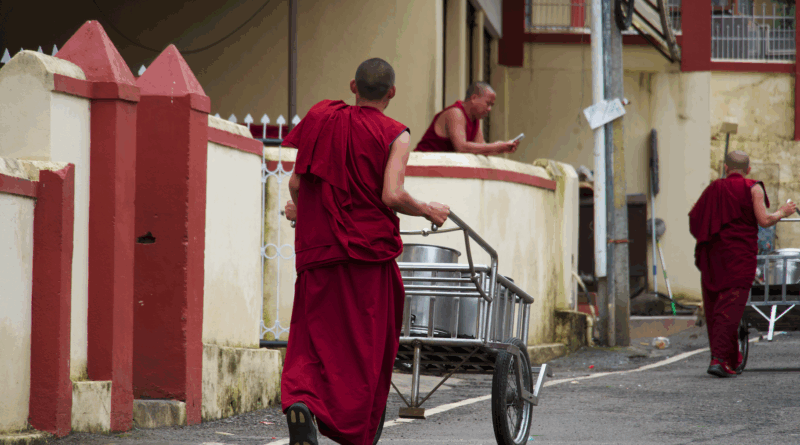
Bylakuppe was born in the wake of the 1959 Tibetan uprising and the Dalai Lama’s flight into exile. As refugees streamed into India, the Mysore state government in 1960 allotted nearly 3,000 acres of barren land near the village of Bylakuppe for their resettlement. The first camp, Lugsum Samdupling, opened in 1961 and sheltered roughly three thousand newcomers; a second enclave, Dickyi Larsoe, was added in 1969 to house later arrivals. With help from the Indian government and aid groups such as MYRADA, the settlers cleared jungle, tamed the monsoon-soaked terrain, and built monasteries, homes, schools, and farms on what locals once called “Byla‑koppa,” literally “barren land.” Despite early hardships—dense forests, heavy rains, and wildlife—the community flourished, becoming the oldest and best‑documented Tibetan settlement in India and a model of successful exile life. Today it is overseen by a Tibetan Settlement Officer under the Central Tibetan Administration, coordinating welfare and infrastructure while maintaining close ties with neighboring Kannada communities. Six decades on, Bylakuppe remains a vivid testament to Tibetan resilience: traditional homes and prayer flags share the landscape with South Indian market stalls, and maroon‑robed monks pedal past golden cornfields in a uniquely blended cultural tableau.
Major Monasteries and Religious Centers
Monastic life shapes the very soul of Bylakuppe. Scattered across the settlement are grand temples and monastic universities representing each of the four main schools of Tibetan Buddhism, serving simultaneously as places of worship, higher learning, and community gathering. The most notable among them are:
Namdroling Monastery (Golden Temple)
Founded in 1963 by Kyabje Penor Rinpoche, Namdroling is the world’s largest Nyingma institution and Bylakuppe’s most recognizable landmark. Its gleaming golden roof crowns an immense prayer hall that shelters more than 5,000 monks and nuns, a junior high school, a shedra (monastic college), an infirmary, and a home for the elderly. Inside, visitors marvel at towering eighteen‑metre statues of Buddha Shakyamuni, Guru Padmasambhava, and Amitayus, all framed by vivid frescoes. Open daily from morning until early evening, the temple draws a steady flow of pilgrims and tourists.
Sera Monastery (Sera Jey & Sera Mey)
One of Tibet’s great Gelugpa universities, Sera was rebuilt here in 1970 by survivors from its original seat near Lhasa. Today, thousands of monks pursue advanced philosophical studies on its expansive campus of prayer halls, dormitories, colleges, and the Great Assembly Hall. The signature highlight is the late‑afternoon debate courtyard, where young monks clap and call out challenging questions in a dramatic test of reasoning. Sera’s scholarly atmosphere sustains its reputation as the intellectual powerhouse of the settlement.
Tashi Lhunpo Monastery
Relocated to Bylakuppe in 1972, Tashi Lhunpo is the exile seat of the Panchen Lama and one of the four great Gelug monasteries of central Tibet. Though smaller than Sera, it remains spiritually and culturally significant, preserving teachings in Buddhist philosophy, logic, ritual arts, Tibetan medicine, and tantra. The quiet compound of white‑and‑red buildings, adorned with thangka paintings and serene courtyards, offers visitors an intimate glimpse of monastic life. Annual prayer festivals and masked dances echo the traditions of its ancestral home in Shigatse.
Sakya Monastery
A more modest temple complex serves followers of the Sakya lineage. Distinguished by gray, red, and white striped pillars, it hosts regular pujas and houses images of Guru Padmasambhava and Sakya Pandita. Though less frequented, it welcomes travelers seeking a quieter devotional setting.
Karma Kagyu Monastery (Kagyur)
Perched on a hilltop overlooking the settlement, this monastery offers sweeping views of Bylakuppe and the surrounding coffee country. Its presence completes representation of all four major Tibetan Buddhist schools within the settlement.
Nunneries
Several nunneries, most notably the Ngagyur Nyingma Nunnery linked to Namdroling, provide rigorous spiritual education and communal life for hundreds of Tibetan Buddhist nuns.
Together, these monasteries and nunneries form the spiritual backbone of Bylakuppe—institutions where religion, scholarship, and Tibetan culture flourish side by side, and where visitors can feel the quiet discipline and devotion that define this unique community in exile.
Cultural and Community Life
Festivals and Rituals
Even in exile, Tibetans of Bylakuppe keep their cultural calendar alive with energy and color. The year’s highlight is Losar—Tibetan New Year—celebrated in February or March. Monasteries glow with butter lamps and flowers, while residents don traditional robes to pray for good fortune. Celebrations run three days or more, filled with music, dance, hearty bowls of guthuk noodle soup, sweet dresi rice, and vibrant performances of Tibetan opera. Later in the year comes Saga Dawa (May‑June), honoring Buddha’s birth and enlightenment; thousands of butter lamps flicker as monks chant through the night. Monasteries also host the Great Prayer Festival Monlam Chenmo, lively cham mask dances, and the Gutor purification rite at year’s end, when rituals drive out negativity and welcome Losar afresh. These gatherings unite villagers from every camp, strengthening identity and faith.
Community Centers and Daily Traditions
Each camp maintains a community hall for meetings, weddings, sports, and holiday feasts, where families share steaming plates of momo dumplings and bowls of thukpa noodle soup. Five‑colored prayer flags flutter across rooftops and roads, believed to spread blessings on the wind. Large prayer wheels stand at camp entrances; locals spin them clockwise while softly reciting mantras. At dawn, elders circle temple courtyards in contemplative kora, rosaries clicking in their hands.
Younger Tibetans join cultural troupes, sports clubs, and handicraft groups to keep traditional skills alive. The settlement’s Tibetan Opera ensemble occasionally stages folk dramas during Losar and other festivals, while artisans weave carpets, paint thangkas, carve wood, and roll incense in cooperative workshops—activities that provide livelihoods and safeguard heritage.
Overall, life in Bylakuppe balances the spiritual and the everyday: fields and markets hum with activity by day, prayer and ritual infuse dawn and dusk, and the community’s shared rhythms ensure Tibetan culture flourishes on South‑Indian soil.
Educational Institutions
Education—both modern and traditional—stands at the heart of Bylakuppe, echoing the Dalai Lama’s vision for the Tibetan diaspora.
Sambhota Tibetan School (STS), Bylakuppe
Founded in 1962, STS is among India’s oldest Tibetan schools. Managed by the Sambhota Tibetan Schools Society, it offers classes from kindergarten through Grade XII, following India’s CBSE curriculum. Early grades are taught in Tibetan, with English introduced at higher levels, ensuring students gain modern knowledge while preserving language, history, and culture. Branch primary schools in nearby camp clusters make education accessible to younger children, while facilities such as science labs, libraries, sports grounds, and hostels support a rounded learning environment. Many alumni credit STS for preparing them to excel in universities across India and abroad.
Tibetan Children’s Village (TCV) School
Established in 1981 on land donated by the settlement, TCV functions as both a residential school and care center, especially for orphans and children from remote areas. Covering nursery to Grade XII, it blends academic excellence with strong Tibetan identity. Students live in family‑style group homes led by foster mothers, and the campus houses dormitories, a library, playgrounds, and a small clinic. TCV also runs day‑care centers and outreach programs for other South‑Indian Tibetan communities, upholding a holistic approach praised for nurturing both intellect and compassion.
Monastic Colleges
Parallel to mainstream schools, Bylakuppe’s monasteries serve as major centers of higher Buddhist learning.
- Sera Jey and Sera Mey colleges offer a rigorous 20‑year curriculum in philosophy culminating in the revered Geshe degree.
- Ngagyur Nyingma Institute at Namdroling provides advanced studies in the Nyingma tradition.
- Tashi Lhunpo Monastery maintains a specialized syllabus for its monks, covering philosophy, logic, ritual arts, Tibetan medicine, and tantra.
Together these institutions educate thousands of monk scholars at any given time.
Traditional Medicine and Astrology
A Tibetan Astrology and Medicine College, attached to the Men‑Tsee‑Khang clinic, trains students in Sowa Rigpa (traditional Tibetan medicine) and astro‑science, ensuring these ancient healing arts continue to thrive.
From modern classrooms to centuries‑old monastic universities, Bylakuppe’s layered education system safeguards the community’s future while honoring its spiritual and cultural roots.
Social Services and Community Initiatives
Co‑operative Societies (Economic Pillars)
From the earliest days of resettlement, refugees formed co‑ops to rebuild their livelihoods. The first cooperative, registered in 1964, coordinated farming and trade; today each of the two settlements runs its own multi‑service society. Together they supply farmers with seed, fertilizer and tractor hire, operate handicraft workshops that weave carpets and roll incense, and manage consumer stores, a flour mill, dairy and poultry units, and the famous seasonal “sweater‑selling” network. Profits cycle back into schools, monasteries and small‑business loans, making the settlement largely self‑reliant and economically resilient.
Healthcare Network
Bylakuppe provides both modern and traditional medical care. The 20‑bed Tsojhe Khangsar Hospital handles general medicine, maternity services, minor surgery and pharmacy needs, staffed by qualified doctors and nurses who serve Tibetans and local Indians alike. For traditional healing, a branch of the Men‑Tsee‑Khang clinic offers herbal medicine, acupuncture and astrological consultations, preserving the Sowa Rigpa system. Most monasteries maintain first‑aid units, the TCV school has its own infirmary, and the Settlement Office conducts vaccination drives, clean‑water projects, sanitation campaigns and periodic medical camps with visiting specialists.
Welfare Homes
Dedicated facilities care for the most vulnerable. An Old‑Age Home offers lodging, meals and companionship to elders without family support, while a home for differently‑abled residents provides therapy, basic education and craft activities. Both are funded by the Central Tibetan Administration and supplemented by global donations. During festivals, community members visit with gifts so residents feel included in the wider social fabric.
Community Welfare Programs
The Settlement Office administers stipends and rations to destitute families, arranges scholarships for under‑privileged students, installs potable‑water systems and runs workshops on organic farming to encourage youth to stay in agriculture. Women’s self‑help groups teach tailoring and small‑business skills, and local chapters of the Tibetan Women’s Association and Tibetan Youth Congress organise cleanliness drives, tree‑planting and cultural events.
Through this network of cooperatives, health services and welfare projects, Bylakuppe sustains a robust culture of mutual aid—ensuring that newcomers and the needy are supported, while upholding the Tibetan ideals of compassion, self‑reliance and community solidarity.
Tourist Attractions and Visitor Information
Namdroling Monastery (Golden Temple)
Bylakuppe’s unmissable landmark, the Golden Temple, dazzles visitors with its ornate roof, towering Buddha statues and tranquil prayer hall. Wander the complex, watch monks chanting between roughly 1 p.m. and 2 p.m., and stroll past prayer wheels and a small stupa in the garden. The temple welcomes visitors daily from about 9 a.m. to 6 p.m.; entry is free, though donations are appreciated. Early mornings are quieter, while a nearby bazaar and café sell souvenirs and Tibetan snacks.
Sera Monastery Complex
Three kilometres from Namdroling, Sera feels like a self‑contained university town. Its two colleges—Sera Jey and Sera Mey—line small lanes of prayer halls, dormitories and debate courtyards. Arrive around 5 p.m. on weekdays to witness the famous monk debates, an energetic exchange of claps, questions and philosophical arguments. The Great Assembly Hall and a smaller temple dedicated to Padmasambhava are open to visitors at set times.
Tashi Lhunpo Monastery
A short drive from Sera, Tashi Lhunpo is usually calm and uncrowded. Its main hall, inaugurated by the Dalai Lama, houses a large statue of Shakyamuni Buddha and vivid murals of Tsongkhapa and the Panchen Lamas. Visitors may see monks studying or playing traditional sports in the courtyard. Photography is allowed outdoors; ask permission indoors. A small museum displays artifacts from the monastery’s lineage.
Sakya Monastery and Kagyu Viewpoint
In Camp 1, the modest Sakya temple offers a quieter alternative—ideal for those who want to experience a different Buddhist school. Farther uphill, the Kagyu monastery provides a sweeping sunset view of red roofs, golden spires and verdant farmland.
Shopping and Cuisine
Near the Golden Temple, a bustling bazaar sells hand‑woven carpets, prayer flags, incense, jewelry and carved Buddha statues—perfect keepsakes that also sustain local artisans. A Tibetan bookstore inside the temple precinct stocks Buddhist texts and cultural titles. When hunger calls, family‑run cafés across from Namdroling’s gate and in Camp 1 dish out hot momos, hearty thenthuk, crisp shapaley and creamy butter tea. Steamed beef or vegetable momos with spicy chili sauce are a local favourite, and the sweet, pan‑fried bread called balep is worth a try. These simple eateries, decorated with prayer wheels and colourful posters, offer a homely taste of Tibetan hospitality.