
History and Geopolitics of India’s Largest Buddhist Monastery
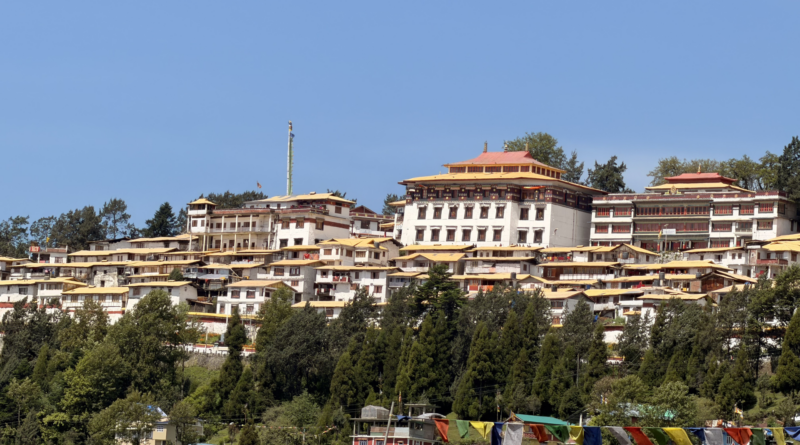
The high-altitude enclave of Tawang, historically designated in classical Tibetan literature as Monyul or Lho Mon (meaning “the lower land to the south”), occupies a critical cultural and strategic space in the Eastern Himalayas. Situated at an average elevation of approximately 3,000 meters (9,800 feet), this rugged terrain is dominated by the awe-inspiring Tawang Monastery.
Known in Tibetan as Gaden Namgyal Lhatse—translating to “the divine paradise of complete victory” or “celestial paradise on a clear night”—it stands as the largest Buddhist monastery in India and the second-largest in the world, surpassed only by the Potala Palace in Lhasa, Tibet.
Over the centuries, the monastery has transitioned from a fortified monastic sanctuary into a major pilgrimage site and administrative center for the Monpa people, ultimately becoming a focal point of geopolitical friction between India and China. The historical evolution of this sacred monument reveals the complex interactions of Himalayan sectarian politics, classical trade networks, traditional community structures, and the realities of modern border infrastructure.
Geographic and Administrative Context of Tawang
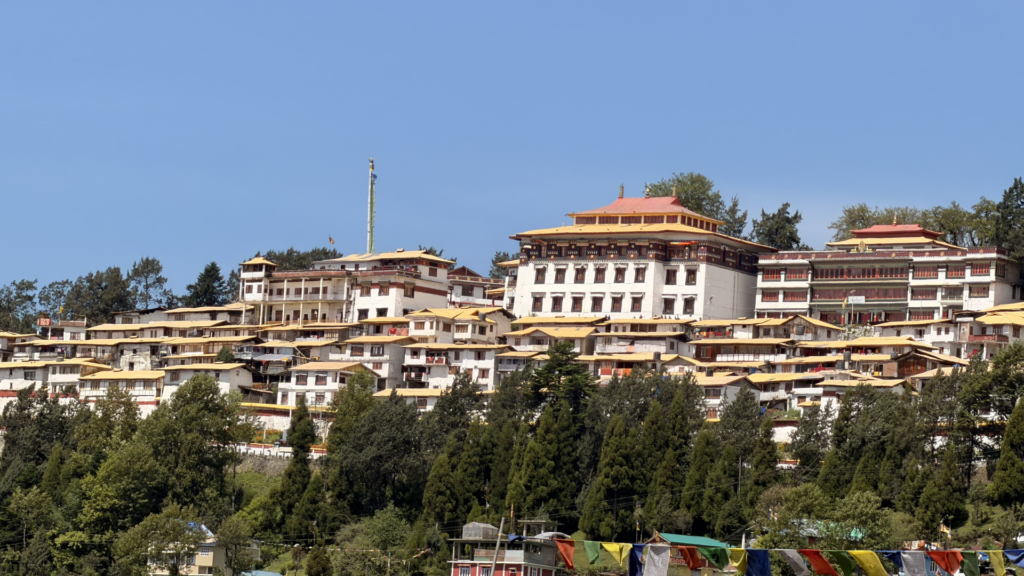
The physical geography of Tawang has historically isolated yet strategically positioned the monastery. Situated near the top of a mountain overlooking the sprawling Tawang Chu valley, the complex is framed by snow-capped peaks and dense coniferous forests. The site is bounded on its southern and western flanks by steep ravines carved by mountain streams, on the north by a narrow spur, and on the east by a gentle slope. Access to the complex is concentrated along the sloping northern spur, characterized by high-altitude alpine vegetation.
In traditional Tibetan geography, Monyul was bounded by the Bom-La Pass in the north (delimiting the Tibetan administrative center of Tsona) and the plains of Assam in the south. This expansive territory was traditionally measured by the time required to traverse it on horseback: typically fifteen days along its length and two to three days across its breadth. The region is drained by five major rivers—the Ni Shang Chu, Pang Ma Chu, Tawang Chu, Pang Nang Chu, and Rong Nang Chu—which flow south to feed the Brahmaputra river system in Assam.
Administratively, Tawang was historically the center of the Tawang Tract. Following its integration into the Republic of India, the territory was divided into the Tawang and West Kameng districts. Today, Tawang serves as the administrative headquarters of the district, further divided into the Tawang and Kitpi administrative circles. It is located approximately 448 kilometers by road northwest of the state capital, Itanagar, and roughly 555 kilometers from Guwahati.
The local climate is classified as a warm-summer humid continental climate, featuring heavy precipitation during the summer monsoon (averaging 3,080 millimeters annually). Winters bring heavy snowfall, which historically isolated the valley from the rest of the Indian subcontinent for several months each year.
Historical Evolution and the Sectarian Crucible
The establishment of Tawang Monastery in the late seventeenth century (1680–1681) was a direct consequence of sectarian rivalries within Tibetan Buddhism. Prior to the hegemony of the Gelug (Yellow Hat) school, the Eastern Himalayas were characterized by a fluid co-existence of older Buddhist schools, principally the Nyingma (Black Hat sect) and various Kagyu sub-sects, alongside the indigenous, animistic Bon religion.
This ecclesiastical balance fractured in 1616 when Ngawang Namgyal, a prominent Tibetan lama of the Drukpa Kagyu (Red Hat) sect, consolidated political authority over Bhutan under the title of Dharma Raja. Seeking to forge a unified Bhutanese national identity, he initiated a systematic purge of Gelugpa influence within his domains.
During this persecution, Lodoi Gyatso—popularly known as Merak Lama due to his origin in the Bhutanese village of Mera—stood as the principal Gelugpa preacher in the region. Experiencing repeated attacks on his Gelugpa establishment by the dominant Drukpas, Merak Lama fled Bhutan in the 1640s under the advice of the Fifth Dalai Lama, Ngawang Lobsang Gyatso. Retreating into the contiguous, rugged hills of Monyul, Merak Lama sought divine guidance to establish a new Gelugpa base.
Precursor Establishments and Diplomatic Struggles
The monastic presence at Tawang did not emerge in a vacuum. Before the construction of the fortified complex, there existed an earlier monastic structure known as Sanglamphel. Following 1642, with the political and financial backing of the Gaden Phodrang (the Gelugpa administrative government in Lhasa), Sanglamphel was expanded.
This institutional transition was fraught with hardship. Merak Lama was initially without local supporters and suffered severe harassment from dominant Nyingmapa practitioners. To secure his mission, he sought the administrative and military assistance of the Tsona district official, known as the Dingpon. In response, the Gaden Phodrang issued formal edicts commanding local leaders to use diplomatic methods to place the monastic estates of Monyul under direct Gelugpa authority.
The Three Legends of Site Selection
Local oral traditions record three distinct legends concerning the specific site selection of Tawang Monastery, each emphasizing divine sanction through a horse:
-
The Lost Steed of Merak Lama: Merak Lama struggled to find a suitable location and retired to a cave to pray. Upon emerging, his horse was missing. He tracked it to the summit of Tana Mandekhang, the historical site of the palace of the Monpa King, Kala Wangpo. Interpreting this as auspicious, he began construction in 1681.
-
The Treasure-Finder’s Initiation: The name “Tawang” is associated with Terton Pemalingpa, a famous diviner. At this geographic point, Pemalingpa is said to have delivered the highly sacred initiations (Wang) of the deities Tamdin and Kagyad. Ta is an abbreviation for Tamdin, and Wang signifies “initiation.”
-
The Lhasa Prince’s White Horse: A sacred white horse belonging to the Prince of Lhasa wandered into the Monpa region. When a search party found the horse grazing on the current hill, locals began to worship the spot, eventually building the monastery to preserve its sanctity.
Fifth Dalai Lama
Construction and Fortification
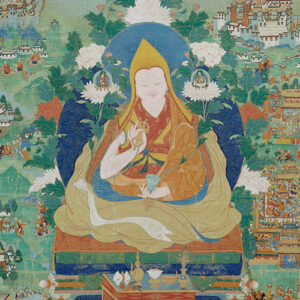
To safeguard against hostile Nyingma practitioners and recurrent Bhutanese Drukpa invasions, the Fifth Dalai Lama sent a ball of yarn; its length dictated the perimeter of the outer defensive walls. Consequently, Tawang was constructed as a heavily fortified citadel (Dzong). Construction began in 1680 and was completed in 1688. The monastery was dedicated to the Fifth Dalai Lama, who presented a sacred sandalwood statue of the Buddha that remains preserved within the sanctuary today.
To permanently end Bhutanese incursions, the Fifth Dalai Lama dispatched a massive Mongol military force from Lhasa under General Gursi Khan in 1647. This forced Bhutanese forces to sue for peace, securing Gelugpa dominance. In recognition, a large mural of General Gursi Khan was painted on the walls of the main assembly hall.
Socio-Economic Structures and Monastic Governance
Following regional pacification, Tawang Monastery evolved into the absolute spiritual, social, and economic hub of Monyul, functioning as a feudal landowning entity that levied agricultural and pastoral taxes.
The Evolution of Taxation Rights
The monastery’s right to collect land taxes originated from family conflicts among the descendants of a local patron, Trangpo Dar. Originally assigned local revenues by Merak Lama, Trangpo Dar’s sons engaged in bitter inheritance disputes, eventually voluntarily transferring their tax-collecting rights to Tawang Monastery.
| Governance Dimension | Historical Mechanism | Cultural and Economic Implication |
| Taxation Basis | Acquired from the descendants of Trangpo Dar following inheritance disputes. | Shifted land ownership and economic surplus from local clans to the monastic center. |
| Pastoral Levies | Butter tax collected from Pangchen village and high-altitude grazers; Grain tax from farmers. | Standardized by Merak Lama’s 1.5 kg stone (kept with a Zambala statue) to prevent corruption. |
| Labor & Maintenance | Compulsory labor (posa) provided by adjacent Monpa villages. | Sustained the physical infrastructure of the massive 65-building fortified complex. |
| Monastic Recruitment | The Buchum barma custom conscripting the middle son of families with three sons. | Embedded the monastic community within local lineages, maintaining a stable population of 450-700 lamas. |
| Liturgical Collaboration | Joint performance of the Bumtsok (100,000-fold offering) with five major regional clans. | Consolidated spiritual alliances between the Gelugpa hierarchy and the Monpa laity. |
Architectural Design, Layout, and Sacred Iconography
Tawang Monastery represents a fusion of traditional Tibetan monastic design, vernacular Indian Himalayan craftsmanship, and medieval fortification. The triple-storied complex is enclosed by a fortified, 925-foot (282-meter) stone compound wall, housing the main assembly hall, ten functional structures, and 65 residential quarters.
The Kakaling and Main Portals
The primary approach is restricted to the northern ridge, passing through the Kakaling, a monumental, hut-like gateway. Its interior wooden ceiling is painted with complex geometric Mandalas (Kying-Khores), and its stone walls feature detailed frescoes of Buddhist saints and protectors.
The Dukhang (Main Assembly Hall)
Constructed between 1860 and 1861, the triple-storied Dukhang is the spiritual heart of the complex.
-
The Gilded Shakyamuni Buddha: Positioned on an elevated platform is an 18 to 26-foot (8-meter) gilded statue of the Buddha in the meditative Padmasana (lotus position). His right hand forms the Bhumisparsha Mudra (Calling the Earth to Witness). He is flanked by his principal disciples, Maudgalyayana and Sariputra.
-
The Sacred Thangka of Palden Lhamo: Adjacent to the Buddha is a silver chest containing a revered thangka of Palden Lhamo, the wrathful female guardian deity. Monastic legend claims the Fifth Dalai Lama painted this using blood from his own nose during intense meditation. In local theology, she is compared to Kali and Ma Tara. Myth recounts she fled a demon king in Sri Lanka on a mule; an arrow struck the mule’s flank, and through the resulting wound, Palden Lhamo could watch the supreme teachings of the Buddha.
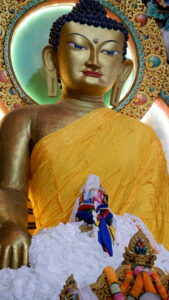
Lord Buddha Of Tawang Monestry
The Courtyard, Par-Khang, and Residential Quarters
Behind the main temple lies a large stone-slab courtyard designed for religious mask dances.
-
Par-Khang (Library): The three-storied library houses rare, centuries-old Buddhist literature, including complete, hand-printed editions of the Kangyur and Tengyur, lettered in gold and silver on handmade Monpa paper.
-
Southern & Eastern Flanks: These house food provisions, the Rhum-Khang, and the official residence of the Dra-Tsang Buk (monastic administrator).
-
The External Giant Buddha Statue: Consecrated in 2015 by Thegtse Rinpoche, a modern 30-foot gilded bronze Buddha statue overlooks the Tawang Chu valley near the Circuit House.
The Liturgical Cycle and Regional Festivals
Tawang Monastery operates on a complex liturgical calendar based on the Tibetan lunar system to reinforce community cohesion and seek agricultural protection.
The Torgya and Dung-Gyur Festivals
The most prominent festival is Torgya, celebrated over three days starting on the 28th day of the eleventh lunar month (typically January).
-
Day 1: 14 lamas craft a three-foot-tall sacrificial cake called the Torma over 16 days. A mound of dry bamboo leaves (the Mechang) is built at the southern gate. Led by the Arpo (lamas wearing brass bells) and the Choige yap-yum (wearing yak horn masks), the Abbot performs the Sangonna-Torgya, casting the Torma into the flaming Mechang to annihilate evil forces.
-
Day 2: The courtyard hosts secret Cham dances (e.g., Phagcham, Durdag, Lhamcham). Monks wear heavy wooden masks (cows, tigers, monkeys) and brocade robes, depicting mythological battles to the drone of brass horns.
-
Day 3: The Abbot performs the Wang (initiation), distributing Tseril (sweet barley balls) and Tse-Chang (sacred beer) from a skull bowl. Lamas tie protective colored threads around devotees’ wrists.
Every third year, Torgya is scaled up and renamed Dung-Gyur, featuring the Mani Dung Drub ritual—millions of recitations of Om Mani Padme Hum.
Losar (The New Year Festival)
Losar falls in late February/early March. Preparations begin weeks in advance with making Bongp-nelap (fried loaves) and Khab-se (biscuits). Homes are whitewashed and decorated with sun, moon, and swastika symbols. During the festival, locals fetch purified starry-night water, hoist prayer flags, shout “Lha so lo, ki ki so so lhagyal to,” and perform traditional Yak and Achi Lhamu dances.
Other Major Festivals
-
Choe-Kor (Choskar): An agricultural festival (July/August) where the village circumambulates their lands carrying sacred scriptures to protect crops.
-
Saga Dawa: Observed in the fourth lunar month (May), marking the Buddha’s birth, enlightenment, and Nirvana, featuring the Nyung-ne fasting ritual.
-
Gorsam Kora: A massive 3-day pilgrimage festival at the Gorsam Stupa in Zemithang.
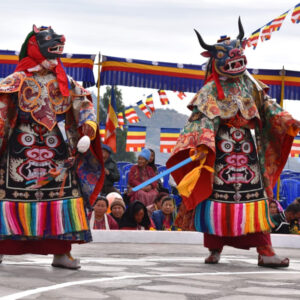
Losar celebration
Modern Geopolitics and Sela Tunnel Infrastructure
The modern history of Tawang Monastery is deeply entangled in the geopolitical rivalry between India and China. Under the 1914 Shimla Accord, the boundary was established along the McMahon Line, ceding Tawang to British India. However, India only established full administrative control in February 1951, freeing Monpas from heavy Tibetan taxes.
In 1959, the 14th Dalai Lama fled Chinese forces, crossing into India on March 31 and taking sanctuary in Tawang Monastery. This catalyzed the 1962 Sino-Indian War. The Chinese People’s Liberation Army (PLA) overran Sela Pass and occupied Tawang for six months. While the PLA later withdrew, the monastery remained intact—escaping the destruction of Mao’s Cultural Revolution. Today, China claims Tawang as “South Tibet,” viewing the monastery as historical evidence of its sovereignty.
The Sela Tunnel: An Engineering Marvel
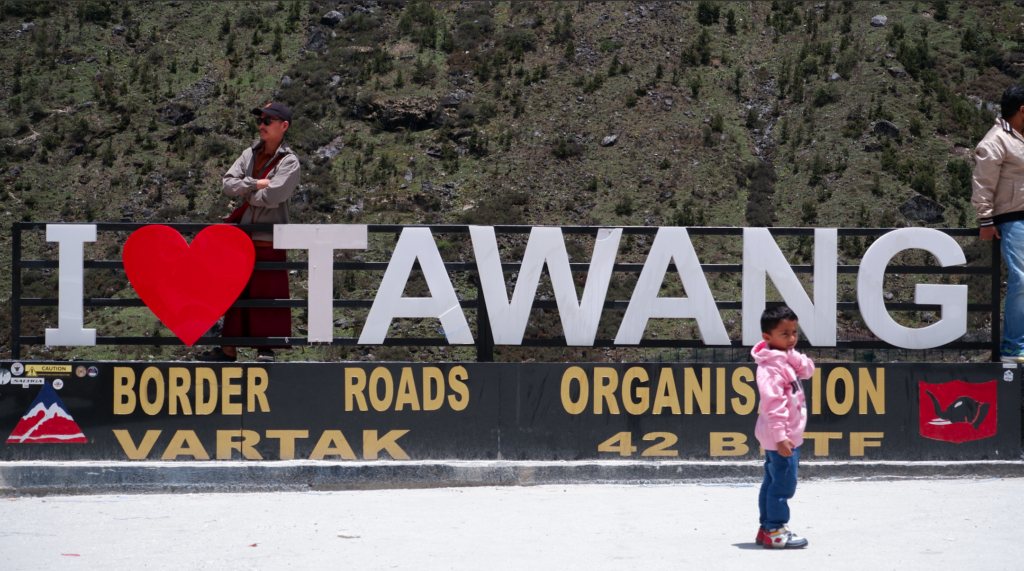
In March 2024, the region’s historic isolation ended with the operationalization of the Sela Tunnel. Built by the Border Roads Organisation (BRO) for ₹825 crore using the New Austrian Tunneling Method (NATM), it is the world’s longest bi-lane tunnel above 13,000 feet.
Sitting at 9,800 feet (below the winter snowline), it bypasses the hazardous 13,700-foot Sela Pass. The project includes Tunnel 1 (980m single-tube), Tunnel 2 (1,555m twin-tube with an escape passage), and a 1,200m link road. It cuts travel time from the IV Corps headquarters at Tezpur to Tawang by an hour and ensures year-round civilian and military connectivity to the Line of Actual Control (LAC).
Travel Logistics, Permits, and Itineraries
Due to Tawang’s sensitive border location, travel is strictly regulated:
-
Inner Line Permit (ILP) for Indian Citizens: Non-residents of Arunachal Pradesh must obtain an ILP (₹300 for 3 days; ₹500 for 14 days) via arunachalilp.com. Applicants must upload a valid government photo ID (
[Aadhaar Redacted], Voter ID, or Passport; PAN Card is not accepted) and a passport photo. -
Protected Area Permit (PAP) for Foreign Nationals: Issued for 10 days ($50 royalty fee). Foreigners must travel in groups of at least two through a registered agent. Citizens of Pakistan, Bangladesh, China, and Myanmar require prior approval from the Ministry of Home Affairs.
Standard Travel Itinerary
| Journey Segment | Distance / Time | Key Geographic Landmarks & Cultural Highlights |
| Guwahati to Tezpur / Nameri | ~185 km / 4–5 hrs | Starting point in Assam; features Nameri National Park and Agnigarh in Tezpur. |
| Tezpur to Bomdila | ~150 km / 6 hrs | Bhalukpong ILP checkpoint; Tippi Orchid Center, Sessa Orchid Sanctuary, Bomdila Monastery. |
| Bomdila to Dirang | ~40 km / 1–2 hrs | Dirang Dzong, Sangti Valley, and Dirang Monastery. |
| Dirang to Sela Tunnel | ~60 km / 2 hrs | Bypasses Sela Pass (13,700 ft) via the Sela Tunnel (9,800 ft); views of Sela Lake. |
| Sela Tunnel to Tawang | ~70 km / 2–3 hrs | Jaswant Garh War Memorial, Nuranang Waterfalls (Jang Falls), Urgelling Monastery. |
| Tawang Local Excursions | Varied (4×4 req.) | Madhuri Lake (Shongatser), P.T. Tso Lake, Indo-China border at Bumla Pass (15,200 ft). |
Conclusion
Tawang Monastery remains an active center of religious devotion, community administration, and massive geopolitical importance. From its 17th-century origins in the furnace of Tibetan sectarian conflict, the fortified Gaden Namgyal Lhatse has preserved its unique spiritual heritage. As modern infrastructure like the Sela Tunnel integrates Tawang closer to mainland India, it presents a delicate, ongoing balance between national security and the preservation of global cultural heritage.
For planning a trip, check out:- https://driftditto.com/driftditto-login.html