The Political Ascent of P. A. Sangma: From Grassroots Activist to National Statesman
Purno Agitok Sangma (1947–2016) emerged from a humble background in the West Garo Hills of Meghalaya to become one of India’s most distinguished politicians. His journey is a testament to the power of personal determination and the strategic navigation of a complex political landscape. Born into a poor family on September 1, 1947, Sangma was one of seven children. He faced significant hardship early in life, losing his father at the age of 11 and being forced to temporarily abandon his education due to poverty. A local Catholic missionary, Father G.B. Busolin, intervened to help him return to school, an experience that instilled in Sangma a lifelong and deep-seated belief in the transformative power of education
Sangma’s academic pursuits were rigorous and self-financed. He earned a Bachelor’s degree from St. Anthony’s College in Shillong before moving to Dibrugarh, Assam, to pursue a Master’s degree in International Politics from Dibrugarh University. To support himself, he taught at a Don Bosco high school. In addition to his political career, Sangma held several other professions, including lecturer, lawyer, and journalist, which provided him with a broad foundation of skills and perspectives. His political philosophy was deeply shaped by his upbringing in the rural Garo Hills, which cultivated a profound respect for tribal cultural heritage and a commitment to championing the cause of marginalized communities. This background would prove to be a defining influence on his approach to public life, characterized by an ethos of inclusivity and community upliftment.
p-a-sangma-political-legacy-npp
Sangma’s political career, which began in the early 1970s with the Indian National Congress (INC), was marked by a rapid and impressive ascent. By 1973, he had been appointed Vice-President of the Meghalaya Pradesh Youth Congress, and just two years later, he became the General Secretary of the state Congress committee. His intelligence and charisma were quickly recognized, culminating in his election to the 6th Lok Sabha from the Tura constituency in 1977 at the remarkable age of 30. This was a significant achievement for a young leader from Northeast India, a region often underrepresented in national politics. He would go on to be elected to the Lok Sabha from Tura a total of nine times over his career, a clear demonstration of his enduring popularity and grassroots support in his home region.
During the 1980s, Sangma’s influence grew on the national stage as he rose through the Congress ranks, serving as Joint Secretary of the All India Congress Committee in 1980. He held a series of ministerial positions in the Union government, including Deputy Minister of Industry (1980) and Commerce (1982), Minister of State (MoS) for Commerce and Supply (1984), MoS for Home Affairs (1984), and Minister of State for Labour with independent charge by 1986. These roles under Prime Ministers Indira Gandhi and Rajiv Gandhi provided him with invaluable administrative experience and forged his reputation for competence and approachability [Para-3]. He was widely respected for his “meticulous homework” and his ability to address complex debates in Parliament without the aid of notes, a skill that earned him the admiration of his peers.
The political trajectory of P. A. Sangma took a strategic turn in 1988 when the Congress leadership, recognizing his profound understanding of state-level politics, sent him back to Meghalaya to serve as the state’s Chief Minister. This move was particularly significant, as he became the first leader from the Garo community to hold the state’s highest political office, succeeding Williamson A. Sangma. Although his tenure lasted a relatively short period, from February 1988 to March 1990, it underscored the deep trust the national party placed in him to manage the affairs of his home state. His tenure was marked by a focus on rural development and education [Para-4]. After his government fell in 1990, he continued to play a pivotal role as the Leader of the Opposition in the Meghalaya Assembly before returning to national politics in 1991. Back in the Union Cabinet under Prime Minister P.V. Narasimha Rao, he held the portfolio of Union Minister of State for Coal (1991–1993) and then for Labour (1993–1995) with independent charge. He was subsequently elevated to the rank of Cabinet Minister for Information and Broadcasting in September 1995, a high-profile role in which he oversaw India’s media policy during a period of liberalization.
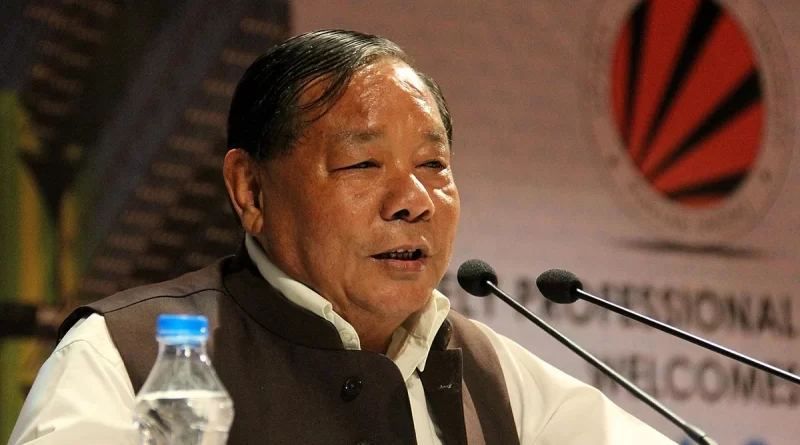
A defining moment in Sangma’s career came in 1996, a period of political instability that resulted in a hung Parliament. It was in this environment that a consensus emerged to appoint him as the Speaker of the 11th Lok Sabha. He was unanimously elected to the position in May 1996, becoming the first tribal politician in India’s history to hold this high constitutional office. His Speakership earned him widespread acclaim for his impartial and efficient conduct of parliamentary business. He was noted for his wit and good humor, which were instrumental in de-escalating tension during heated debates. Even opposition leaders praised his non-partisan approach, acknowledging his deep knowledge of parliamentary rules and traditions. His time as Speaker cemented his reputation as a national statesman, a figure respected by all sides of the political spectrum.
p-a-sangma-political-legacy-npp
Sangma’s political career began during a period of significant ethno-political instability and regional unrest in Northeast India, a time when movements for autonomy and separatist demands were prevalent. The Indian National Congress, a centralizing national party, sought a credible regional voice to counter these local movements. Sangma’s identity as a Garo tribal leader, combined with his ability to ascend the national party’s ranks without losing touch with his roots, allowed him to uniquely bridge the gap between regional aspirations and national politics. He became a conduit for bringing the concerns of the Northeast to the national mainstream, a critical role during a time of intense regional conflict and xenophobia. This strategic function, beyond his personal abilities, was a key factor in his early political success. His unanimous election as Speaker in a hung parliament, a time of political fragility, further validates his exceptional standing. The fact that political parties from across the ideological spectrum trusted him with this sensitive constitutional office demonstrates that his reputation for fairness was a widely acknowledged reality. This event elevated him from a prominent politician to a truly respected national figure, a foundation that would later become a powerful political asset for his son.
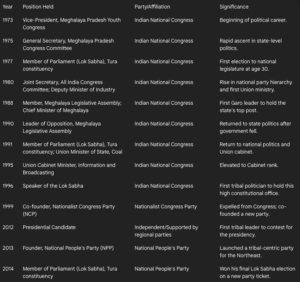
The following table provides a structured, chronological overview of P. A. Sangma’s political career, highlighting his major roles and affiliations.
P. A. Sangma’s political career
Ideological Divergence and the Birth of a New Political Force
Despite a long and distinguished career with the Indian National Congress, P. A. Sangma’s journey with the party came to a definitive end in 1999. This split was not a result of political opportunism but a profound ideological point of contention. Along with senior leaders Sharad Pawar and Tariq Anwar, Sangma openly challenged the leadership of Sonia Gandhi, questioning her suitability as a prime ministerial candidate due to her foreign birth. This act of defiance led to their expulsion from the party in May 1999. The trio responded by founding the Nationalist Congress Party (NCP) in June of the same year, with Sangma serving as a co-founder and a prominent leader.
However, the new political alliance was not without its own internal conflicts. By 2004, Sangma had a falling-out with Sharad Pawar, who had begun to align the NCP with its former rival, the Congress party. Sangma briefly split with Pawar, merging his faction with Mamata Banerjee’s Trinamool Congress, before rejoining the NCP in 2006. His political life can be viewed as a complex struggle between assimilation into a national political structure and a desire to maintain a distinct regional identity and political voice. He spent decades rising through the ranks of the INC, a centralized party, yet he never fully shed his identity as a regional and tribal representative. The final break from the Congress over the issue of Sonia Gandhi’s foreign origin was more than a simple dispute; it was a manifestation of a deeper philosophical conflict between the aspirations of regional leadership and the command structure of a centralized party. This ideological rift shows that Sangma, despite his national success, ultimately prioritized a form of regional-centric politics. The eventual founding of the NPP was not a sudden decision but the logical conclusion of this long-standing tension, cementing his legacy as a champion of regional identity within the national political sphere.
p-a-sangma-npp
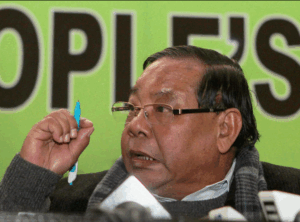
In 2012, P. A. Sangma made an ambitious and historic bid for the presidency of India, becoming the first tribal leader to contest for the highest constitutional office. His candidacy was backed by a coalition of key regional parties, including the AIADMK and the BJD, and later by the Bharatiya Janata Party (BJP). This decision placed him in direct conflict with his own party, the NCP, which was allied with the Congress. The ideological clash prompted Sangma to resign from the NCP to pursue his presidential ambitions. Although he ultimately lost the election to Pranab Mukherjee, the bid was a profound political statement. The presidential campaign, while unsuccessful in terms of electoral victory, was not merely about winning. It was a calculated political maneuver to announce the arrival of a new, independent political force on the national stage. By contesting with the backing of non-Congress parties, particularly the BJP, Sangma was signaling his political realignment and his willingness to break from the established alliances of the day. This action, which led to his final departure from the NCP, served as the ideological and political catalyst for the formation of the National People’s Party (NPP). It was a grand, national-stage introduction of his new, regional-first political project.
On January 5, 2013, P. A. Sangma formally launched the National People’s Party (NPP) with a clear and distinct mission. The party was founded as a “tribal-centric” platform dedicated to giving a strong voice to the concerns of India’s Northeastern states and tribal communities within national politics. The party’s election symbol, a book, was deliberately chosen to reflect its foundational belief that “only literacy and education can empower the weaker sections,” a mission that resonated with Sangma’s own personal story of overcoming poverty through education. From its inception, the NPP announced an alliance with the BJP-led National Democratic Alliance (NDA). This new party provided P. A. Sangma with the political vehicle he had long sought—a platform rooted in regional identity and aspirations but with a presence on the national stage, distinct from the centralized, legacy parties he had once been a part of.
The Enduring Legacy of P. A. Sangma and the Rise of Conrad K. Sangma
Purno Agitok Sangma passed away on March 4, 2016, leaving behind a legacy that transcended political affiliations. He was posthumously awarded the Padma Vibhushan in 2017, the second-highest civilian honor in India and the first from Meghalaya to receive it, a tribute that cemented his place in public memory. Sangma is remembered as a self-made leader and the “foremost political voice of the Northeast,” a figure who successfully bridged the gap between tribal communities and mainstream Indian politics. His commitment to education, inclusivity, and integrity remains a hallmark of his public life. However, his most lasting contribution was arguably the creation of the National People’s Party, a political vehicle designed to carry his vision forward and establish a political dynasty.
The mantle of leadership was passed to his son, Conrad Kongkal Sangma, who had been immersed in the world of politics from a young age [Para-11]. Born on January 27, 1978, Conrad received a modern education, earning a Bachelor of Business Administration from the Wharton School and an MBA from Imperial College, London. His political career began by managing his father’s 1999 election campaign, and he was later elected as a Member of the Legislative Assembly (MLA) in 2008, becoming the state’s youngest Finance Minister. Following his father’s death, Conrad assumed the presidency of the NPP and, in a symbolic act of succession, won the by-election for his father’s Tura Lok Sabha seat in 2016.
p-a-sangma-conrad-sangma-political-legacy-npp
The political success of the NPP is deeply and explicitly linked to the legacy and “brand name” of P. A. Sangma. The profound trust and emotional connection that voters in the Garo Hills have with his name provides Conrad and the NPP with a significant political advantage over rivals. Voters in Tura still affectionately refer to the NPP as “Purnoda’s party,” highlighting a “soft corner” and “sense of trust” that the party benefits from simply by association with its founder’s name. This phenomenon provides the party with a stable and inherited political capital, allowing Conrad to build on a pre-existing foundation of public credibility. This element of inherited trust is a critical political asset that gives Conrad and the NPP a substantial advantage over new entrants or rival parties. It explains why the party can successfully navigate the complexities of coalition politics and campaign without a pre-poll alliance with the BJP, as its core vote bank is built on the Sangma name, not on national affiliations. The “brand name” is the primary foundation of the party, and Conrad’s political strategy is to leverage this trust while building his own modern political identity and administrative brand.
The leadership styles of the two men present a fascinating contrast, highlighting a generational shift in political strategy. P. A. Sangma was a charismatic orator and master of parliamentary procedure, revered for his integrity and ability to work across party lines. His political philosophy was rooted in a strong regional identity and a deep connection to his Garo tribal heritage. He was an idealist who was willing to break from powerful parties on a point of principle. In contrast, Conrad Sangma is often described as a pragmatic, “CEO-like” administrator with a focus on tangible development and modern governance. His political style is defined by his skill in coalition management and a focus on efficiency. He is a realist who understands the importance of strategic alliances for governance and development. This generational shift reflects a change in the political environment. P. A. Sangma excelled in a unipolar political system dominated by the Congress, where personal charisma and intellectual prowess were highly valued. Conrad, on the other hand, operates in a multipolar, coalition-driven political reality, where his skill at alliance-building and modern administration is more essential than old-school charisma. His success is not a carbon copy of his father’s but a strategic adaptation of the family legacy to a new political reality.
Conrad’s Governance and the Evolution of the NPP
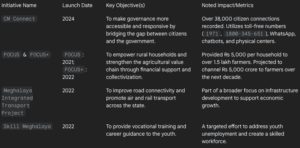
Conrad Sangma’s chief ministership is characterized by a “CEO-like” approach to governance, with a clear focus on implementing targeted, well-branded policy initiatives. His administration has prioritized modernization and citizen-centric services. In the realm of digital governance, he introduced initiatives such as e-office, digital land records, and the CM Connect helpline.
CM Connect is an innovative platform that utilizes both technology (toll-free numbers, WhatsApp, chatbots) and physical centers in all 56 state blocks to bridge the gap between citizens and the government. This initiative aims to foster a “culture of listening” and has recorded over 38,000 citizen connections since its inception, promoting a more transparent and accountable government. This focus on digital and accessible governance is more than just good policy; it is a strategic political tool. By using technology to bypass traditional bureaucratic hurdles and directly address citizens’ grievances, Conrad is building a personal brand of efficiency and accessibility, much like his father was known for his approachability in Parliament. This strategy helps him counter allegations of anti-incumbency and corruption by presenting a modern, responsive face of the government to the public.
In the agricultural and rural development sectors, the administration has launched flagship initiatives such as the FOCUS and FOCUS+ schemes. These programs provide direct financial support of Rs 5,000 per household to farmers and are designed to promote collectivization and strengthen the agricultural value chain. The FOCUS+ scheme has already supported over 1.5 lakh farmers, with a long-term goal of channeling Rs 5,000 crore to farmers over the next decade. Conrad has also focused on other critical areas, including expanding road connectivity, promoting tourism through events like the Cherry Blossom Festival, and strengthening social welfare programs for women and rural laborers.
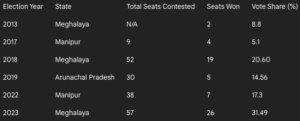
Under Conrad Sangma’s leadership, the NPP has undergone a significant transformation, evolving from a regional entity into a recognized national party. This landmark achievement was formally granted by the Election Commission of India on June 7, 2019. The NPP became the first party from Northeast India to be accorded national party status. This status was earned not solely through its dominance in Meghalaya but also through its strategic electoral performance in other states. For example, in the 2019 Arunachal Pradesh assembly elections, the NPP won five seats with a vote share of over 14%, fulfilling one of the key criteria for national party recognition. This strategic expansion aligns with the party’s founding mission as a “tribal-centric” platform with a national voice. The party has successfully expanded its presence into other states in the region, including Manipur and Nagaland, solidifying its role as a key regional player. The party’s achievement of national status was not a product of traditional, pan-India expansion but rather a result of strategic regional dominance within a larger, pre-existing alliance. This new model of national party recognition, built on a strong regional base and strategic alliances, is a testament to the NPP’s pragmatic approach.
The NPP’s political strategy involves a delicate balancing act of maintaining its regional identity and “regionalism” ideology while simultaneously aligning with the national ruling party. The NPP is a key member of the North-East Democratic Alliance (NEDA), a political front led by the BJP that aims to unite non-Congress parties in the region. This alliance provides the NPP with a crucial link to the central government, ensuring access to development funds and political support. However, the party has shown its independence by campaigning alone in state elections, such as in 2023, where it achieved its best electoral performance to date without a pre-poll alliance with the BJP. This strategic flexibility allows the NPP to leverage national alliances for governance while retaining its focus on local issues and its core regional identity, a political model that P. A. Sangma would have likely endorsed.
The following tables provide a detailed view of Conrad Sangma’s key policy initiatives and the NPP’s electoral performance, highlighting the party’s strategic growth.
Major Governance Initiatives under Conrad K. Sangma (2018-Present)
National People’s Party
National People’s Party (NPP) Electoral Performance (2013-2023)
National People’s Party
A Comparative Analysis of Two Political Dynasts
The political careers of P. A. Sangma and his son, Conrad Sangma, offer a compelling case study in the evolution of political leadership in India. While both leaders share a foundational commitment to uplifting the Northeast, their styles, strategies, and philosophies diverge significantly. P. A. Sangma’s political style was that of a charismatic orator and a consensus-builder, revered for his integrity and his ability to work effectively across party lines. His political journey was rooted in a strong regional identity and a deep connection to his Garo tribal heritage. He was an idealist who was willing to break from a powerful political machine, the Indian National Congress, on a matter of principle concerning national leadership.
Conrad Sangma, in contrast, presents a more pragmatic and administrative leadership style. Described as a “CEO-like” administrator, his approach is informed by his education at top global universities. His political success is defined by his adeptness in coalition management and a focus on delivering tangible development outcomes through modern governance initiatives. He is a political realist who understands that in a fragmented political landscape, strategic alliances are essential for securing power and driving development.
The political paths of both leaders have also been marked by unique challenges and critiques. P. A. Sangma’s career was largely free of personal corruption scandals, but his political decisions were not immune to controversy. His decision to split from the Congress party led to the formation of the NCP, and his controversial presidential bid was followed by a brief, unsubstantiated accusation of graft against his opponent. For Conrad Sangma, the challenges have been different. He has faced allegations of corruption during his tenure as Chief Minister. A notable public controversy arose when former Manipur Chief Minister N. Biren Singh publicly criticized Conrad for allegedly “interfering” in Manipur’s internal affairs, a critique that also invoked P. A. Sangma’s past parliamentary speech advocating for smaller states. Singh termed this a “dangerous idea” that threatened national unity, to which Conrad responded by calling the attack “unfortunate” and emphasizing his father’s lifelong commitment to the rights of the people of the Northeast.
The political journeys of P. A. Sangma and Conrad Sangma highlight a fundamental shift in political strategy—from the principled stands of a single charismatic leader to the pragmatic, coalition-based governance required in modern Indian politics. P. A. Sangma’s career, while successful, was marked by significant breaks from powerful parties on ideological grounds. His split from the Congress and his departure from the NCP were decisions of principle, but they came with a political cost: a fragmented career path and the constant need to rebuild his political base. In contrast, Conrad’s success is rooted in his ability to compromise and form stable alliances. He has not broken from the BJP-led NEDA despite differing political ideologies, choosing instead to work within the existing system to achieve his political goals. This contrast reveals a shift from principled defiance to pragmatic collaboration.
The “Sangma” brand has also evolved from a personal reputation of integrity and parliamentary excellence into a strategic political asset. P. A. Sangma’s name and legacy provide Conrad with a significant advantage in the Garo Hills, giving him a “soft corner” and “a sense of trust” among voters. This inherited political capital allows Conrad to focus on administrative and developmental issues rather than building trust from the ground up. The legacy is no longer just a memory; it is a live, functioning element of the party’s success, a phenomenon that has facilitated the rise of a regional political dynasty.
A Political Dynasty’s Path Forward
P. A. Sangma’s life was a testament to the power of a self-made leader from a marginalized community who rose to the highest echelons of Indian politics. His career was instrumental in shifting the political discourse, bringing the voice of the regional and tribal communities of the Northeast to the national stage. He successfully bridged the gap between his grassroots identity and his role as a national statesman, culminating in his historic and respected tenure as Speaker of the Lok Sabha.
Conrad Sangma’s leadership demonstrates a modern, pragmatic evolution of this legacy. He has successfully transformed his father’s ideological project, the National People’s Party, into a stable, governing political force in the Northeast and a recognized national party. His “CEO-like” approach to governance and his adeptness at coalition management have allowed him to navigate the complex, multi-party landscape of modern Indian politics, ensuring both stability and a focus on development.
The Sangma political dynasty represents a unique and evolving case study in Indian politics. The NPP’s success under Conrad’s leadership is a new model of national party recognition—one that is built on regional dominance within a larger, pre-existing alliance. The party’s ability to maintain its tribal-centric, regional identity while strategically aligning with the national ruling party highlights a dynamic and adaptable political strategy. With multiple family members in prominent political positions, the Sangma dynasty appears poised to continue its influential role, carrying forward the vision of its founder while strategically adapting to the shifting realities of the Indian political landscape.