
Sela Pass: Where Mountains, History and Courage Meet
Have you ever wondered why travelers heading to Tawang must pass through a place that remains covered in snow for months every year?
Have you ever thought about how a route located nearly 13,700 feet above sea level came into existence?
Is it just another mountain road, or is there a much deeper story of nature, history, war, culture, and human determination hidden behind it?
And why is Sela Pass often called the Gateway to Tawang?
The answers to all these questions take us to one of the most famous and important locations in Arunachal Pradesh—Sela Pass.
Located in the western part of Arunachal Pradesh, Sela Pass is a high-altitude mountain pass that connects the Tawang region with the rest of India. Today, visitors see a well-maintained road, military convoys, tourist vehicles, and travelers crossing this breathtaking landscape. However, the story of Sela Pass is far older than the road that now runs through it.
The origins of Sela Pass go back millions of years. At that time, neither the Himalayas nor the Indian subcontinent existed in their present form. Geologists believe that the Indian landmass was once a separate tectonic plate slowly moving northward. After millions of years of movement, it collided with the Eurasian Plate. The impact was so powerful that the Earth’s crust began to rise, eventually creating the mighty Himalayan mountain range.
As these mountains rose higher and higher, natural gaps and pathways formed between them. One of these natural mountain corridors eventually became what we know today as Sela Pass. In other words, Sela Pass was not created by kings, governments, or engineers. It was created by nature itself through geological processes that took place over millions of years.
But if there were no roads, how did people travel through these mountains?
For centuries, the indigenous Monpa people used this route to travel, trade, and visit religious sites. Long before modern highways and vehicles existed, people crossed these mountains on foot. They relied on yaks, horses, and mules to transport goods across the rugged terrain. Trade between Tibet and Tawang, as well as cultural and religious exchanges, took place through these ancient mountain routes.
Imagine the difference. Today, vehicles can complete the journey in a matter of hours. In earlier times, travelers often spent days crossing dangerous mountain trails, battling snowstorms, freezing temperatures, and unpredictable weather. During heavy winters, the region could remain cut off from the outside world for months.
As time passed, the strategic importance of the region became increasingly clear. After India’s independence, the government recognized the need for reliable connectivity to Tawang and other border areas. However, building roads at such extreme altitudes was a massive challenge.
At these heights, oxygen levels are lower, temperatures can fall far below freezing, and heavy snowfall and landslides are common. Yet engineers and workers persevered. The Border Roads Organisation (BRO) spent years carving roads through mountains, removing massive rocks, stabilizing slopes, and creating a route that could withstand some of the harshest weather conditions in India.
The road that thousands of travelers use today is the result of decades of hard work, engineering expertise, and continuous maintenance.
Yet Sela Pass is not only a story of nature and engineering. It is also connected to one of the most emotional chapters in the history of the region.
In 1962, India and China fought a war along the Himalayan frontier. The Tawang region became one of the key battle zones. Indian soldiers defended the area under extremely difficult circumstances. Among them was Rifleman Jaswant Singh Rawat, whose bravery became legendary.
According to local folklore, two Monpa women named Sela and Nura helped Indian soldiers during the conflict by supplying food and assistance. It is said that Sela made great sacrifices while supporting the defenders of the region. In her memory, the mountain pass was later named Sela Pass.
Although historians debate some details of the story, it remains deeply embedded in local tradition and continues to be remembered by the people of Arunachal Pradesh.
This is one reason why Sela Pass is much more than a geographical location—it is also a symbol of courage, sacrifice, and local heritage.
Another remarkable feature of Sela Pass is its collection of high-altitude lakes.
Have you ever wondered how lakes can exist at such incredible heights?
The area around Sela Pass is home to several Himalayan lakes, the most famous being Sela Lake. Surrounded by snow-covered mountains, the lake appears almost magical. During winter, its surface often freezes completely, transforming the landscape into a vast world of ice and snow.
Local communities consider the lake sacred. Colorful Buddhist prayer flags flutter around the area, adding a spiritual atmosphere to the already breathtaking scenery.
The region is also deeply connected to Buddhist culture and traditions. Travelers heading toward Tawang Monastery—one of the largest Buddhist monasteries in India—pass through Sela Pass. For centuries, this route has served not only as a transportation corridor but also as a bridge connecting people, cultures, and religious traditions.
Yet as beautiful as the region appears, life here is far from easy.
During winter, temperatures can plunge to minus 15 or even minus 20 degrees Celsius. Powerful icy winds sweep across the mountains. Heavy snowfall often buries roads under thick layers of snow. In such conditions, keeping the route open becomes an enormous challenge.
Snow-clearing machines and road maintenance crews work tirelessly to reopen blocked roads and ensure safe passage for both civilians and military vehicles.
But why is so much effort invested in maintaining this route?
The answer lies in its strategic importance.
Tawang is located close to the India-China border, making Sela Pass one of the most critical transportation corridors in the region. Military supplies, equipment, personnel, and essential goods all depend on this route.
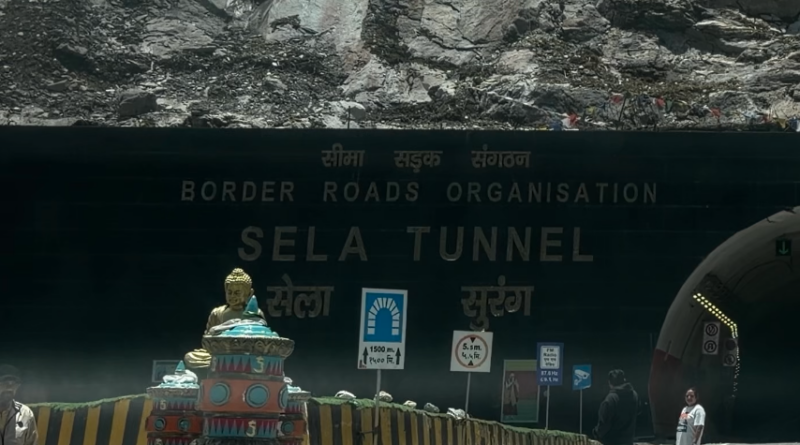
Recognizing its importance, India recently constructed the Sela Tunnel, a major engineering achievement designed to provide all-weather connectivity to Tawang. The tunnel allows traffic to continue even during periods of heavy snowfall, significantly reducing travel time and improving accessibility throughout the year.
Today, when travelers cross Sela Pass, they are witnessing much more than a beautiful mountain road. They are traveling through millions of years of geological history, centuries of Monpa traditions, the legacy of Buddhist culture, memories of the 1962 war, stories of bravery and sacrifice, and the remarkable achievements of modern engineering.
That is why Sela Pass is not merely a route to Tawang. It is a living story of nature, history, culture, resilience, and human determination standing proudly among the towering peaks of the Eastern Himalayas.