
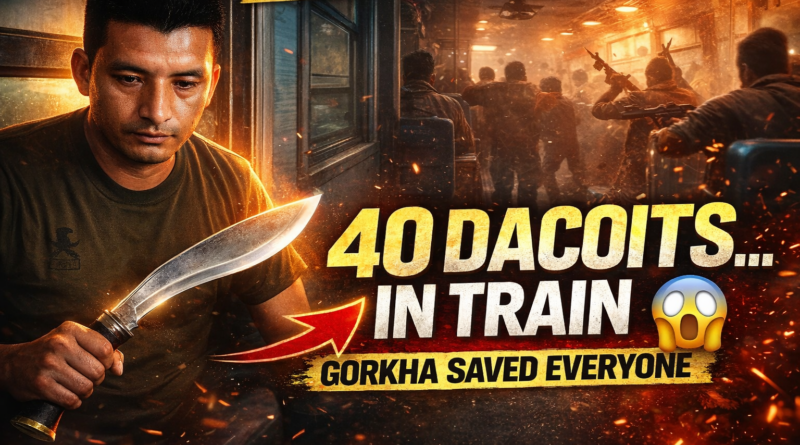
How One Gorkha Soldier Fought 40 Dacoits on the Maurya Express
Imagine… You are traveling on a train. It is the dead of night, and hundreds of passengers are asleep in the coach. Suddenly, the doors are smashed open… and forty armed dacoits storm inside. Everyone is terrified; no one dares to raise their voice.
But at that exact moment… a man stands up. His weapon? Just a small Khukri—the ultimate symbol of Gorkha tradition. And then… that lone man takes on all forty of them.
This is the story of Bishnu Prasad Shrestha— > The Gorkha who saved a train from terror… and showed the world what true bravery looks like.
Unveiling a Saga of Valor
On an ordinary night in September 2010, as the Maurya Express hurtled from Ranchi toward Gorakhpur, hundreds of passengers were engrossed in their own worlds. Some were with family, students were lost in books, businessmen were planning their next day, and tired laborers had sunken into a deep sleep. Outside, it was pitch dark, and the coaches were filled with a mix of hushed conversations and slumber. No one had the slightest inkling that the next few moments would turn this journey into an immortal saga of Indian courage and humanity.
This is the story of Bishnu Prasad Shrestha, a retired soldier from the Indian Army’s 8th Gorkha Rifles. When armed dacoits raided the train and the dignity of an innocent young woman was threatened, this soldier did not just face the loot and violence; he risked his own life to protect her. Different reports offer varying accounts of the incident. Some state the number of dacoits was between 11 and 15, while others claim it was 30 to 40. Some reports say Shrestha killed three dacoits and injured eight, while his own statements indicate he severely injured three. Despite these discrepancies, one fact remains undisputed: that night, one man displayed unimaginable courage while fulfilling his moral duty.
1. Introduction: Setting the Stage
The Maurya Express incident was not merely a train robbery; it was a decisive clash between overwhelming fear and moral courage. This story illustrates how an ordinary-looking passenger refused to remain a silent spectator when the dignity of an eighteen-year-old girl was jeopardized. The tales of Gorkha valor and fearlessness are centuries old, and Bishnu’s actions were a direct extension of that proud tradition.
This report not only reconstructs the sequence of events but also examines them through various sources. It explores how this incident evolved into a modern myth and highlights the genuine human element at its core.
2. Factual Reconstruction: The Night of September 2, 2010
At approximately 11:25 PM that night, the Maurya Express reached a desolate stretch between the Chittaranjan and Kulti stations on the West Bengal-Jharkhand border. Suddenly, the train ground to a halt. Some reports suggest the dacoits disconnected the vacuum hose, while others mention they pulled the emergency chain. Immediately after, the sound of shattering windows echoed through the night, and a mob of armed dacoits swarmed into the coaches. Armed with knives, daggers, and crude country-made pistols, they unleashed terror, stripping passengers of cash, jewelry, mobile phones, watches, and laptops.
To the passengers, it seemed like a standard—albeit terrifying—train robbery. But within moments, the situation took a horrifying turn. The dacoits grabbed an eighteen-year-old girl traveling with her parents. They ripped the earrings from her ears and began dragging her away. The girl was screaming, her parents were weeping and begging for mercy, and the entire coach was paralyzed with fear. Some initial reports also mentioned an attempt to snatch jewelry from an eight-year-old girl and her mother, but the most widely accepted account centers on the young woman being targeted.
Bishnu Prasad Shrestha was in the very same coach. He had been sleeping, and initially, he assumed that, like the other passengers, he would quietly hand over his belongings. But the moment he heard the young woman’s screams, the soldier inside him awoke. For him, this was no longer just a robbery; it was a direct assault on a woman’s honor and life.
3. The Rise of the Hero: The Flash of the Khukri
Bishnu immediately drew his most prized weapon—his Khukri. The Khukri is not just a sharp blade; it is the physical embodiment of Gorkha valor and honor. History bears witness to how this relatively small curved blade has vanquished enemies on some of the world’s most brutal battlefields.
When Bishnu stood up and unsheathed his Khukri, a stunned silence fell over the coach. The dacoits hesitated for a split second, but soon, enraged, they swarmed him in a pack. What followed was a scene straight out of an action thriller.
Using his intense military combat training in the narrow aisle of the train, Bishnu wielded his Khukri with lightning speed. One dacoit fell, then another. Within moments, the attackers began sustaining heavy injuries. According to reports, three were killed on the spot and over eight were severely wounded. However, Bishnu did not emerge unscathed. He suffered a deep gash on his arm and began bleeding profusely.
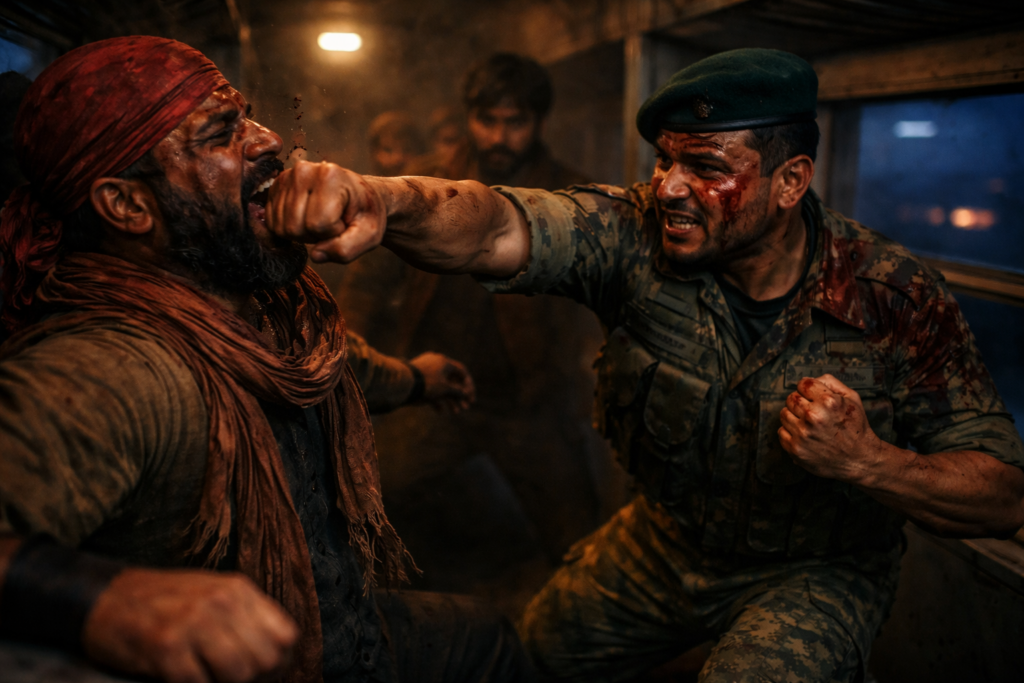
The struggle was incredibly fierce. According to some reliable sources, at one point, the dacoits managed to snatch his Khukri and used it to injure him. Yet, he refused to give up until the young woman was safe and the remaining dacoits were forced to flee the train.
4. The Hero and His Ethos
Bishnu Prasad Shrestha was around 35 years old at the time of the incident. He had served as a Rifleman in the 7th Battalion, 8th Gorkha Rifles. Reports vary regarding his exact retirement status—some state he had just retired, while others suggest he was still in active service. Regardless of this technicality, his actions immortalized him.
For Bishnu, the Khukri was more than a weapon. It was his identity, his ethos, and his moral compass. The Gorkha motto states: “Better to die than be a coward.” That night, he lived that philosophy with his own blood.
When the rescued girl’s parents tried to offer him a massive cash reward, Bishnu politely declined. His reasoning was simple yet profound:
“Fighting the enemy in battle is my duty as a soldier. Fighting thugs on a train is my duty as a human being.”
This statement adds an incredibly deep layer of humanity to his physical bravery.
5. Discrepancies and Mythical Expansion
Over time, the story of this incident has been told in many variations. The number of dacoits fluctuates between 11-15 and 30-40. The casualty count shifts between three dead and simply severely injured. Popular internet lore paints him as an invincible, untouched superhero, while reliable sources confirm he fought through severe pain and was brought to his knees by his injuries.
Yet, his true victory was never about the exact headcount of dacoits he defeated. His true victory was that, despite the overwhelming fear and the odds stacked against him, he stood up and protected an innocent life.
6. Aftermath and Honors
When the bloodied train finally reached Chittaranjan station, the police arrested six of the fleeing dacoits. Cash, jewelry, mobile phones, and weapons were recovered. The passengers were in tears; many fell to Bishnu’s feet in gratitude.
The Indian Army recognized his extraordinary valor by awarding him the Sena Medal and the Uttam Jeevan Raksha Padak. His unit presented him with a cash reward and reportedly postponed his retirement to allow for a promotion. The media rightfully dubbed him a “One Man Army,” and the saga of his bravery echoed across the nation.
7. A Timeless Tale of Courage

The saga of Bishnu Prasad Shrestha teaches us that true heroism does not mean being invincible. True heroism is standing up and fighting when everyone else is paralyzed by fear. That night on the Maurya Express, Bishnu did exactly that. He proved that sometimes, a single individual can change the fate of dozens of lives.
His greatest triumph was refusing to let fear override his sense of duty. And for that very reason, his name is remembered with immense respect today—Rifleman Bishnu Prasad Shrestha, the Gorkha who single-handedly fought a gang of forty armed men, armed with nothing but a Khukri and an unbreakable spirit.