
Sagol Kangjei: The Forgotten Ancestor of Modern Polo from Manipur
I. Introduction: Framing Manipur as the Cradle of Polo
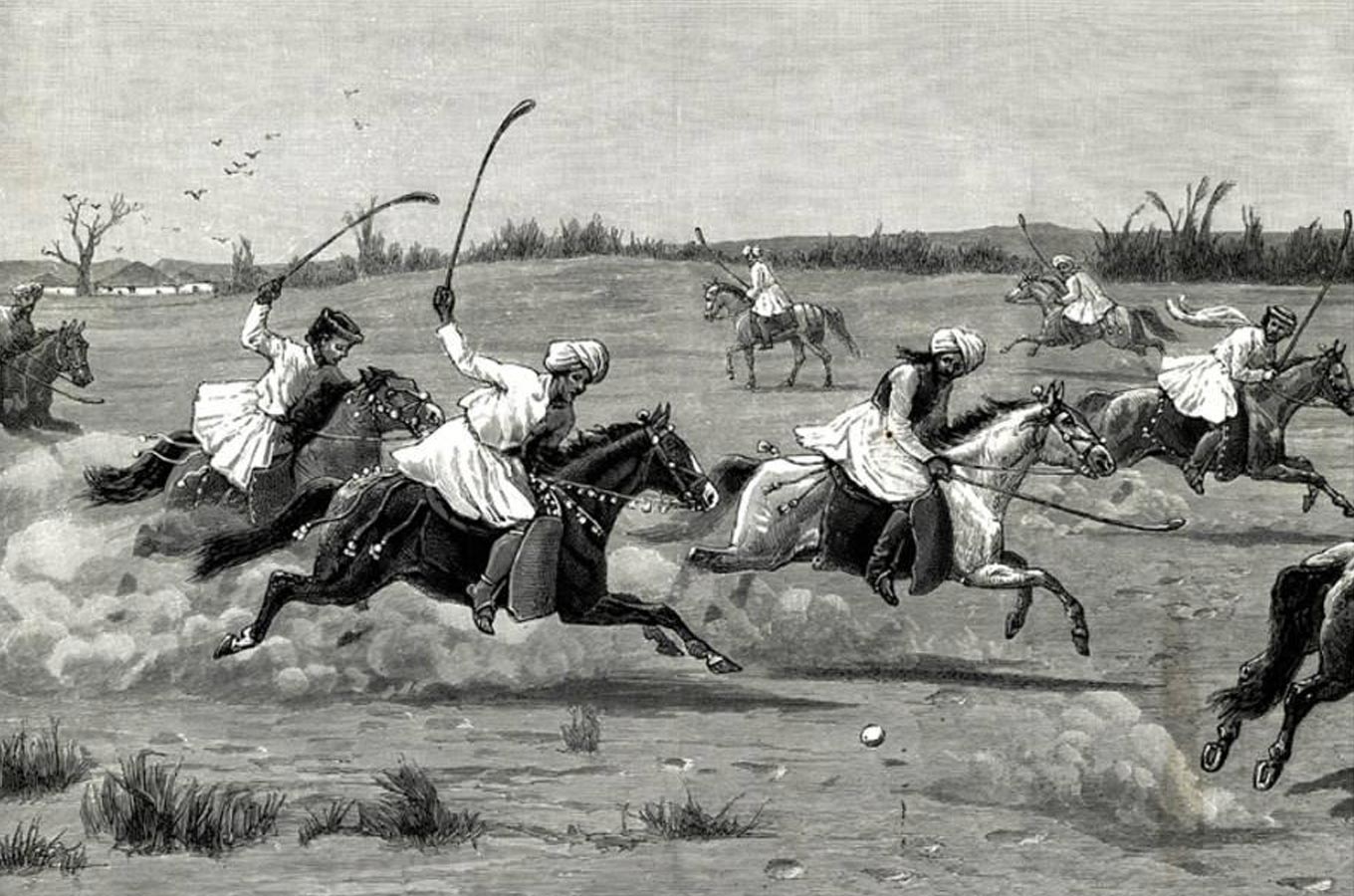
The modern equestrian sport known globally as polo traces its indisputable origins to the ancient kingdom of Kangleipak, now the state of Manipur, India. The indigenous Meitei game, Sagol Kangjei, stands as the direct and formalized predecessor of the international sport.
This report details the exhaustive historical, mythological, and mechanical evidence that establishes Manipur’s unique position as the birthplace of modern polo. It analyzes the sport’s profound cultural integration and the subsequent process of diffusion and adaptation that led to its global standardization.
1.1 Statement of Historical Thesis and Global Recognition
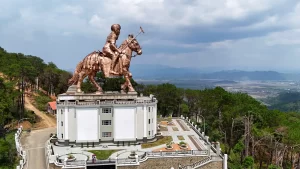
Manipur’s foundational claim rests upon a continuous, documented tradition of equestrian ball sport dating back millennia. The modern era has recognized this unique heritage, symbolized by landmarks such as the world’s tallest statue of a mounted polo player, dedicated to the Meitei polo deity Marjing, erected at Heingang in Imphal East.
This affirmation of origin, often highlighted during international events, underscores the pivotal moment in the 19th century when the traditional Meitei game was observed, adopted, and subsequently refined by British colonial officers, leading to the international game of polo.
1.2 Nomenclature and Definition: What is Sagol Kangjei?
Understanding the origin requires a precise definition of the indigenous terminology. The Manipuri game is known as Sagol Kangjei (Meitei: ꯁꯒꯣꯜ ꯀꯥꯡꯖꯩ).
-
Sagol: Meaning pony or horse.
-
Kangjei: Meaning a hockey stick or the game of sticks.
Literally translating to ‘horse hockey’ or ‘Kangjei on horseback’, the game is also sometimes referred to as the Game of Kings. The concept of Kangjei is a fundamental element of Meitei sporting culture, encompassing three distinct forms of hockey practiced in the region:
-
Sagol Kangjei (Equestrian sport)
-
Khong Kangjei (Foot hockey)
-
Mukna Kangjei (Hockey combined with wrestling)
The international term Polo itself is an anglicization adopted during the period of British contact. This term is believed to derive from the Tibetic or Kashmiri word pulu or polo, which signifies the wooden ball used in the game.
1.3 Addressing Alternative Origin Theories
Academic inquiry into the origins of equestrian ball games often acknowledges the existence of similar sports in ancient Persia (such as Chovgan) and Central Asia, suggesting complex historical layers of cultural exchange along the Silk Road. Some scholars propose that the diffusion of polo may involve multiple origins, including ancient Tibetan practices.
However, the historical narrative supporting Manipur as the progenitor of the modern international sport is distinct and robust. While other regions may lay claim to older, more generalized forms of equestrian ball games, the evidence is overwhelming that Sagol Kangjei—specifically the 7-a-side game played on the short-statured indigenous ponies—was the highly codified, fully developed template directly encountered by British observers in the mid-19th century.
This encounter, documented in Assam and Sylhet, initiated a direct, traceable chain of cultural diffusion (Manipur to British India to England) that led to the formation of the first polo clubs and the formalization of the international rulebook. The historical record isolates Sagol Kangjei as the critical nexus point for the sport’s global dissemination.
II. Deep Antiquity: Mythological and Pre-Historical Origins
The origins of Sagol Kangjei are deeply interwoven with the cosmological and religious narratives of the Meitei people, lending the sport an ancient legitimacy that transcends mere recreation.
2.1 The Pantheon of Polo: Lord Marjing and Divine Play
Sagol Kangjei is culturally revered as a “Godly game” and a ritual practice. Meitei mythology holds that the game was originally played by the gods themselves. The central deity associated with the sport is Lord Marjing, the Meitei polo deity, who is often described as the Winged-Pony God of Polo. Marjing is credited with initiating the game for the first time.
The creation myths surrounding the Meitei kingdom include a divine polo match involving seven players on each side, utilizing the bamboo-root ball (Kangdrum). In one famous mythical contest, Marjing led one team, while Lord Thangjing led the opposing team. The location of Marjing’s mythical abode, the Heingang Ching hilltop, is now commemorated by the Marjing Polo Statue, reinforcing the belief that Manipur is the sacred birthplace of the sport.
2.2 Historical and Legendary Chronology (c. 3100 BCE – 1st Century CE)
The antiquity of Sagol Kangjei is unparalleled in equestrian sport documentation. Legendary accounts claim the sport was first played as early as c. 3100 BCE in ancient Kangleipak.
King Ningthou Kangba (c. 1405–1359 BCE) is recognized in tradition as the deity-king who invented the game and reproduced it from a mythical pastime into a formalized sport. His dedication to the sport was so profound that during his reign, he conferred a specific clan name, “Kangujam,” upon individuals highly skilled in designing the Kangjei (hockey stick).
The transition from legend to historical record is marked by the royal chronicle, Cheitharol Kumbaba, which records the first formal polo match during the reign of deity-king Nongda Lairen Pakhangba in 33 CE. This foundational match established the longevity of the game within the state.
2.3 The Religious-Cultural Matrix: Lai Haraoba
The enduring cultural importance of Sagol Kangjei is maintained through its deep integration into the annual Meitei festival of Lai Haraoba (meaning the rejoicing of gods and goddesses).
The game’s cosmological significance is ritually enacted during a trance ceremony called Kanglei Thokpa. During this rite, the Maibi (priestess) performs a unique dance, utilizing a mallet, to mime the actions of the polo player and wrestler Khoriphaba, the polo-playing god of sports and son of Marjing. This ritual performance often culminates in the Maibi hooking a girl from the crowd with her polo stick, a ceremonial act known as Lai Nupi Thiba (Predilection of bride).
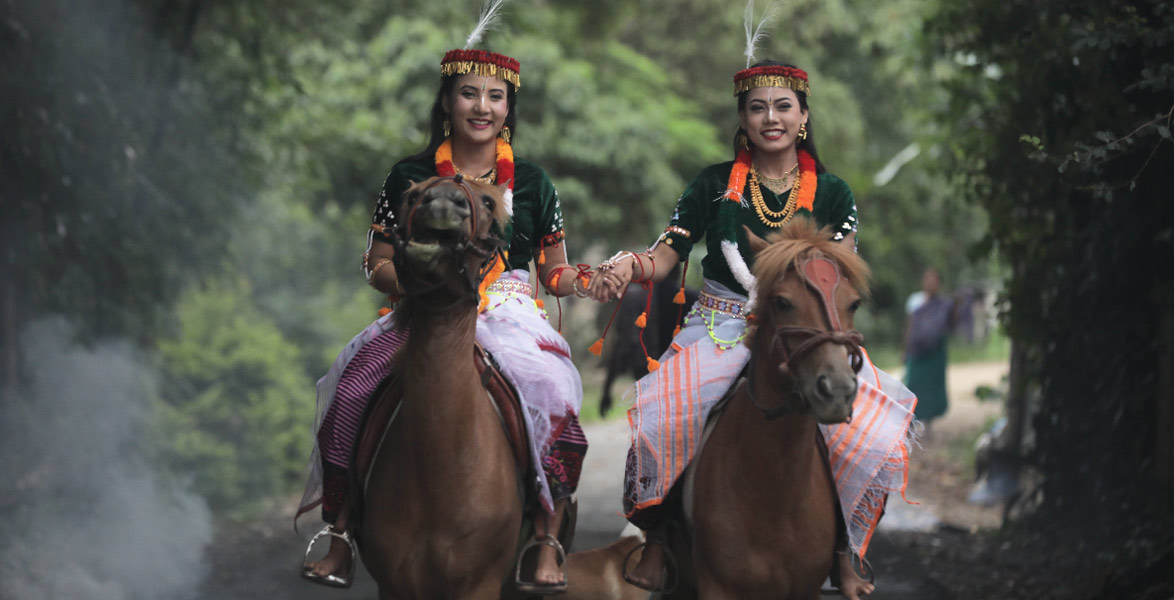
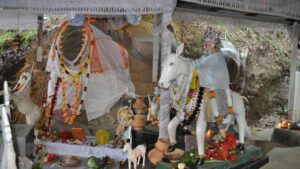
Furthermore, devotees regularly offer polo mallets and bamboo-root balls (Kangdrum) at the shrine of God Marjing. This tradition is followed even when household animals are ill, illustrating the spiritual connection between the game, the deity, and equine welfare.
III. The Royal Era: Chronological Development and Codification (14th–17th Centuries)
While Sagol Kangjei possessed deep mythological roots, its institutionalization and formal standardization were achieved under the patronage of successive Meitei kings, transforming it into a highly organized state sport.
3.1 Evidence from the Royal Chronicle and Historical Sites
The history of polo within Manipur is meticulously documented in the Cheitharol Kumbaba, dating the sport back to AD 33. This chronicle confirms the exceptional antiquity of the Mapal Kangjeibung, located in Imphal, which is globally recognized as the world’s oldest polo ground.
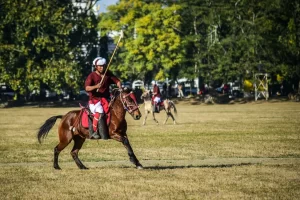
Its significance was recognized even by colonial authorities; Lord Curzon, the Viceroy of India, visited the state in 1901 and officially measured the historic ground at 225 yards long and 110 yards wide. Weekly games known as Hapta Kangjei (Weekly Polo) were also regularly played near the palace.
3.2 Systematization under Royal Edict: The Reign of Khagemba
A major turning point in the sport’s history occurred during the reign of King Khagemba (1597-1652 CE). Khagemba is credited with framing new rules for the game and initiating regular, formalized play starting in 1605 or 1606 CE.
Under Khagemba, the structure of the sport was interwoven with the political administration through the introduction of Pana Sagol Kangjei. This institutionalized framework mandated matches between the four high-status administrative divisions, or Panas:
-
Laipham
-
Khabam
-
Ahallup
-
Naharup
The institutionalization of Pana Sagol Kangjei demonstrates that the sport moved far beyond simple recreation to function as an apparatus of political governance and social engineering. By compelling different ruling clans to compete under royal supervision—often with the Ruler serving as the final authority (the Kangburel)—the king utilized the game to manage intra-kingdom competition. This redirected potential internal conflicts into a formalized sporting ritual while simultaneously demonstrating centralized royal authority.
IV. Sagol Kangjei: The Traditional Sport and its Mechanics
The rules and mechanics of traditional Sagol Kangjei (the Pana style) are critical for understanding how the indigenous game differentiated itself from the later international adaptation.
4.1 The Traditional Rules and Governance
Sagol Kangjei utilizes a distinctive structure that contrasts sharply with modern four-player polo:
-
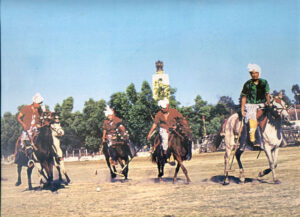
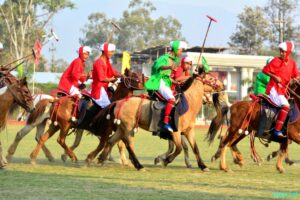
Roster and Field: Traditionally, matches feature seven (7) players per team. The playing field is rectangular, usually measured around 210 yards long and 100 yards wide.
-
Goal Structure: In a key divergence from modern polo, traditional Sagol Kangjei features no goal posts. A goal is scored simply when the ball is hit and crosses the entire end line of the opponent’s field.
-
Duration: In the early historical periods, matches lacked a definite time duration, often resulting in continuous play with minimal stoppage. The playing season itself is interwoven with cultural restrictions, being forbidden during the ritual period of Laicheppa to Lai Lengkhatpa (approx. June to October).
-
Officials: Match governance is centralized under the Kangburel, while the game is started by the Huntre-hunba.
Sagol-Kangjei-Manipur-Innercall
4.2 Equipment and Attire
The traditional equipment reflects both local materials and a necessity for rider protection:
-
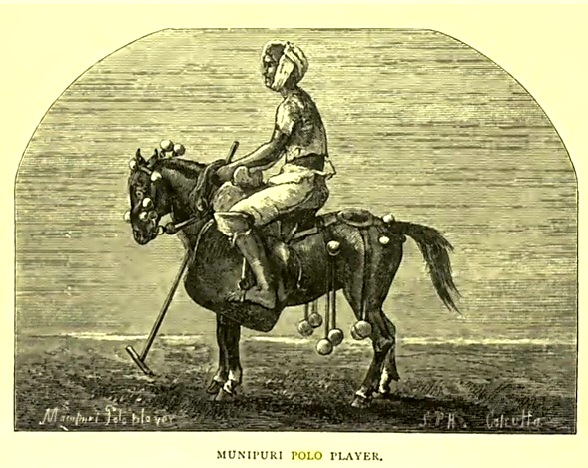
The Ball (Kangdrum): Small (about three inches in diameter), lightweight, and historically crafted from the seasoned roots of bamboo.
-
The Stick (Kangjei): A long stick made of seasoned cane with a narrow wooden head fixed at a 45-degree angle. Players must strike the ball exclusively with the long side of the mallet head.
-
Protective Gear: Players protected their legs by suspending huge uncured buffalo or mithun skins, known as Nakthing, from the saddle on both sides of the pony.
4.3 Causal Link to Modern Adaptation
The traditional style, known for being a fast, fluid, high-speed game involving continuous play, often allowed for physical contact, where riders were permitted to block or jostle opponents using their sticks. This rougher, more intense traditional environment contrasted sharply with the structure introduced by the British.
V. The Indispensable Steed: The Manipuri Pony
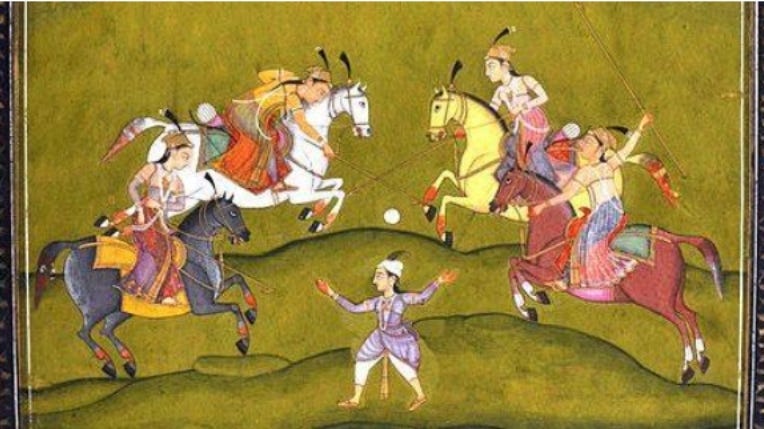
The Manipuri Pony (Meitei Sagol) is not merely an accessory but an indispensable component of Sagol Kangjei, giving the game its unique characteristics.
5.1 Breed Characteristics
The Manipuri Pony is an indigenous breed of small horse, recognized as one of India’s seven registered equine breeds. Historically present and noted in the Manipur Royal Chronicle from 1584, the breed became internationally known when British colonial accounts began referring to it specifically as the “polo pony”.
These ponies are distinctly small, typically standing between 11 and 13 hands (112 to 132 cm) high. Their low stature is a defining feature, influencing the equipment; riders use shortened mallets because of the ponies’ height. They are structurally compact, muscular, and known for their exceptional sure-footedness, agility, and endurance.
5.2 The Crisis of Extinction and Conservation Efforts
Despite their invaluable cultural role, the Manipuri pony breed is now critically endangered. The population has witnessed a steep decline, plummeting from 1,898 ponies in 2003 to approximately 1,000 estimated as of 2024.
The decline is attributable to habitat loss due to urbanization, shrinking grazing grounds, road accidents, and the ingestion of toxic waste. In response, the state government implemented the Manipuri Pony Conservation and Development Policy 2016.
The conservation crisis reveals a critical disconnection between the global celebration of polo’s origin and the maintenance of the physical components essential for its authentic practice. If the breed were to become extinct, the ability to authentically replicate the traditional game vanishes.
VI. Diffusion and Adaptation: The Birth of Modern Polo (19th Century)
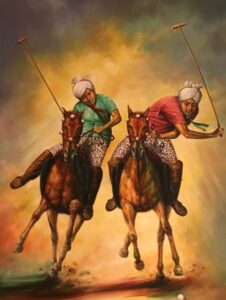
The transition of Sagol Kangjei from an insular Manipuri tradition to a globally recognized sport was initiated by a period of profound geopolitical turmoil followed by observation by British colonial authorities.
6.1 The Geopolitical Catalyst (1819–1826)
The initial phase of diffusion was triggered by the Seven Years Devastation (1819–1826 CE), during which Manipur was conquered by Burma. This caused a large-scale exodus of Manipuri courtiers to neighboring territories, notably in Assam and Sylhet. These displaced Manipuris continued to play Sagol Kangjei as a means of maintaining cultural identity.
6.2 The British Discovery
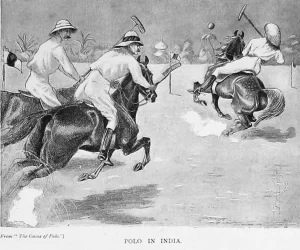
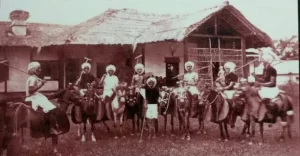
It was in these refugee settlements in Assam that British army officials first observed the game. Two key figures are historically credited with adopting the game: Lieutenant Joseph Ford Sherer (the “father of English Polo”) and Captain Robert Stewart. Captivated by the speed and skill, they began playing with Manipuri players.
6.3 Establishment of the First Polo Clubs
The decision by these officers to formalize the game marked the birth of modern polo clubs:
-
Silchar Polo Club (1859): The world’s first European polo club, established in Assam by Sherer and Stewart.
-
Calcutta Polo Club (1862): The oldest surviving polo club in the world, responsible for creating the first organized rulebook.
6.4 Export to the West
The newly adapted game spread quickly through the British military. It reached Malta in 1868 and was introduced to England in 1869, initially played by military regiments like the 10th Hussars. The Hurlingham Polo Association in the UK established the first formal British rules in 1874, gradually transforming the game into the faster, larger-field version played today.
VII. Comparative Analysis: Divergence of Traditional and Modern Forms
A systematic comparison of the indigenous Sagol Kangjei (Pana Style) and the internationally standardized Modern Polo reveals the extent of the adaptation.
7.1 Structural and Roster Differences
The change in roster size profoundly altered the nature of the game.
-
Sagol Kangjei: Mandates seven players per side, designed for a narrow field and continuous engagement.
-
Modern Polo: Settled on four players per side, optimizing the game for larger fields and structured runs.
7.2 Rules of Play and Field Geometry
-
Field Size and Goals: Sagol Kangjei uses a field of ~210×100 yards with no goal posts (scoring by crossing the end line). Modern polo standardized the field to 300×200 yards with 8-yard wide goalposts.
-
Duration: Sagol Kangjei was traditionally continuous. Modern polo is structured into timed periods called Chukkas.
7.3 Equipment Standards
The foundational dependence on the Manipuri Pony was shed during international standardization. While Sagol Kangjei necessitated the small Manipuri Pony (11–13 hands), modern polo transitioned to taller, specialized horses (often exceeding 14.2 hands) to facilitate the faster gallops required for the larger field.
Conclusion
The history of polo conclusively confirms that the game originated from the indigenous Manipuri equestrian sport, Sagol Kangjei. The historical documentation, rooted in the Cheitharol Kumbaba, confirms a tradition that predates most organized sports. The clear lineage from Manipur to British India to England establishes Sagol Kangjei as the definitive ancestor of modern international polo.