
How Trust and Law Combined to End the Mizo Insurgency
The resolution of the two-decade-long insurgency in Mizoram stands as a seminal example of successful constitutional reconciliation in India’s Northeast. The sustained effort required to move beyond political and military deadlock highlights the central question of why the protracted attempts—the necessary “try again”finally yielded an enduring peace.
The success ultimately hinged on the introduction of a non-traditional, trusted intermediary, Swaraj Kaushal, whose unique legal expertise and personal credibility provided the critical pathway for the Mizo National Front (MNF) to transition from underground resistance to constitutional governance.
Historical Context: The Roots of Alienation
The seeds of the Mizo insurgency were sown in the 1960s, driven fundamentally by a perception of neglect from the central government, particularly during the devastating 1959 Mautam famine. This perceived abandonment fueled the Mizo National Front’s demand for full independence, leading to an armed uprising in 1966.
For twenty years, deep mistrust characterized the relationship between the Indian state and the Mizo people, resisting numerous attempts at resolution. This protracted conflict created an imperative for a strategic shift: pure military or political solutions had failed, necessitating a focus on constitutional engagement facilitated by an individual capable of earning faith on both sides of the divide.
The Search for a Trustworthy Intermediary
Before the final breakthrough, negotiations often stalled because the demands of the insurgent groups conflicted irreconcilably with the existing constitutional structures of the Union. For instance, initial demands from MNF leader Laldenga included ensuring that no Act of the Indian Parliament would be legalized in Mizoram unless the state government approved it—a demand constitutionally impossible for the Central Government to accept.
The persistence required to “try again” mandated finding an interlocutor who could translate the political needs of the insurgents (autonomy, identity) into legally defensible, constitutional language acceptable to New Delhi.
Swaraj Kaushal’s path to becoming this crucial intermediary was forged through his career defending high-stakes political adversaries of the establishment. During the Emergency of 1975–77, he garnered national attention by defending socialist leader George Fernandes in the famous Baroda dynamite case. This successful constitutional defense established his public reputation as a formidable and independent criminal lawyer whose loyalty was demonstrably to the rule of law rather than to any ruling political establishment.
Establishing Credibility: Beyond the Courtroom
Kaushal cemented his legal authority very early in his career. He was designated a Senior Advocate by the Supreme Court of India on December 20, 1986, at the young age of 34. This distinction conferred significant legal gravitas, crucial for drafting a document intended to be an enduring constitutional settlement. His youth amplified this image, presenting him as a figure of independent legal brilliance rather than one deeply entangled in the capital’s established political machinery.
Crucially, this technical legal expertise was paralleled by a deep, personal commitment to the Mizo cause. Kaushal first served as the legal counsel for MNF leader Laldenga when the latter was incarcerated in Tihar Jail in 1979 during the peace talks. This relationship transcended the purely professional.
Former Chief Minister and MNF party chief Zoramthanga later confirmed that Kaushal was “not merely acting as a lawyer but also spent money for the MNF leader so that he could be released on bail.” In the high-stakes environment of insurgency resolution, this act of personal financial sacrifice signaled a profound commitment to the individual leader, transforming the professional relationship into a fraternal, trustworthy bond.
The Legal Architecture of Resolution: The 1986 Accord
The success of the “try again” mandate was realized through Kaushal’s instrumental role in constitutional diplomacy—translating the existential demands of the MNF into a structured, legally sound framework that secured lasting stability.
Constitutional Advisory to the MNF
For many years leading up to the Accord, Kaushal functioned as the “constitutional adviser to the underground Mizo National Front.” This access provided him with a unique vantage point to understand the fundamental political and identity issues driving the conflict. His primary early contribution was securing the release of Laldenga in 1979, an action critical for keeping the dialogue alive.
This advisory role allowed Kaushal to perform a critical function: mitigating demands that were structurally impossible within the Indian Constitution while ensuring that the core elements desired by the Mizo people—autonomy, dignity, and development—were enshrined in the resulting agreement.
Drafting the Mizoram Peace Accord
The intensive and lengthy negotiations culminated in the signing of the Mizoram Peace Accord on June 30, 1986, bringing an end to twenty years of armed conflict. Kaushal’s role was far more than advisory; he “helped write” the Accord and was specifically described by MNF leaders as “instrumental in drafting the terms and conditions.”
He ensured that the document was not merely a political pact but a legally binding constitutional agreement. The Accord addressed key long-standing demands, including the elevation of Mizoram from a Union Territory to a full-fledged state, the provision of Special Category State assistance, and the option for the state to adopt its local dialects as official languages.
Key Constitutional Provisions
The Mizo Accord established a framework of mutual commitment, detailing specific actions and guarantees from both sides.
| Provision Category | Key Term or Condition | Constitutional Impact & Significance |
| Insurgency Termination | MNF surrender of arms; constitutional conformity required for MNF organization. | Immediate cessation of violence; institutionalized the transition of the MNF into a democratic political party. |
| Political Status Change | Elevation from Union Territory status to Full Statehood. | Met the core Mizo demand for self-determination; enabled the establishment of an elected Legislative Assembly. |
| Financial/Development Aid | Assistance given to the state government as a “Special Category State.” | Guaranteed preferential central funding and resource allocation essential for post-conflict rebuilding and economic development. |
| Cultural & Identity Safeguards | Adoption of local dialects as official languages; establishment of a university. | Protected cultural identity and linguistic rights, addressing historical grievances of neglect. |
| Demobilization & Reintegration | Government to provide settlement and rehabilitation to underground personnel. | Ensured successful socio-economic reintegration, vital for preventing the collapse of the peace process and discouraging new recruitment. |
Bridging Insurgency and Governance (1987–1993)
A common point of failure in peace accords is the period immediately following the agreement. Kaushal’s commitment to the success of the peace process extended beyond the negotiating table into the administrative machinery of the new state, fulfilling the second phase of his mandate: institutionalization.
The Advocate General’s Mandate (1987–1990)
Following the signing of the Accord, Mizoram attained full statehood. Swaraj Kaushal was appointed the first Advocate General (AG) of Mizoram in 1987 at the age of 34. As the state’s premier legal officer, the AG is tasked with advising the government on all legal matters and ensuring the administration operates strictly within constitutional bounds.
This appointment meant the man who had drafted the peace agreement was now responsible for embedding its core promises into the daily administrative fabric of the state. His tenure spanned a chaotic period of political transition, including the dissolution of the Assembly in 1988 and the imposition of President’s Rule. His continuous presence served as a constitutional anchor, assuring the demobilized insurgents that the legal terms of the Accord would not be dismantled by political instability.
Stabilization: The Governor’s Tenure (1990–1993)
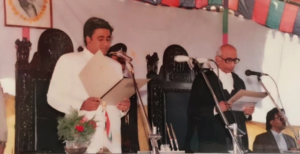
The culmination of Kaushal’s commitment to Mizoram was his appointment as the Governor of Mizoram in February 1990. At age 37, he held the distinction of being India’s youngest Governor.
The decision to appoint the Accord’s drafter and the state’s first Advocate General as Governor was strategically significant. It served as a massive symbolic guarantee that the constitutional spirit of the peace agreement would be upheld at the highest level of state administration. Kaushal’s tenure provided necessary constitutional oversight during the consolidation of the first non-MNF government post-statehood, ensuring that the Union Government’s commitments were honored.
Timeline of Swaraj Kaushal’s Pivotal Roles in Mizoram
| Period | Role | Significance to Peace/Statehood |
| 1979 | Legal Counsel (for Laldenga) | Secured Laldenga’s release from Tihar Jail; provided financial support for bail, establishing foundational personal trust with MNF leadership. |
| 1986 | Constitutional Advisor/Accord Drafter | Instrumental in drafting the Mizoram Peace Accord (30 June 1986), ensuring constitutional viability and ending 20 years of insurgency. |
| 1987–1990 | First Advocate General of Mizoram | Established the state’s legal framework post-Accord; provided institutional continuity and legal integrity during the turbulent political transition. |
| 1990–1993 | Governor of Mizoram | Overseeing post-conflict stabilization and transition; provided symbolic continuity and administrative assurance to the Mizo people. |
Enduring Legacy and Impact
The successful transition of Mizoram from an insurgency hotbed to one of India’s most peaceful states provides a definitive answer to the query “why try again.” The persistence succeeded because the effort was founded on a strategic synthesis of high-level legal expertise and profound personal trust, systematically institutionalized across multiple roles.
A Template for Northeastern Stability
Kaushal’s expertise was not confined to Mizoram; the peace formula he helped establish became a strategic model for addressing other protracted insurgencies in the region. His success led to his appointment as the first official interlocutor for the Naga peace talks in 1998. NSCN-IM General Secretary Thuingaleng Muivah held Kaushal in high regard, utilizing the architect of the Mizoram Accord for the Naga process—a testament that the Mizo methodology offered a viable model for negotiating constitutional settlements with non-state armed actors.
Validation of Integrity
The enduring respect Kaushal commanded provides the final validation of his unique methodology. Upon his passing, the Mizo National Front praised him as a “trustworthy person” and a “good friend,” while active groups like the NSCN-IM condoled the death of the “renowned lawyer… held in high regard by both Indians and Nagas.”
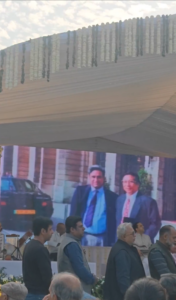
This cross-cutting political and community respect confirms that Kaushal operated above partisan conflict. His success in Mizoram validates the strategy that persistence in conflict resolution requires intermediaries who leverage legal integrity and personal commitment to achieve constitutional outcomes, thereby securing peace that is institutionally embedded and universally accepted.