
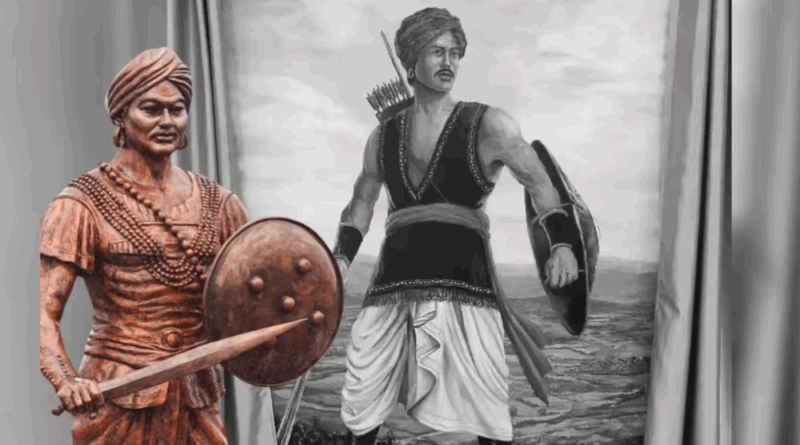
U Tirot Sing-The Khasi King Who Fought for Freedom
The Defiant Syiem: U Tirot Sing and the Khasi Struggle for Sovereignty
Part I: The World of the Khasi Hills: Society and Sovereignty in the Early 19th Century
To comprehend the resistance led by U Tirot Sing, one must first understand the world he sought to defend a world socially, politically, and culturally distinct from the empires that surrounded it. The Khasi Hills in the early 19th century were not a unified kingdom but a vibrant confederacy of independent states, each governed by a unique system of consultative leadership and bound by a sophisticated matrilineal social structure. This intricate socio-political milieu shaped Tirot Sing’s identity, his authority, and the very nature of his conflict with the British East India Company. The clash that ensued was not merely over territory but over fundamentally different conceptions of sovereignty, governance, and societal order.
The Matrilineal Order: Kinship, Land, and Social Structure
The bedrock of Khasi society was its matrilineal system, a societal structure where lineage, inheritance, and clan identity are traced through the female line. This system was not a matriarchy, where women hold primary political power, but a framework that placed women at the center of the clan (kur or jaid) and the family. Ancestral property, a cornerstone of Khasi life, was inherited by the youngest daughter, the Ka Khadduh, who acted as the custodian for the entire family. This practice ensured the stability and continuity of the clan, as property and lineage remained anchored to a single, unbroken maternal line.
While women were the custodians of the family and clan, men fulfilled crucial public roles as protectors, administrators, and warriors. The maternal uncle, in particular, held a position of significant authority within the family, providing guidance and managing affairs. This created a delicate balance of gender roles, distinct from the patriarchal norms prevalent in both the Indian plains and British society. Land ownership was similarly complex, divided between clan land (ri-kur), private family land (ri-kynti), and various forms of public land, including sacred groves (Ki ‘lawkyntang). This communal yet structured approach to resources would later become a point of friction with the British, whose concepts of land tenure were based on individual ownership and state revenue.
The inherent stability provided by the matrilineal system also had profound political implications. It created clear lines of succession for leadership roles within clans and provided a social cohesion that was resilient in the face of external threats. The influence of senior women from royal clans, while not always formal, was substantial. The fact that the British agent David Scott made his initial overtures not only to Tirot Sing but also to his mother is indicative of this dynamic. To the British, this may have seemed a quaint local custom; in reality, it was a reflection of a core principle of Khasi political legitimacy, where the counsel of senior women in the Syiem’s matrilineage carried immense weight. This nuanced power structure was a source of strength for the Khasis but was likely underestimated by the British, who were accustomed to dealing with singular, male-centric figures of authority.
A Confederacy of States: The Political Landscape of the Himas
In the early 19th century, the Khasi Hills were a mosaic of approximately 25 independent states or chiefdoms, known as Himas. These states, such as Nongkhlaw, Mylliem, and Khyrim, were sovereign entities, maintaining their own governance structures and engaging in diplomacy, trade, and occasional warfare with one another. There was no single Khasi king or paramount ruler. Instead, the Himas formed a loose confederacy, bound by shared cultural and linguistic ties but fiercely protective of their individual autonomy.
These states had long-established economic and political relationships with the communities in the plains, particularly in the Brahmaputra Valley to the north (Assam) and the Surma Valley to the south (Sylhet). This pre-existing engagement with the outside world is crucial for understanding why the British proposal for a road connecting these two valleys was not dismissed out of hand. For the Khasi chiefs, such a project, if properly controlled, promised enhanced trade and strategic advantages.
The Syiem and the Durbar: The Nature of Khasi Governance and Leadership
The ruler of a Khasi Hima was the Syiem, a title often translated as ‘chief’ or ‘king’. However, the Khasi Syiem was not an absolute monarch. He was a constitutional head who shared authority with a council, or Durbar. The Durbar was a representative body, comprising elders and leaders (Basan, Myntri, Lyngdoh) from the principal clans within the Hima. This system was fundamentally democratic and consultative; all major decisions, from land grants to treaties and declarations of war, required the deliberation and consent of the Durbar.
The ascension to Syiemship was typically limited to adult males from a designated Syiem clan, ensuring a continuation of the royal line. The very title reflected the chief’s role: “U syiem u mraw,” meaning “a king, a slave,” signified that the Syiem was a servant-leader, beholden to the welfare of his people, the Ki Khun Ki Hajar (the children of the state). This concept of leadership stood in stark contrast to the hierarchical and command-driven structure of the British East India Company. This fundamental difference in governance philosophy would prove to be a critical factor in the eventual conflict. The British, represented by David Scott, negotiated with Tirot Sing as an individual ruler, likely underestimating that any agreement he made was not a personal decree but a sacred pact sanctioned by the entire collective body of the Durbar. When the British later acted unilaterally, they were not merely breaking a promise to a chief; they were violating the foundational political institution of the Khasi people, an act of profound disrespect that made a violent response almost certain.
The Ascension of Tirot Sing of the Syiemlieh Clan
U Tirot Sing, born around 1802 in the Nongkhlaw region, was a scion of the esteemed Syiemlieh clan. He ascended to the position of Syiem of Nongkhlaw, one of the key states in the mid-western Khasi Hills, and quickly distinguished himself as a leader of exceptional caliber. He was respected for his wisdom, deep patriotism, and diplomatic skill. Notably, he was well-versed in several regional languages, including Bengali and Assamese, which facilitated his interactions with neighboring states and, initially, with the British. As Syiem, he was the constitutional head of his Hima, sharing authority with his Durbar and embodying the Khasi ideal of a leader who was both a ruler and a protector of his people’s sovereignty.
Part II: A Fateful Encounter: The British East India Company and the Strategic Imperative
The arrival of the British East India Company on the doorstep of the Khasi Hills was not accidental but the logical outcome of a grand imperial strategy. Following their victory in the First Anglo-Burmese War, the British found themselves in control of vast, disconnected territories in Northeast India. The independent Khasi states, once a peripheral concern, were now a strategic obstacle. The subsequent encounter, spearheaded by the shrewd British agent David Scott, was a classic colonial prelude to conquest, cloaked in the language of mutual benefit and progress but driven by an unyielding geopolitical logic.
Post-Yandabo Geopolitics: British Expansion into the Northeast Frontier
The Treaty of Yandabo, signed in 1826, formally ended the First Anglo-Burmese War and ceded the territory of Assam, including the Brahmaputra Valley, to the British East India Company. The British already controlled the Surma Valley, which included the commercially vital region of Sylhet. A glance at the map revealed a pressing strategic problem: the rugged, independent Khasi Hills stood as a formidable barrier between these two key possessions.
Connecting the administrative and military centers of Guwahati in the north and Sylhet in the south was paramount for the consolidation of British power in the region. The existing route was long, arduous, and ran through malarious country, making the movement of troops and officials slow and perilous. A direct, all-weather road through the Khasi Hills was not just a convenience but a strategic necessity for the British to project power, facilitate trade, and administer their newly acquired frontier.
David Scott’s Mission: The Diplomatic Prelude to Conflict
The architect of British policy in the region was David Scott, the Agent to the Governor-General for the Northern Territory. Described as a “shrewd politician,” Scott was a quintessential agent of empire, adept at using diplomacy and coercion in equal measure. He recognized U Tirot Sing as a formidable and able leader whose cooperation was essential for British ambitions. Historical accounts suggest that Scott resolved to bring the Khasi Hills under British suzerainty “by hook or by crook,” a clear indication that his diplomatic overtures were merely the first phase of a larger plan for annexation. He approached Tirot Sing with a proposal framed in the language of partnership and mutual advantage, a standard British tactic for gaining an initial foothold in a sovereign territory.
The Road Proposal: A Nexus of Commerce, Communication, and Control
Scott’s proposal was simple on its surface: he sought permission from Tirot Sing and the Nongkhlaw Hima to construct a road directly through their territory, linking Guwahati and Sylhet. To make the offer palatable, Scott tailored a quid pro quo specifically to address Tirot Sing’s known political and economic objectives. In return for the right of passage, the British promised to grant Tirot Sing control over the duars (passes leading into Assam), which were a subject of a long-standing dispute with a neighboring ruler, and also guaranteed the Khasis rights to free trade along the new route.
This offer was a masterful piece of colonial diplomacy. It leveraged a pre-existing regional conflict—the dispute over the duars with Balaram Singh, the Raja of Ranee—to the British advantage. By positioning themselves as the arbiters who could grant Tirot Sing his territorial ambitions, the British created a powerful incentive for cooperation. This was not a generous concession but a calculated move to exploit a local rivalry, a precursor to the classic “divide and rule” strategy. The road itself was a geopolitical tool, a “Trojan Horse” of colonialism. While presented to the Khasis as a trade route, for the British it represented military mobility, administrative consolidation, and economic penetration. This fundamental disconnect in the perceived purpose and strategic value of the road meant that the alliance was built on a foundation of misunderstanding and unequal intentions, making future conflict almost inevitable.
The Nongkhlaw Durbar’s Deliberation: A Calculated Agreement
Tirot Sing did not, and could not, accept this proposal unilaterally. True to Khasi political tradition, the matter was brought before the Nongkhlaw Durbar. After a two-day session of intense deliberation, the Durbar gave its consent. This was not a naive or hasty decision. The Khasi leadership, weighing the potential benefits of securing the duars and expanding trade against the risks of a foreign presence, made a calculated political judgment.
Crucially, their acceptance was conditional. The agreement was predicated on one vital clause: the British were to have no right to interfere in the internal administration and sovereign affairs of the Hima Nongkhlaw. This condition reveals the primary concern of Tirot Sing and his Durbar—the preservation of their autonomy. They were willing to enter into a strategic partnership but not to cede their sovereignty. It was the subsequent and flagrant violation of this core principle that would unravel the agreement and plunge the Khasi Hills into war.
Part III: The Unraveling of Trust: From Alliance to Open War
The fragile pact between the Hima Nongkhlaw and the British East India Company was destined for a short life. Built on divergent intentions and a Khasi assumption of honorable conduct that the British did not share, the agreement began to fray almost as soon as the work on the road commenced. A series of British actions, perceived by the Khasis as calculated betrayals, systematically eroded the trust upon which the alliance was founded, transforming disillusionment into a resolute determination to expel the foreigners by force. To provide a clear framework for the events that precipitated the conflict, the following chronology outlines the key moments in the escalation of tensions.
Date — Event — Significance
- 1826 — Treaty of Yandabo — British gain control of the Brahmaputra Valley, creating the strategic imperative to connect it with Sylhet.
- c. 1826–1828 — David Scott’s Proposal — Scott approaches Tirot Sing to build a road through Nongkhlaw in exchange for control of the duars.
- December 1828 — The Duars Confrontation — Tirot Sing attempts to claim the duars and is blocked by British sepoys, the first major act of betrayal.
- Early 1829 — British Military Buildup — News of British reinforcements arriving in Assam reaches the Khasis, revealing colonial intentions.
- April 4, 1829 — The Nongkhlaw Massacre — Khasi forces attack the British garrison at Nongkhlaw, killing two officers and formally igniting the Anglo-Khasi War.
- 1829–1833 — The Anglo-Khasi War — A four-year-long guerrilla conflict ensues between the Khasi confederacy and the British military.
- January 13, 1833 — Tirot Sing’s Surrender — Betrayed and concerned for his people, Tirot Sing surrenders to Captain Inglis at Lum Mardiang.
- 1833–1835 — Exile in Dhaka — Tirot Sing is deported and held in Dhaka as a political prisoner.
- July 17, 1835 — Death of Tirot Sing — U Tirot Sing dies in Dhaka, becoming a martyr for Khasi sovereignty.
The Dispute over the Duars: The First Test of the British Compact
The first clear sign of British duplicity came with the dispute over the duars. As per the agreement, control of these strategic passes was Tirot Sing’s primary gain. However, when the rival chief, Balaram Singh of Ranee, contested his claim, the British failed to support their Khasi ally. In December 1828, when Tirot Sing marched with a party of armed men to enforce his claim—an action he believed was sanctioned by his treaty with the British—he was met not with British assistance but with a detachment of Company sepoys who blocked his path.
This act was a profound betrayal. It demonstrated that the British promise was hollow and that they had no intention of honoring their side of the bargain. For Tirot Sing, the betrayal was not just political but deeply personal. He had entered into the agreement on the basis of a friendship with David Scott, who had reportedly assured him, “your enemy is the Company’s enemy”. Scott’s refusal to support him against Balaram Singh exposed this “friendship” as a colonial ruse, transforming a political disagreement into a matter of personal and collective dishonor that fueled the Khasi resolve to resist.
Signs of Betrayal: British Reinforcements and Khasi Disillusionment
The confrontation over the duars was followed by further alarming developments. News soon reached Nongkhlaw that the British were amassing military reinforcements in Guwahati and Sylhet. This military buildup contradicted their stated peaceful purpose for the road and confirmed Khasi suspicions that the project was a precursor to a full-scale occupation.
Simultaneously, the British began to overstep their authority within the Hima itself. In a flagrant violation of the agreement’s core condition of non-interference, British officials began imposing taxes on the people of Nongkhlaw. It became painfully clear to Tirot Sing and the Durbar that the British had a “hidden agenda” to subjugate the Khasi people and annex their lands as soon as the road provided them with the necessary military access.
The Point of No Return: The Nongkhlaw Massacre of April 4, 1829
Faced with undeniable evidence of British imperial designs, Tirot Sing convened another Durbar. The Khasi leadership, realizing that war was now inevitable, made a strategic decision. They issued a final ultimatum to the British, demanding that they immediately evacuate Nongkhlaw. The British, confident in their military superiority, paid no heed to the order.
This refusal was the final catalyst. On April 4, 1829, a band of Khasi warriors under Tirot Sing’s command launched a surprise attack on the British garrison stationed at Nongkhlaw. This event, which came to be known as the “Nongkhlaw Massacre,” resulted in the deaths of two British officers, Lieutenant Richard Gurdon Bedingfield and Lieutenant Philip Bowles Burlton, along with a number of their sepoys. David Scott, the primary architect of the British policy and the main target of the attack, had left for Cherrapunji shortly before and narrowly escaped.
This attack was not an act of wanton violence but a calculated, preemptive strike. Having exhausted diplomatic options and witnessed the steady encroachment on their sovereignty, the Khasi leadership concluded that their only hope of preserving their independence was to act decisively before the British could further entrench their position. The Nongkhlaw Massacre was the first shot in a war for Khasi survival, a desperate but deliberate defense of their homeland against a colonial power that had proven itself untrustworthy.
Part IV: The Anglo-Khasi War (1829–1833): A Strategic and Tactical Analysis
The Nongkhlaw Massacre ignited a full-scale conflict that raged across the Khasi Hills for four years. The Anglo-Khasi War was a quintessential example of asymmetrical warfare, pitting a technologically inferior but highly motivated indigenous force against the disciplined, well-equipped army of the British East India Company. The Khasis, under the leadership of Tirot Sing, compensated for their lack of firearms with a masterful use of guerrilla tactics and an intimate knowledge of the terrain, waging a prolonged and costly resistance that severely tested the British military.
To understand the dynamics of the conflict, it is essential to compare the capabilities, strategies, and resources of the two opposing forces.
Metric — Khasi Forces — British East India Company
- Leadership Structure — A decentralized confederacy of Syiems unified under the strategic leadership of Tirot Sing; decisions required consultation and consensus. — A hierarchical military command structure under the political authority of the Agent to the Governor-General, enabling decisive and coordinated action.
- Weaponry — Traditional weapons: two-handed swords (waitlam), shields, bows and arrows, spears, and bamboo rods. — Modern firearms: muskets and guns that allowed for killing from a distance; artillery for sieges and open battle.
- Dominant Tactics — Guerrilla warfare: ambushes, night raids, disrupting supply lines, and using the dense forests and caves as cover. — Conventional warfare: open-field battles, volley fire, punitive expeditions to destroy villages, and construction of fortified garrisons.
- Logistical Strengths — Intimate knowledge of the terrain, strong local support, ability to live off the land, and the use of secret caves for shelter and ammunition production. — Organized supply lines from established bases in Assam and Sylhet, and the ability to call upon significant reinforcements.
- Logistical Weaknesses — Inability to engage in sustained open battle, lack of firearms, and dependence on maintaining a fragile coalition of independent chiefs. — Vulnerable supply lines susceptible to ambush, unfamiliarity with the difficult terrain, and troops susceptible to diseases of the region.
Asymmetrical Warfare: Khasi Guerrilla Tactics vs. British Firepower
The Khasis quickly learned a brutal lesson in the opening stages of the war: their traditional weapons and valor were no match for British firearms in open battle. An enemy who could kill from a distance rendered their swords and shields ineffective in a conventional fight. In response, they seamlessly shifted to a strategy of guerrilla warfare, a form of combat for which the hilly, forested terrain was perfectly suited.
For four years, Khasi warriors tormented the British forces. Their tactics were fluid and unpredictable, designed to exploit British vulnerabilities. They conducted lethal night raids on isolated outposts, ambushed patrols and supply columns along narrow hill tracks, and then melted back into the dense forests. This unconventional warfare instilled fear and sent “waves of terror” through the British army, whose training had not prepared them for such an enemy. So effective were these tactics that Tirot Sing’s leadership has been compared to that of the great Maratha king, Shivaji, another master of guerrilla warfare.
The Battlefield Terrain: Leveraging the Hills for Strategic Advantage
The Khasi Hills themselves became a weapon in the hands of the resistance. The rugged landscape, with its deep valleys, steep precipices, and dense forests, was a natural fortress. The Khasis used this terrain to their full advantage. The numerous caves in the region served as more than just hiding places; they were strategic assets used as secret headquarters, shelters for warriors to recuperate, and even workshops for producing ammunition. The cave near Mairang where Tirot Sing took refuge after being wounded is now a memorial to this crucial aspect of the war.
Using the cover of thick forests and hill caves, they harassed British outposts and supply lines. This asymmetric warfare allowed the outnumbered Khasis to frustrate the British for years. Caves known as Krem Tirot became secret bases where warriors regrouped and crafted weapons, a strategy that kept the resistance alive despite British firepower.
In battle, the Khasis employed topographical warfare, using the high ground to their advantage. At strongholds like Nongnah, warriors would cast down heavy rocks and boulders onto British battalions attempting to advance up the slopes, supplementing these natural projectiles with volleys of arrows and gunfire from captured weapons.
Key Engagements and Alliances: The Pan-Khasi Resistance
Tirot Sing’s greatest political achievement during the war was his ability to forge a pan-Khasi resistance. Overcoming the traditional independence of the various Himas, he built a coalition of chiefs who recognized the existential threat posed by the British. Notable allies included Bormanik Syiem of Hima Shyllong and Sngap Sing Syiem of Hima Maharam, who joined forces with Tirot Sing to conduct coordinated attacks. The alliance reportedly extended beyond the Khasis to include other regional tribes like the Garos, Khamptis, and Singphos, who were united in their goal of driving the foreign invaders from the hills. This ability to maintain a broad-based coalition for four years in the face of immense British pressure is a testament to Tirot Sing’s leadership and the shared commitment to sovereignty among the hill peoples. The conflict was not merely the Nongkhlaw rebellion; it was truly the Anglo-Khasi War.
The British Counter-Insurgency: Retaliation, Scorched-Earth Policies, and the “Divide and Rule” Strategy
The British responded to this effective insurgency with a classic and brutal counter-insurgency campaign. Their strategy combined overwhelming military force with political warfare. Militarily, they launched punitive expeditions, retaliating against Khasi attacks by burning villages and destroying crops in a scorched-earth policy designed to break the will of the civilian population that supported the warriors.
Politically, they implemented a strategy of “divide and rule.” David Scott recognized that as long as Tirot Sing remained free and the Khasi coalition held, a purely military victory would be difficult and costly. The British therefore worked to sow seeds of distrust among the Khasi chiefs, exploiting old rivalries and using bribery to weaken the alliance from within. They imposed an economic embargo on the Khasi Hills, cutting off trade with the plains to create economic hardship and pressure the chiefs to surrender. This two-pronged approach—relentless military pressure combined with political and economic subversion—was ultimately what led to the erosion of the Khasi resistance. The Anglo-Khasi War thus stands as a significant, if often overlooked, early case study in the dynamics of insurgency and counter-insurgency that would define many colonial conflicts of the 19th and 20th centuries.
Part V: The Final Stand: Betrayal, Capture, and Exile
After four years of relentless warfare, the Khasi resistance, though unbowed in spirit, was facing a war of attrition it could not win. The superior resources of the British, combined with their ruthless counter-insurgency tactics, began to take a devastating toll. The final chapter of Tirot Sing’s struggle was marked by the corrosive effects of treachery, culminating in a principled surrender that was as defiant as his initial declaration of war. His subsequent exile and death in Dhaka would cement his status as a martyr for Khasi sovereignty.
The Erosion of the Resistance: Attrition and Treachery
The prolonged conflict had inflicted immense suffering on the Khasi people. Villages had been burned, trade had been blockaded, and countless families had lost husbands, brothers, and sons in the fighting. Tirot Sing was deeply pained by the plight of his people, a burden that weighed heavily on his decision-making. The war had also taken a personal toll; during one engagement, he was wounded by a British gunshot and forced to take refuge in a remote cave to recover.
It was during this period of vulnerability that the British strategy of “divide and rule” bore its most bitter fruit. The location of Tirot Sing’s hiding place was betrayed to the British by one of his own countrymen—a Khasi chief or kinsman who had been bribed with gold coins. This act of treachery, coming from within his own camp, reportedly left Tirot Sing shattered and was a critical factor in the collapse of the unified resistance.
The Surrender at Lum Mardiang: A Principled Capitulation
Faced with a fractured alliance, the immense suffering of his people, and the knowledge that his location was compromised, Tirot Sing made the difficult decision to surrender. This was not an act of military defeat but a calculated sacrifice. Recognizing that continued fighting would only lead to the further annihilation of his people, he chose to give himself up to end the bloodshed. This final act was consistent with his role as “U syiem u mraw,” a servant-leader prioritizing his people’s welfare above his own freedom.
On January 13, 1833, U Tirot Sing surrendered gracefully to the British officer Captain Inglis at a site known as Lum Mardiang, near the present-day Elephant Falls in Shillong. During the surrender negotiations, the British representative offered to spare his life and the lives of his followers if he would sign a treaty acknowledging British suzerainty over the Khasi Hills. Tirot Sing’s response has echoed through Khasi history as the ultimate statement of his principles. He boldly declared: “Better die an independent king than reign as a vassal!”. With this immortal refusal, he rejected personal safety in favor of an unwavering commitment to the sovereignty of his homeland. His only request to the British was that they grant “full justice to the rights of his countrymen”.
The Journey to Dhaka: The Fate of a Captured King
Following his surrender, Tirot Sing was subjected to a brief trial and sentenced. The initial order was for life imprisonment and transportation to Tenasserim province in Burma. However, the Supreme Government council in Calcutta revised this sentence, ordering instead that he be deported to Dacca (now Dhaka, Bangladesh) for detention. This decision removed him permanently from the Khasi Hills, neutralizing him as a leader and a symbol of resistance without the risk of creating a site of martyrdom closer to his homeland.
A Contested End: Reconciling the Accounts of Tirot Sing’s Imprisonment and Death
The precise circumstances of Tirot Sing’s final years and death in Dhaka are the subject of a significant historical debate, reflecting an evolution in historical interpretation as new evidence has come to light.
The popular and long-standing narrative holds that Tirot Sing died as a prisoner in the Dhaka Central Jail, a tragic end that fits the archetype of a freedom fighter martyred in a colonial prison. This version emphasizes the harshness of his captivity and his ultimate sacrifice.
However, more recent and detailed academic research, most notably by the historian and former UPSC Chairman, Professor David R. Syiemlieh, presents a more nuanced picture based on archival British records. According to this account, upon his arrival in Dhaka, Tirot Sing was initially treated inhumanely, provided with only a blanket. Undeterred, he boldly asserted his royal status, demanding treatment befitting his rank. This protest led to a special order from the British government designating him a “state prisoner” rather than a common criminal. As a state prisoner, his conditions improved dramatically. He was granted a monthly allowance of 63 Rupees, permitted to retain two servants, and was relocated from the jail to a comfortable bungalow under house arrest. Professor Syiemlieh, citing a letter to the editor dated May 14, 1835, found in the National Library in Kolkata, concludes definitively that “Tirot Sing Syiem did not die in jail. He passed away while living in a bungalow under comfortable conditions as a state prisoner”. This revised account does not diminish his sacrifice but offers a more complex view of British colonial policy, which often sought to manage high-value political prisoners by neutralizing them through controlled, “comfortable” confinement rather than risking the creation of a martyr through brutal imprisonment.
This academic view is further complicated by the fact that a recent official delegation from Meghalaya to Dhaka found that Bangladeshi authorities have no official records of Tirot Sing’s incarceration in the old Dhaka Central Jail. While this could be due to the loss of records over nearly two centuries, it also lends credence to the house arrest theory.
Regardless of the exact conditions of his confinement, U Tirot Sing died in exile in Dhaka on July 17, 1835. He never saw his homeland again, having given his life for its freedom.
Part VI: The Legacy of a Patriot: U Tirot Sing in Memory and History
Though his resistance was ultimately suppressed, the spirit of U Tirot Sing was never conquered. In the nearly two centuries since his death, his legacy has not only endured but has grown in stature, transforming him from a historical chief into a potent symbol of Khasi identity, courage, and the unyielding struggle for sovereignty. Today, his memory is actively preserved in the cultural and political landscape of Meghalaya, while his story continues to challenge the mainstream narrative of India’s freedom struggle, demanding recognition for the early, indigenous heroes who resisted colonialism.
Commemoration in Contemporary Meghalaya: State Holidays, Monuments, and Cultural Memory
In modern Meghalaya, U Tirot Sing is a revered figure, a household name whose sacrifice is woven into the fabric of the state’s identity. The most prominent official recognition is the observance of his death anniversary, July 17th, as a state public holiday known as “U Tirot Sing Day”. This day is marked by official ceremonies, cultural programs, parades, and the laying of wreaths at his memorials, serving as an annual reminder of his contribution.
The Government of Meghalaya commemorates U Tirot Sing Day every year on July 17, the anniversary of his death. This date is a state holiday in Meghalaya, dedicated to remembering Tirot Sing’s sacrifice. Public gatherings, memorial services, and cultural performances mark the occasion annually. A prominent martyrs’ column in Shillong, the state capital, bears his name alongside other freedom fighters of the region (such as U Kiang Nangbah and Pa Togan Sangma) as an eternal tribute.
The landscape of Meghalaya is dotted with monuments that honor his memory. Key among these are the U Tirot Sing Memorial in his native Mairang, and a life-size statue at Madan Iewrynghep in the state capital, Shillong, which was notably erected through the initiative of the Khasi Students Union (KSU). This involvement of a prominent student body demonstrates that Tirot Sing’s legacy is not merely a static historical fact but a living, dynamic force in the identity politics of the region’s youth. Other statues and memorials exist at the State Central Library and the Raj Bhavan.
There are also proposals to honor him internationally – for instance, in 2023 it was announced that a bust of Tirot Sing would be installed at the Indira Gandhi Cultural Centre in Dhaka, Bangladesh, and the center’s library renamed in his memory, recognizing that he spent his last days on Bangladeshi soil.
Beyond formal monuments, his legacy is preserved in the land itself. The cave system where he took refuge during the war is now a protected historical site and a popular destination, offering a tangible connection to the guerrilla struggle he waged. His story has also entered the realm of popular culture through Meghalaya’s first animated film, “U Syiem” (The King), released in 2022, which introduced his heroism to a new generation. As no contemporary portraits of him exist, his visual representation in art and sculpture is a “fictional image innovated from the features of the royal clan,” a creative act of cultural reconstruction to give a face to their hero. This active and multi-faceted commemoration is more than just historical remembrance; it is a continuous political and cultural reassertion of Khasi identity and the historical foundations of their distinctiveness within the Indian nation.
An “Unsung Hero”: Situating Tirot Sing in the National Narrative of India’s Freedom Struggle
U Tirot Sing stands as a pioneer of India’s freedom struggle. His war against the British began in 1829, nearly three decades before the Sepoy Mutiny of 1857, which is often cited in mainstream historiography as the “First War of Independence”. He recognized the true nature of British colonialism and rose to oppose it at a time when many across the subcontinent were not yet aware of its ultimate consequences.
Despite the significance of his early resistance, Tirot Sing remains largely an “unsung hero” outside of Northeast India. His name is conspicuously absent from most national history textbooks, and his struggle is often overlooked in the broader narrative of Indian independence. This omission is not due to a lack of importance but is symptomatic of a long-standing historiographical bias that has tended to center the freedom struggle on the activities of the Indian National Congress and events in the Gangetic plains. Early, regional, and indigenous resistances like the Anglo-Khasi War have frequently been marginalized or categorized as mere “local disturbances” rather than foundational anti-colonial movements.
Philatelic Honor: In 1988, the Government of India issued a commemorative postage stamp featuring U Tirot Sing, as part of a series celebrating freedom fighters. The stamp (denomination 60 paisa) introduced Tirot Sing’s story to a nationwide audience and remains a collectors’ item. Its issuance underlined his importance at the national level, ensuring that his name figures among the pantheon of Indian patriots.
Tirot Sing’s revolt, like other major tribal uprisings of the period such as the Santhal and Munda rebellions, was fundamentally a struggle against the colonial encroachment on land, autonomy, and traditional ways of life. However, the specific context of his resistance—a war triggered by the violation of a formal, negotiated agreement between two sovereign political entities—positions his struggle as a defense of national sovereignty in its purest form. Recognizing his contribution is therefore essential for a more inclusive and accurate understanding of India’s long and diverse fight for freedom.
Conclusion: Tirot Sing and the Enduring Spirit of Indigenous Resistance
U Tirot Sing’s legacy is ultimately one of unwavering principle and profound sacrifice. He is remembered not as a defeated chief, but as a symbol of the Khasi people’s courage, resilience, and unyielding desire to live free from oppression. His final declaration—”Better die an independent king than reign as a vassal!”—has become the encapsulation of this spirit, a timeless assertion of dignity and sovereignty that continues to inspire generations.
His story is a powerful testament to the challenges faced by indigenous communities in the face of colonial expansion. It highlights their determination to protect their cultural identity, their political autonomy, and their ancestral lands. In an era where the narratives of “unsung heroes” are being brought to the forefront, the story of U Tirot Sing of Nongkhlaw serves as a vital chapter in the history of India, reminding the nation that the fight for freedom was waged not only by well-known figures in the political mainstream but also by defiant leaders in the hills and forests, who fought and died for the sacred cause of independence.