
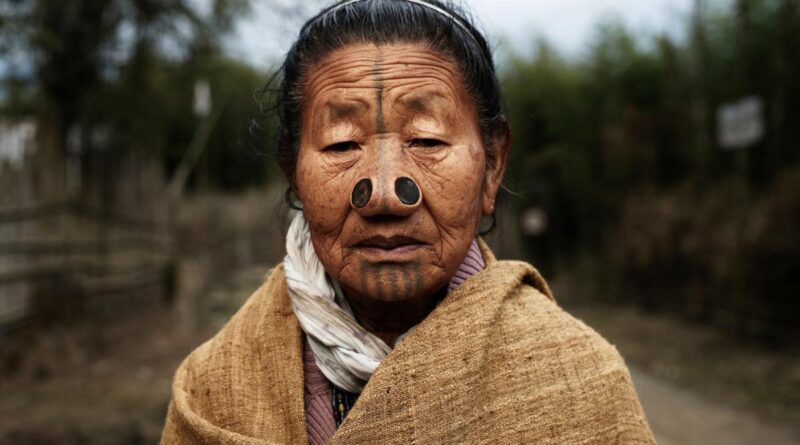
Apatani Identity: The Deep Meaning Behind Arunachal Pradesh’s Traditional Tattoos
In the remote northeastern frontier of India, cradled by the green hills of Arunachal Pradesh, lies the Ziro Valley — home to one of the country’s most culturally rich and ecologically conscious indigenous communities: the Apatani tribe. Unlike many other tribes of the Eastern Himalayas, the Apatanis developed a sophisticated and sustainable way of life. Their agricultural system is unique — instead of shifting cultivation, they practice permanent wet rice farming on terraced fields, ingeniously combining it with fish farming using no machines or chemical inputs. This deep connection to nature is guided by their ancestral faith called Donyi-Polo, the worship of the Sun and Moon, which governs not just their farming calendar but also their spiritual worldview. Apatani villages are tight-knit, with bamboo stilt houses, narrow stone paths, and a lifestyle that balances tradition and simplicity. Their festivals, like Myoko and Dree, celebrate fertility, friendship, and harvests with prayers, rituals, and dances passed down through generations. Women are especially skilled in handloom weaving, while the entire community preserves their history through oral traditions and a council system known as the Bulyang, which governs local life without written laws. Their story is not of isolation, but of intelligent resistance — maintaining their roots even as modernity brushes against the valley. And among all their traditions, one stands out sharply — written not in books or songs, but on the human body itself: the Apatani tattoos.
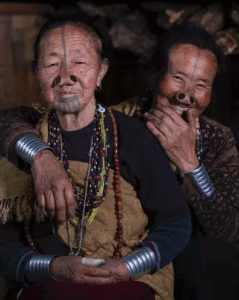
In the same lush Ziro Valley, the Apatanis once practiced a form of body modification that wasn’t mere decoration. These tattoos carried stories — of history, protection, pain, identity, and pride — deeply embedded in the fabric of their culture. Known for their distinct facial tattoos and large wooden nose plugs worn by women, the Apatanis wore these marks as more than just tribal symbols — they were declarations of who they were.
For the Apatani, facial tattooing, called tiipe or tippei, and nose plugging, known as yaping hullo, carried enormous cultural weight as visible markers of identity. According to one popular legend, Apatani women were so renowned for their beauty that men from neighboring tribes would raid their villages to abduct them. To deter these raiders, the Apatani began tattooing the women’s faces and inserting large nose plugs to make them appear less attractive. Another tale speaks of ancestral spirits — it is said fallen Apatani warriors returned as ghosts to find their wives, so a priest advised women to tattoo their faces to become unrecognizable and avoid spiritual torment. While many today regard such tales as mythic, the more accepted reason lies in how tattoos functioned as ethnic identifiers — a way to distinguish Apatanis from other tribes. What may have started as a strategy of self-protection evolved into something deeper. Over time, the tattoos and nose plugs became emblems of womanhood and strength. Elders recall a time when an Apatani woman bearing these markings — the forehead line, chin stripes, stretched earlobes, and wide nose plugs — was seen as more likely to find a good husband. What outsiders saw as disfigurement, the Apatanis wore as a symbol of heritage and honor.
The tattoo patterns themselves were simple but distinct, and clearly gendered. Women traditionally bore a single bold vertical line running from the center of the forehead down to the nose, accompanied by five smaller vertical lines below the lower lip on the chin. These tattoos were typically done during adolescence, often timed with a girl’s first menstruation — marking her readiness for adulthood. Men, by contrast, had only minimal markings: a small T-shaped or single line tattoo under the chin. The effect of women’s tattoos, especially combined with the nose plugs, created a unique and striking facial profile that became synonymous with Apatani female identity. Tattooing wasn’t a personal choice or a fashion statement. It was a social obligation. A young girl was expected to undergo the ritual as a requirement for full membership in the community. In some cases, even newborn girls were given a small forehead mark, called pányo, as a gender signifier before receiving their full tattoos at puberty. These markings weren’t just expressions of culture; they were societal expectations.
The methods used to create these tattoos were rudimentary and painful, passed down through generations using entirely indigenous materials. Girls usually received their tattoos between the ages of ten and twelve. The procedure was often performed in winter — a season believed to aid healing and minimize infection. The ink, known as chinyu, was made from soot collected from kitchen fires and blended with pig’s fat, creating a thick, black paste that stained the skin permanently. Rather than using metal needles, the Apatanis crafted tattooing tools from nature — bundles of sharp thorns from local plants like tipe-tere were tied together to form a multi-pronged spike. The thorn bundle would be dipped in the ink and tapped into the skin with a wooden stick, a process known as stick-and-poke tattooing. No anesthesia, no shortcuts — only raw pain. An elder woman would carry out the procedure slowly and meticulously. The pain was intense. Healing took days, sometimes weeks. Swelling, scabbing, and re-darkening faded tattoos were all part of the experience. Yet the girls endured it with pride, because their faces would now bear the most visible symbol of Apatani identity. The nose plugs, too, had their own ritual. As girls grew older, the sides of their noses were pierced and gradually stretched to accommodate the large circular wooden pegs — carved from carefully cleaned wood to avoid infection. Together, the tattoos and nose plugs were more than body modifications. They were living declarations of belonging.
Traditional tattoos played a central role in Apatani identity, shaping their social standing and even spiritual belief systems. These marks were group identifiers — worn uniformly by Apatani women, they served to immediately distinguish them from other tribal groups. Anthropologists describe this as a classic example of group identity formation. In fact, not getting tattooed was nearly unthinkable. It would have meant separation from community, tradition, and eligibility for marriage. The tattoos also marked the transition to adulthood. For women, they symbolized readiness — readiness to marry, to bear children, and to take on the responsibilities of adult tribal life. Without these tattoos and nose plugs, a woman in those days was seen as improperly dressed, even unattractive. Men’s tattoos were subtler but still marked maturity. Beyond social signaling, there were deeper beliefs at play. The act of enduring such pain was seen as a form of sacrifice — something spiritually purifying. Some Apatanis believed that the tattoos would help their ancestors recognize them in the afterlife. During festivals and communal dances, the tattoos set Apatani women apart, both physically and symbolically. These markings weren’t just worn — they were celebrated. And even today, the tattooed elders are viewed with deep respect. They are keepers of stories, of hardships, and of a legacy etched into their very skin. Yet, these same elders also witnessed a shift — from reverence within the valley to curiosity and discomfort outside of it.
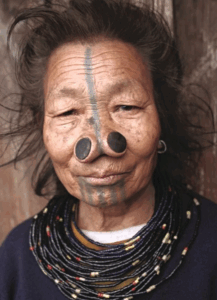
Today, these practices have largely vanished. The decline began in the late 1960s and continued through the 1970s, as modern education, urban migration, and changing values made their way into Ziro Valley. Between 1970 and 1974, with the support of the Indian government and the Apatani Youth Association, the community itself decided to ban further facial tattooing and nose plugging. There were practical reasons. The markings made people easy targets for ridicule and discrimination when they left their villages. In cities, tattooed Apatanis — especially women — faced alienation, and many were mocked for their appearance. The traditional symbols of honor had become sources of discomfort. By the mid-1970s, no new tattoos were being done. Today, only the elderly women — and a few men — carry the marks. Most of them are now in their 60s, 70s, or older. If you walk through Ziro Valley now, you may still encounter a grandmother with bold black lines on her face and wooden discs in her nostrils. She will smile. She will tell you stories. But she knows… she is the last of her kind. For the younger Apatanis, especially those working or studying in India’s cities, the tattoos are seen as outdated. They understand the cultural value, but feel no need to revive them. Many say it’s not a loss, just a choice — a choice to carry identity in other ways. With so much prejudice already tied to being Northeastern in urban India, adding visible tribal markings would only bring more unwanted attention.
Yet all is not forgotten. Scholars, artists, and cultural preservationists have begun documenting these tattoos — sketching the patterns, interviewing the elders, and archiving their meanings. There’s a new interest in tribal tattoo traditions across India. Apatani designs are being reimagined — not on faces, but on arms, backs, and canvas — by tattoo artists as symbols of identity and cultural pride. Artists like Mo Naga and others have incorporated these motifs into their work, blending tradition with modernity. Museums, documentaries, and community exhibitions are ensuring that the Apatani legacy doesn’t disappear. But let’s be clear — this is not revival. It is remembrance. Young Apatani women are not returning to facial tattooing. They are remembering, documenting, and choosing other forms of expression. The Apatani Cultural Landscape is now part of UNESCO’s tentative World Heritage list. Organizations like INTACH have documented the tattooing practices as part of India’s intangible cultural heritage. These efforts are acts of cultural CPR — keeping the story alive, even as the practice fades.
Because the story of the Apatani tattoos is not just about ink on skin. It is about the collision of tradition and transformation. It is about identity, ownership, and the strength to adapt without forgetting. It is a story that lives on — in the faces of the elders, in the hearts of the youth, and in the memory of a valley that once wrote its legacy in lines.