
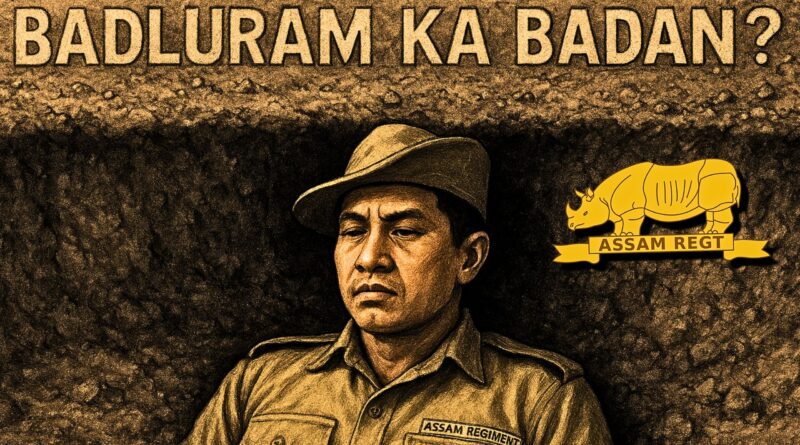
Badluram Ka Badan: Assam Regiment’s Legendary Song
Introduction
“Badluram ka Badan” (often mistakenly referred to as “Badluram ka Sar”) is not just a marching song—it is a living legend within the Indian Army’s Assam Regiment. Rooted in the chaos of World War II, this spirited tune honors a fallen rifleman named Badluram, blending deep reverence with the gritty gallows humor that soldiers often cling to in times of war. As the story goes, Badluram’s death—and a resourceful quartermaster’s failure (or choice) to strike his name off the ration rolls—ended up saving his company from starvation during the Siege of Kohima, one of the fiercest battles in the Indo-Burma campaign. Over the decades, what began as a simple tribute has evolved into a regimental anthem—a symbol of valour, sacrifice, resilience, and the indomitable spirit of the Assam Regiment.
Who Was Badluram? Real Hero or Myth?
By all credible accounts, Badluram was a real person — a Rifleman in the 1st Battalion of the Assam Regiment under the British Indian Army during World War II. According to Indian Army lore, he served with distinction during the fierce Imphal–Kohima campaign of 1944, a turning point in the war often referred to as the
” Badluram was killed in the early stages of the Battle of Kohima, reportedly by a gunshot wound. But remarkably, his story didn’t end with his death — it was only just beginning.
In an unusual twist that would go on to become legend, the company’s quartermaster did not officially report Badluram’s death. His name remained on the ration rolls, which meant the unit continued receiving his food supplies as though he were still alive. Whether this was an act of quiet defiance and foresight to aid the unit, or a simple clerical oversight amidst the chaos of war, remains debated. Either way, the result was the same — Badluram’s unclaimed rations helped his comrades survive through one of the war’s most brutal sieges.
As for whether Badluram was a fictional creation — the answer appears to be a firm no. All available evidence and regimental accounts affirm that he was a genuine soldier, not a symbolic or mythological figure. In fact, the identity of the quartermaster involved, Subedar Kandarpa Rajbongshi, is well preserved in military history; he was even awarded the Indian Distinguished Service Medal (IDSM) for his service. These concrete details lend further credibility to Badluram’s story, which, over time, has passed into oral tradition and regimental folklore, growing into a symbol of survival, sacrifice, and soldierly wit.
In the end, Badluram became more than a name — he became a legacy. His story is a powerful example of how soldiers keep the memory of their fallen comrades alive, not just through solemn silence, but also through song, humor, and enduring respect.
War Context: The Siege of Kohima and Badluram’s Rations

In the spring of 1944, the 1st Battalion of the Assam Regiment was stationed in the hills of Nagaland, near Kohima, tasked with defending India’s northeastern frontier against the advancing Japanese 15th Army. What followed was the fierce and historic Battle of Kohima, fought between April and June 1944, during which Allied (British-Indian) forces were encircled and cut off from their supply lines. Amid this chaos and carnage, Rifleman Badluram was killed early in the conflict — but his story was far from over.
In the normal course of wartime administration, a soldier’s death is promptly recorded, and their rations discontinued. But in Badluram’s case, the company quartermaster failed to report his death, either by accident or design. As a result, his food rations continued to arrive.
Then came the siege.
With supply routes completely blocked and food supplies dwindling, the encircled troops found themselves on the brink of starvation. It was then that the unclaimed rations issued in Badluram’s name became a lifeline. His company, unknowingly stockpiling food thanks to the clerical oversight, was better equipped than others to endure the prolonged deprivation. For weeks, those ghost rations kept the soldiers going — one fallen rifleman continuing to nourish his comrades long after death.
As one account poignantly put it:
“For Badluram’s company, the surplus rations drawn under his name proved to be life-saving during the siege of Kohima and helped the company survive while cut off from regular supplies.”
By the time the siege was broken in June 1944, and Allied reinforcements forced the Japanese to retreat, Badluram’s contribution — unintentional but invaluable — had already become etched in the unit’s memory. It was a story that perfectly blended tragedy, irony, and deep soldierly pride, forming a legend told and retold within the ranks: a fallen comrade whose very name continued to serve the living.
Birth of the Song “Badluram ka Badan” (1946)
In the aftermath of World War II, the Assam Regiment sought a way to commemorate the extraordinary — and ironically life-saving — contribution of Rifleman Badluram. The responsibility of preserving this powerful wartime anecdote fell upon Major M. T. Proktor, an officer of the Regiment. In 1946, Major Proktor wrote and composed the now-iconic marching song “Badluram ka Badan” as a tribute to the fallen soldier whose name continued to nourish his brothers-in-arms.
To ensure the song’s appeal and memorability, Major Proktor set the lyrics to the well-known melody of the American Civil War tune “John Brown’s Body,” which also served as the basis for “The Battle Hymn of the Republic.” This instantly recognizable, upbeat marching rhythm gave Badluram ka Badan its infectious and energetic character — perfect for regimental parades and marching drills.
Despite being rooted in the somber reality of death and siege, the lyrics adopt a wry, playful tone, echoing the kind of dark humor common in military culture. The first verse opens light-heartedly, referencing a “beautiful girl” who distracts a rifleman during parade — a classic example of barracks banter. But quickly, the song transitions into its heart: Badluram’s fate, and the “smart quartermaster” who kept his name on the rolls, ensuring the unit’s survival through his unclaimed rations.
The now-famous chorus, sung to the tune of “Glory Hallelujah,” proclaims:
“Badluram ka badan zameen ke neeche hai,
Toh humein uska ration milta hai… Sabash, hallelujah!”
Translated:
“Badluram’s body lies buried in the ground — but we still receive his ration!”
These lines encapsulate the essence of the story: a fallen soldier continuing to feed and protect his comrades even after death. The cheeky “hallelujah” and rousing “Sabash!” (Bravo!) inject a tone of celebration and honor, perfectly balancing respect and humor.
Major Proktor’s creation is a masterclass in military storytelling — blending reverence with irreverence, gallows humor with deep respect. The song transforms a morbid twist of fate into a spirited anthem of survival, unity, and sacrifice. As one reflection aptly noted, it reminds soldiers that survival isn’t just about brawn — sometimes it’s about heart, wit, and the invisible bonds of brotherhood.
Written just as India and its regiments were transitioning into a post-war, soon-to-be independent era, “Badluram ka Badan” was not just a tribute — it was a deliberate effort to preserve a proud, living piece of regimental folklore for generations to come.
Assam Regiment’s Beloved Anthem and Tradition

What began as a humble company ditty in the late 1940s soon grew into something far greater: “Badluram ka Badan” became the official regimental song of the Assam Regiment. After India gained independence in 1947, the tradition endured, passed from one generation of riflemen to the next with undiminished fervor. The song is now an integral part of the Regiment’s training and culture — taught to new recruits and sung proudly at their attestation parades in Shillong, Meghalaya, home to the Assam Regimental Centre.
To this day, the thunderous chorus praising Badluram echoes across parade grounds during passing-out ceremonies, linking young recruits to a legacy forged in war and bonded by brotherhood. With every rousing chant of “Badluram ka badan zameen ke neeche hai… Sabash, hallelujah!”, soldiers are reminded of the selfless sacrifice and timeless story that defines their regiment’s spirit.
Over the decades, the song has become inseparable from the Assam Regiment’s identity. No regimental celebration, gathering, or formal event is considered complete without a stirring rendition of it. During the Regiment’s Platinum Jubilee in 2016, commemorating 75 years since its raising in 1941, both serving soldiers and proud veterans stood together to sing it. The moment was made even more special when the Chief Guest, Kiren Rijiju (then Minister of State for Home Affairs), stood and joined the chorus — a reflection of how deeply this musical tribute resonates, even beyond military ranks.
Far from being just a piece of entertainment, Badluram ka Badan has evolved into a musical memorial — a living tradition that pays homage to the fallen, celebrates survival, and unites every soldier under the banner of shared history and pride.
Remarkably, the legacy of the song has crossed regimental — and even national — boundaries. Widely regarded as one of the Indian Army’s most beloved marching songs, it has gained recognition far and wide. A notable example came in September 2019, during the Indo–US joint military exercise Yudh Abhyas held in Washington state. A now-viral video showed American soldiers enthusiastically singing and dancing alongside their Indian counterparts to the iconic chorus, delighting many who noted the shared melody with the Civil War song “John Brown’s Body.” That moment of cross-cultural connection showcased not only the song’s infectious energy, but also how Badluram’s story — born in a battlefield of Nagaland — continues to echo around the world.
How the Song Came to Be Written
The creation of “Badluram ka Badan” was a product of both its time and its people — born out of wartime resilience, regimental pride, and the need to immortalize an unlikely act of sacrifice. In 1946, Major M. T. Proktor, an officer of the Assam Regiment, penned the song specifically to honor Rifleman Badluram and to uplift the morale of his men returning from some of the most grueling campaigns in Burma and Northeast India.
In a regiment rich with stories of hardship and valor, Badluram’s tale stood apart — not for an act of combat heroism, but for how his absence became a source of sustenance for his brothers-in-arms. Proktor knew that stories told in song endure far longer in military memory than those confined to written records. So he transformed this quiet, almost comical anecdote into a marching anthem — something soldiers could stomp their boots to, shout in unison, and carry forward with pride.
Choosing the tune of the American Civil War classic “John Brown’s Body” was no accident. Familiar, rousing, and easily remembered, it ensured the story would travel far and stick fast. With each cheerful shout of “Hallelujah!”, the memory of Badluram was reinforced not through grief, but through celebration.
Lyrically, the song operates as a subtle piece of wartime folklore. It commemorates not just Badluram’s death, but also the quartermaster’s “resourcefulness” — whether accidental or intentional — that kept the company alive. It quietly suggests that in war, rules may bend, but loyalty endures. The light-hearted opening — about a pretty girl distracting a rifleman — sets a humorous tone before shifting into the deeper story of ghost rations and a fallen comrade’s silent sacrifice.
Ultimately, “Badluram ka Badan” was written to do what all great army songs do — inspire, unify, and remind. In the uncertain world of post-war India, the song gave the Assam Regiment something to hold on to: a story that was tragic yet triumphant, personal yet universal. It turned a moment of deprivation into a celebration of ingenuity, camaraderie, and enduring spirit. Badluram may have fallen, but through this marching song, he continues to lead.
Badluram may have fallen in war, but through song, memory, and tradition, he continues to march with every soldier of the Assam Regiment — a silent sentinel of sacrifice, forever remembered.
You can Watch the Full story here: https://youtu.be/CnGScrwKtPw
This is such a patriotic song and humourous lyrics being composed long before we were born.While reading this article i feel conscious about the WW ii and the Assam regiment and the true meaning of Badluram ka badan.
Indeed Sir, 🙂