
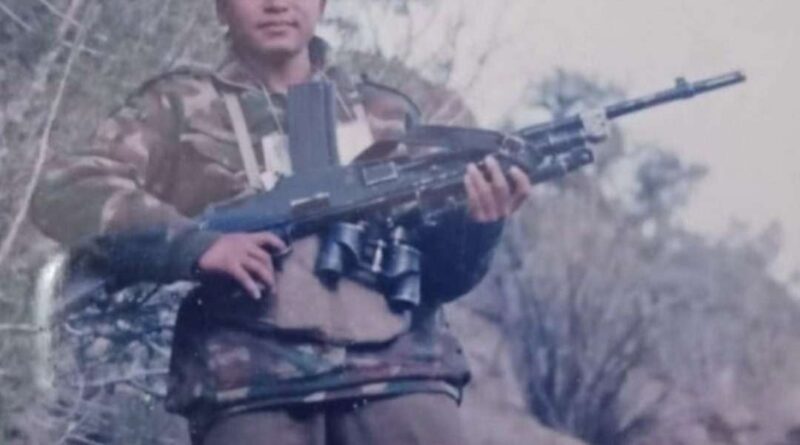
Story of Captain Keishing Clifford Nongrum
In every corner of India, from the deserts of Rajasthan to the forests of the Northeast, there are stories—quiet, powerful stories—of ordinary people who chose to rise for something greater than themselves. But once in a while, one story stands out. Not because it’s louder, but because it carries the weight of truth, sacrifice, and undying love for the nation. This is the story of a young man from the hills of Meghalaya, a man who broke barriers, shattered stereotypes, and walked straight into history with courage in his heart and the tricolour in his soul. His name: Captain Keishing Clifford Nongrum. And his legacy… eternal.
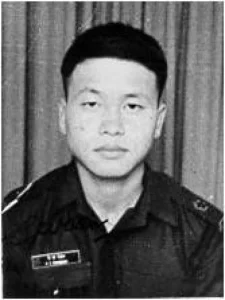
In the misty hills of Shillong, Meghalaya, where clouds brush the pine trees and silence tells ancient tales, a boy named Keishing Clifford Nongrum was born on March 7, 1975. He came from a proud and humble home—his father, Peter Keishing Nongrum, a government employee; his mother, Saily, a homemaker. Clifford was a son of the Khasi hills, deeply rooted in his indigenous identity, yet destined for a journey far beyond his hometown.
From childhood, Clifford showed signs of leadership, sincerity, and an adventurous spirit. At Don Bosco School, he was not only a brilliant student but a sportsman, a friend, a leader. Later, at St. Anthony’s College, he pursued political science. Football kept his body agile. Debates and discipline sharpened his mind. But even more deeply, something else was growing inside him—a calling to serve the nation.
In a place where few imagined wearing the olive green, Clifford saw the Indian Army not just as a job, but as a sacred duty. A chance to represent not just Meghalaya, but all of Northeast India. He cleared the defense exams on his first attempt and joined the Officers Training Academy in Chennai. There, his commitment stood out. In 1997, he was commissioned into the 12th Battalion of the Jammu and Kashmir Light Infantry—one of India’s toughest and most respected regiments.
As an officer, Lieutenant Nongrum was respected for his humility, strength, and a fierce sense of responsibility. He was posted in some of the most difficult terrains, including Siachen Glacier. There, he learned to fight not just enemies, but nature itself—ice, altitude, isolation. His men admired him. He never gave orders from the back. He led from the front.
Then came the summer of 1999. The Kargil War. When Pakistani soldiers and militants infiltrated Indian peaks, Operation Vijay was launched. It was a call to reclaim what was rightfully ours. Among the many critical missions was the capture of Point 4812 in the Batalik sector. A peak at 16,000 feet. Icy, vertical, dangerous.
On the night of June 30, 1999, Lieutenant Clifford Nongrum led his platoon on a near-vertical climb toward Point 4812. For ten hours, they scaled rocks as steep as 70 degrees. With rifles on their backs and grenades in hand, they reached the top—only to be met by heavy machine gun fire. The enemy was ready, entrenched in bunkers carved into the rocks. The situation was grim.
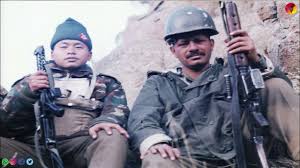
But Clifford did not flinch.
He rose, charged ahead under enemy fire, and lobbed grenades into the bunkers. One by one, he destroyed enemy positions. Even after being shot multiple times, he continued fighting—hand-to-hand. He tried to wrest a machine gun from another enemy soldier, and in the struggle, killed again. Severely wounded, bleeding, exhausted—he refused to retreat. He kept fighting. His last moments were spent urging his men forward.
And they did. Inspired by his courage, his platoon stormed ahead and took Point 4812. But Clifford Nongrum had fallen.
He was just 24 years old.
The Indian Army posthumously awarded him the Maha Vir Chakra, the second-highest gallantry award in the country. He became the first and only soldier from Meghalaya to receive this honor. His parents received the medal with pride and pain. His father remembered Clifford’s last words—that if he ever fell, he would do so with honor.
Shillong mourned. The entire Northeast stood still. His funeral saw thousands—soldiers, civilians, students—gather to bid farewell to a son who had shown the nation what sacrifice truly means.
But his story did not end there.
A road in Shillong now bears his name—Clifford Nongrum Road. His bust stands in the Rhino Heritage Museum, his memory preserved in uniforms, medals, and photos. Every year, schools recount his story. Cadets salute his bravery. Children learn his name.
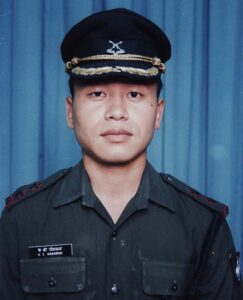
He inspired not just a battalion, but a generation.
Clifford Nongrum broke barriers. He proved that patriotism has no region, no language, no border. A Khasi Christian from Meghalaya, standing shoulder to shoulder with men from across India, fighting for one flag. His life is a message—for unity, for courage, for service.
He did not seek the spotlight. He simply did what he believed in.
And in doing so, he became light himself.
Captain Keishing Clifford Nongrum lives on—not just in granite busts or medals, but in every young soul who dares to dream beyond fear, in every soldier who stands guard at our borders, and in every Indian heart that beats with gratitude.
He was not born into fame. He did not seek it. But in the freezing silence of Kargil, where death walked every ridge, Clifford Nongrum chose to write his name—not in ink, but in blood and bravery. He proved that a soldier’s strength isn’t just in his weapon, but in his heart. That India is not a map divided by states, but a soul united by sacrifice. From the pine-clad slopes of Shillong to the frozen peaks of Drass, his story is more than a memory—it’s a torch. A reminder. That true heroes don’t wait for applause. They simply stand up… when it matters the most. And in doing so, they never fall.
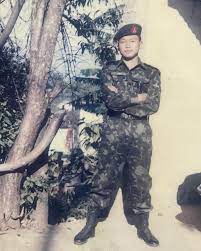
Captain Clifford Nongrum didn’t just die a hero.
He became a reason why India still breathes free.