
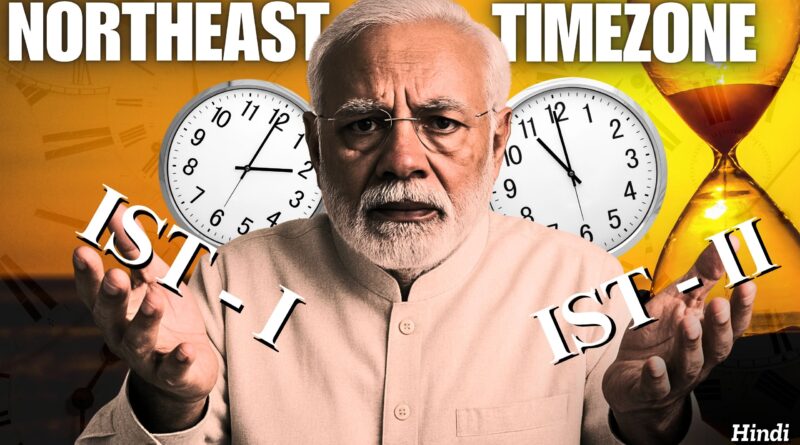
India Time Zone Debate: Why Northeast Demands Separate Time
Introduction India spans nearly 30 degrees of longitude (from 68°E to 97°25′E), which creates about two hours of solar time difference between its eastern and western edges. Despite this, since 1947, India has followed a single time zone — Indian Standard Time (IST), based on 82.5°E longitude (UTC+5:30). The goal was administrative ease and national integration — phasing out colonial time zones like Bombay Time and Calcutta Time. But the Northeast, especially states like Assam, Arunachal Pradesh, and Nagaland, lies far to the east — where the sun rises and sets much earlier than in western India. As a result, daily life in these regions often mismatches with IST.
IST and the Northeast: Untimely Routines and Daily Struggles In parts of Arunachal Pradesh and Assam, sunrise happens around 4:00 or 4:30 AM during summer. In contrast, in Gujarat, the sun rises only after 6:30 AM. Still, both regions run on the same clock. So, while the Northeast is bathed in sunlight early in the morning, most people are still asleep — since schools and government offices open at 9–10 AM IST. In winter, it gets worse — darkness sets in as early as 4 PM, but the working day continues. This mismatch forces children to go to school in the dark, and professionals to work late under artificial lighting. Assam’s tea gardens follow an informal “Chai Bagan Time,” which is about one hour ahead of IST, but it’s not official. Some state governments have tried adjusting office hours earlier than IST, but unless a separate time zone is officially recognized, these efforts remain incomplete. Filmmaker Jahnu Barua says that people cannot spend time outdoors with family in the evening because it’s already dark — affecting social life and mental well-being.
Impact on Productivity and Energy When people don’t work in sync with natural daylight, both productivity and health are affected. Wasted daylight hours reduce work quality. Barua estimates that about two hours of daylight are wasted each day, which over the years since independence equals nearly 27 years of lost productivity. Moreover, energy consumption spikes, as people need artificial lighting in mornings and evenings. Studies by NIAS and NPL show that if IST is shifted 30 minutes ahead, India could save about 2.7 billion units of electricity annually. In the Northeast alone, a one-hour shift could save nearly 20 million units — benefiting the economy and the environment.
Arguments Supporting a Separate Time Zone Several compelling reasons support a second time zone (IST-II) for Northeast India:
- Better alignment with solar time: Schools, offices, and businesses can make better use of daylight, improving efficiency and alertness.
- Significant energy savings: More morning daylight = less need for artificial lights.
- Improved work-life balance: People get time after work for family and community life during daylight, boosting mental health and social connection.
- Recognition of Northeast’s uniqueness: A separate time zone would acknowledge the cultural and geographic distinctiveness of the region and reduce the sense of neglect.
This wouldn’t divide the nation but offer a scientific and administrative solution, much like in the US, Russia, and other large countries.
Arguments Against: Concerns and Challenges Some government officials and experts disagree with the idea. They argue that multiple time zones may weaken national unity, as the concept of “One Nation, One Time” is a symbol of integration. From an administrative point of view, it could complicate railways, flights, banking hours, and create confusion for rural populations. Some experts also believe that productivity won’t increase as drastically as projected — since many issues can be addressed just by adjusting office and school timings instead of changing time zones.
Government Stand and Expert Views So far, the Indian government has avoided officially dividing IST. In 2017, the Guwahati High Court rejected a PIL seeking a second time zone. In 2018, a Ministry of Science and Technology committee opposed it, citing strategic reasons. That said, institutions like CSIR-NPL have conducted detailed research and even laid out a blueprint for IST-I and IST-II. But the final decision rests on political will. Regional leaders like Pema Khandu and former CM Tarun Gogoi have consistently raised this issue. Civil society and student groups also support the change, connecting it with development and dignity. Meanwhile, some technical experts consider dual time zones impractical, suggesting instead a 30-minute shift in IST as a simpler solution.
National Unity vs Regional Adaptation This debate is really about balancing administrative uniformity with regional adaptation. Yes, a single time zone simplifies planning and communication — but it also overlooks local realities. Countries like the US and Russia have multiple time zones that function smoothly. India, too — with its rich diversity and federal structure — is capable of crafting solutions that reflect its geography and its people’s needs.
Summary: Pros and Cons
Benefits of a Separate Time Zone (IST-II)
- Better use of daylight
- Significant energy savings
- Improved productivity and work-life balance
- Reduction in regional dissatisfaction
- Aligns with global standards
Challenges of a Single IST
- Weakens symbolic unity
- Administrative complexity and confusion
- Time comprehension issues in rural areas
- Benefits seen as marginal; local adjustments possible
- Coordination issues for security and military