
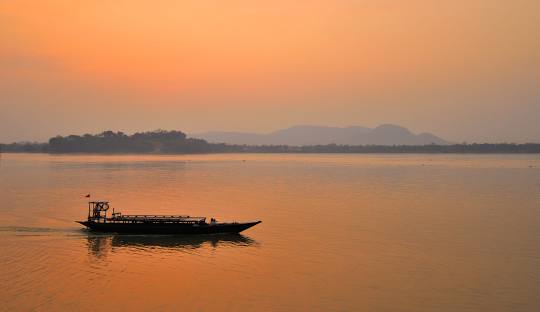
River of Life & Death – The Brahmaputra Story
The Brahmaputra River is not merely a watercourse but a living artery that flows through the heart of South Asia. It originates high in the icy reaches of the Angsi Glacier in Tibet, where it is called the Yarlung Tsangpo, and descends dramatically across the Himalayas to become the Brahmaputra in India. Its path is one of geological power and cultural significance, carving its way through Arunachal Pradesh, nourishing the fertile plains of Assam, and finally transforming into the Jamuna as it enters Bangladesh. There, it merges with the Ganges and Meghna rivers, forming one of the largest and most fertile deltas in the world, before draining into the Bay of Bengal. Spanning nearly 3,800 kilometers, the Brahmaputra is a transnational force of nature – flowing through Tibet (China), India, Bhutan, and Bangladesh – and sustaining a population of over 114 million people who rely on its waters for farming, fishing, transport, and spiritual life.
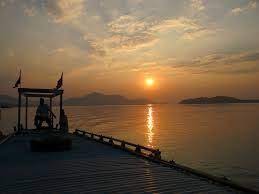
Geographically, the Brahmaputra is one of the most dynamic rivers on Earth. After flowing eastward across the Tibetan plateau, it plunges into India through the Great Bend, a region of violent tectonic energy and deep gorges near Namcha Barwa. Once in Arunachal Pradesh, the river is called the Siang or Dihang, and after meeting with the Lohit and Dibang rivers near Sadiya, it formally assumes the name Brahmaputra. It continues westward through Assam, carving a broad valley that has become a cradle of civilization and conflict alike. Upon entering Bangladesh, the river takes the name Jamuna and veers southward to meet the Padma (Ganges) and later the Meghna, forming a vast estuarine system before reaching the sea. The Brahmaputra basin, stretching over 580,000 square kilometers, is marked by intense rainfall, massive erosion, and some of the highest river discharges globally.
This river is an economic backbone for millions. In Assam, the Brahmaputra’s floodplains are referred to as the “rice bowl” of the Northeast, yielding paddy, jute, mustard, and vegetables. Seasonal floods replenish the soil, while irrigation systems tap the river’s waters during dry months. Fishing is another vital livelihood, with families depending on the rich aquatic life including carp, catfish, and freshwater prawns. The prized hilsa fish, common in Bangladesh, supports both local diets and regional markets. Moreover, the river serves as a vital artery of inland navigation. Barges, ferries, and traditional boats ply its waters, transporting tea, timber, and people. The Indian government has designated a major portion of the Brahmaputra as National Waterway-2, enhancing trade and connectivity. In Bangladesh, river ports like Chilmari and Aricha play key roles in regional commerce. Hydropower potential is immense, especially in Arunachal Pradesh and Tibet, where steep gradients and gushing flows are ideal for energy projects. However, large-scale dam building remains contentious, raising both ecological and geopolitical concerns.
Historically, the Brahmaputra has been at the center of regional identity and politics. In ancient times, it nurtured the Kamarupa Kingdom, with cities like Pragjyotishpura (now Guwahati) emerging as spiritual and administrative centers. The Ahom dynasty, which ruled Assam for over six centuries, built their power along this river, culminating in legendary events like the Battle of Saraighat (1671), where General Lachit Borphukan used river-based guerrilla warfare to defeat the Mughals. The river’s formidable breadth and shifting channels served as natural fortifications and trade routes. Kingdoms like Chutia and Koch also flourished along its banks, while in Tibet, the upper Brahmaputra flows near the historic Yarlung Valley – regarded as the cradle of Tibetan civilization. Thus, from the myths of Brahma’s son descending to Earth to the real battles fought on its waters, the Brahmaputra has always shaped the destiny of civilizations.
Culturally, the Brahmaputra occupies a revered place in the imagination of its people. Unlike most rivers in India, which are seen as goddesses, the Brahmaputra is uniquely considered a male river deity in Hindu mythology. Legends describe it as the son of Brahma, flowing down to cleanse sins. On its banks stands the Kamakhya Temple, one of the most powerful Shakti Peethas in India, where the river turns red during the Ambubachi Mela – symbolizing divine menstruation and fertility. In Guwahati, the Umananda Temple on Peacock Island celebrates Shiva in one of the smallest inhabited river islands in the world. In Assamese literature and folk music, the river is lovingly called “Borluit.” It has inspired songs of Bhupen Hazarika and countless poets who view it as both nurturer and destroyer. Across its length, festivals, folklore, and rituals have blossomed, testifying to its emotional and spiritual resonance.
Ecologically, the Brahmaputra River basin is a biodiversity hotspot of global importance. From the cloud forests of Arunachal to the mangroves of the Sundarbans, the river nourishes countless habitats. Its waters sustain endangered species like the Ganges river dolphin, greater one-horned rhinoceros, Asian elephant, and even the elusive clouded leopard. Protected areas such as Kaziranga National Park, Manas National Park, Dibru-Saikhowa, and parts of the Sundarbans lie within its basin. These sanctuaries are shaped by the river’s seasonal rhythm – floods that replenish wetlands, oxbow lakes that host migratory birds, and grasslands that feed massive herbivores. The river’s sediment-rich waters create new islands (chars) that evolve into complex micro-ecosystems. Seasonal visitors like bar-headed geese, ruddy shelducks, and Indian skimmers turn the Brahmaputra into a winter haven. This unique ecology is as fragile as it is abundant, dependent on the natural balance of sediment, flow, and temperature.
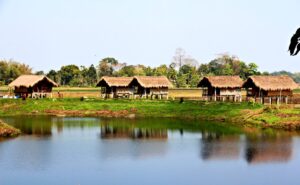
Yet, the Brahmaputra is also a river of destruction. Its floods are legendary – sudden, forceful, and far-reaching. Monsoon rains swell its volume to terrifying levels, inundating farmlands, homes, and towns. Erosion follows in its wake, swallowing villages and forcing communities to relocate again and again. Islands like Majuli, once the world’s largest river island, are shrinking rapidly. Climate change is making these challenges worse – glaciers feeding the river are melting, monsoon patterns are shifting, and sea-level rise threatens the delta. Sediment overload chokes the river’s channels, forcing it to change course unpredictably. Without robust flood management and sediment control, the river’s bounty can quickly turn into catastrophe.
The river’s geopolitical dimension adds further complexity. With its headwaters in China, the Brahmaputra has become a subject of regional tension. China has built and is planning more dams on the Yarlung Tsangpo, raising fears in India and Bangladesh about reduced water flow, potential diversion, and lack of data sharing. India, too, has proposed multiple hydropower projects in Arunachal, prompting concern from Bangladesh, which lies downstream. Unlike the Ganges, the Brahmaputra lacks a comprehensive water-sharing treaty among all stakeholders. Seasonal disputes over water levels, fears of upstream control, and the strategic nature of the river in border regions have made the Brahmaputra a focal point of diplomatic and environmental debate. Collaboration on flood forecasting, disaster management, and sustainable development is urgently needed but remains elusive due to larger political dynamics.
The threats to the Brahmaputra’s health go beyond floods and politics. Unregulated sand mining, pollution from urban runoff, deforestation in its upper catchments, and encroachments into floodplains are slowly degrading the river’s integrity. While it is still cleaner than the heavily industrialized Ganges or Yamuna, the Brahmaputra is showing early signs of ecological stress. Agricultural runoff leads to eutrophication; construction projects disrupt natural channels; and invasive species like water hyacinth are clogging its waterways. Biodiversity, once flourishing, is now at risk unless urgent conservation and basin-level management strategies are adopted.
In conclusion, the Brahmaputra is more than a river – it is a living force, a divine thread connecting cultures, ecosystems, and nations. It gives life to millions but also takes it away in floods. It is both sacred and strategic, vulnerable and mighty. As Asia’s population grows, as climate shocks worsen, and as upstream-downstream dynamics intensify, the need to respect and protect the Brahmaputra becomes ever more pressing. Only by acknowledging its complexity – not just as a water source but as a cradle of civilization and a guardian of biodiversity – can we hope to keep its flow both generous and just. The future of the Brahmaputra is not only a question of water management; it is a question of survival, of coexistence, and of our ability to harmonize with one of the greatest rivers on Earth.