

Why Zubeen Garg is More Than Just a Singer
On 18 November 1972, in the hill town of Tura, Meghalaya, a boy named Jibon Borthakur was born into an Assamese Brahmin family. He would grow up as Zubeen Garg—a stage surname he chose from his ancestral Brahmin gotra “Garg,” and a first name inspired by conductor Zubin Mehta. The family’s roots were in Jorhat, with older ties to Janji in Sivasagar, and because his father served in the Assam Civil Service, transfers meant the children lived across Assam. His father, Mohini Mohon Borthakur—known in literature as the poet-lyricist Kapil Thakur—balanced the discipline of a magistrate with the sensibility of a writer. His mother, the late Ily Borthakur, was a singer and dancer and, crucially, his first guru. That home, full of music, poetry, and rehearsal, was the real conservatory: the place where training began before any formal class.

He was not an only child. His younger sister, Palme Borthakur, became a Bharatanatyam dancer and an academic, while his elder sister, the popular singer-actor Jonkie Borthakur, was already a star in Assam. In 2002, Jonkie died in a car accident on her way to a performance. The loss was devastating. Zubeen’s response—as often happens with artists—was to compose; the album “Xixhu (Shishu)” in 2002 was his memorial to her, a way to bottle grief into melody.
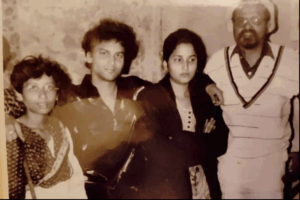
His schooling mirrored his father’s postings: Jorhat, Karimganj, Bijni, Tamulpur—names that map a young life spent learning Assam by living it. He completed high school in Jorhat, spent time at J.B. College, and enrolled for a B.Sc. at B. Borooah College in Guwahati. But in 1992 a turning point arrived: a western solo at a youth festival won him a gold medal and the clarity that his future was music, not labs. The truth is he’d started far earlier—singing at three, practicing tabla for eleven years under Guru Robin Banerjee, and learning Assamese folk under Guru Romoni (Ramani) Rai. At home, his mother drilled raga and rhythm until, as he once joked, “even my dog can sing in rhythm.” By his teens he was composing, picking up instruments—dhol, guitar, harmonium and many more—until a dozen came easily to hand.
The professional leap came in 1992 with his Assamese debut album “Anamika.” It didn’t just sell; it announced a sound—Western rock textures braided with Assamese folk and Indian classical phrasing. “Maya” (1994) and “Asha” (1995) followed, widening the audience. “Rong/Rang” (1995) and “Mukti” (1997) showed range: “Mukti” carried patriotic currents, while “Meghor Boron” and “Xabda” (both 1998) moved through folk, romance, and wistful moods. By decade’s end, he wasn’t just popular—he was shorthand for Assamese pop culture. People joked, only half joking, that Assam is famous for tea, the one-horned rhino, and Zubeen.
Ambition took him west to Mumbai in 1995. The late ’90s brought Indipop albums like “Chandni Raat” and “Yuhi Kabhi,” and early Hindi playback for films—songs in “Fiza” (2000), “Kaante” (2002). These weren’t yet the anthems to come, but they seeded networks and craft. Parallelly, he entered Bengali music, then other languages; over three decades he would sing in more than forty tongues and dialects, recording tens of thousands of tracks—a staggering, workmanlike output that only happens when studio days outnumber idle ones.
The national flashpoint was 2006. In “Gangster,” his song “Ya Ali” detonated across India—an ache-soaked vocal that turned him, overnight, into a name beyond the Northeast. Awards followed: the Global Indian Film Award for Best Male Playback, and major nominations at Filmfare, Zee Cine, and IIFA. He kept cutting Hindi songs—more than two hundred through the 2000s—while also releasing a Hindi pop album, “Zindagi,” in 2007. In Bengal, he voiced big melodies like “Mon Mane Na” and “Piya Re Piya Re,” becoming a familiar presence in Bengali cinema. Back in Assam, he never stopped releasing albums; the point wasn’t to choose a single industry but to belong to many.

Composing came naturally. He scored and co-produced the Assamese film “Dinabandhu” (2004), tied to a National Award for the film and a jury recognition for his contribution. In 2007 he won the 55th National Film Award for Best Music Direction (Non-Feature) for the documentary “Echoes of Silence.” These weren’t detours; they were proofs—that he could write musical architecture, not just sing atop it.
He also stepped in front of the camera. “Tumi Mur Mathu Mur” (2000) marked him as an actor, writer, director, and composer in one film—ambitious, perhaps reckless, but very Zubeen. In 2008, his role in “Mon Jaai” earned a Special Mention at the National Film Awards. He threaded through titles like “The Underworld,” “Rodor Sithi,” “Priyar Priyo,” and “Gaane Ki Aane,” toggling between drama and swagger. Cameos delighted fans: a “Mantra” performance in the Hindi film “Strings,” an on-screen “Ya Ali” in “Gangster,” and beloved walk-ins in Assamese hits like “Raamdhenu.” As a director-producer, he mounted “Mission China” (2017) and “Kanchanjangha” (2019). The latter took aim at corruption in public service exams—proof he wanted films to entertain and also say something. Plans for a Hindi directorial called “Dustbin” were in the air. In award circuits at home, “Mission China” bagged Best Actor and Best Film (as producer) in 2018; across years he stacked nominations as an actor, music director, and singer. He judged TV singing shows, anchored Assamese programming, and published poetry, winning the Seuji-Seuji Award in 2007. “Renaissance man” is overused; here, it fits.
The catalogue is too vast to read out, but a few milestones sketch the arc: “Anamika” (1992); “Maya” and “Asha” (’94–’95); “Rong,” “Mukti,” “Meghor Boron,” “Xabda,” “Snigdha Junak” (’95–’98); “Pakhi” (1999), a tribute to his mother; “Sparsh” (2000); “Xixhu/Shishu” (2002), in memory of Jonkie; “Jantra” (2004); “Mukha” (2006); “Rumaal” (2008); then a 2010s run—“Baahi,” “Runjun,” “Rock,” “Prem,” “Pakeeza,” “Nahor,” “Path,” with later titles like “Maa” (2019) and “Silaa” (2020). The notes matter: some albums are elegies, some experiments; many fold in Borgeet and folk idioms, reminding listeners that modernity in Assam can carry its own past with grace. In Hindi cinema, “Ya Ali” remains the unmatched national calling card; in other languages, songs like the Bengali “O Bondhure” widened the map.
Recognition mirrored the output. The National Award for “Echoes of Silence” sits alongside earlier National nods around “Dinabandhu.” “Ya Ali” brought the GIFA trophy and mainstream nominations. Closer home, Prag Cine Awards repeatedly cited his playback, acting, and production; cultural honors like the Purushottam Das Award acknowledged his standing beyond box office. In life he sometimes declined state decorations, arguing younger artists deserved the spotlight. In death he received a state funeral, an irony he might have smiled at.
But the ledger is incomplete if we list only songs and statues. He used fame as a tool. Through the Kalaguru Artiste Foundation he directed money and attention to floods, medical emergencies, and daily crises—sometimes headlining benefit shows, sometimes just paying fees or bills quietly. In the worst COVID months he turned his own Guwahati house into a care center; the gesture was simple and radical at once. He and his wife, designer-filmmaker Garima Saikia, did not have biological children; instead they took responsibility for fifteen underprivileged kids—

rescuing some from abusive situations, funding education, making a family from the people who needed one. He loved animals, opposed cruel rituals, planted trees, and dreamed aloud of an open-air studio by the Brahmaputra where songs would sound like the river they rose from.
He spoke, too. In 2019–20 he became a major cultural voice against the Citizenship Amendment Act in Assam—organizing, singing, addressing protests with a line that stuck: “Politics nokoriba, bondhu”—don’t play politics, friend. He could be blunt, even explosive. Sometimes that courage veered into controversy: a remark about replacing the state anthem drew fierce backlash; a toy gun on stage sparked headlines; an Independence Day flag-etiquette complaint became an FIR; a slap to a teenager split opinion on discipline versus violence; a spat with a newspaper escalated into counter-complaints; an ill-phrased line about Brahmins led to a public apology; a friendly hug with the Chief Minister during anti-CAA days confused supporters until he clarified courtesy isn’t consent. And years earlier, defying ULFA diktats against Hindi songs at Bihu functions, he kept singing anyway—an act that risked personal safety and cemented his image as fearless. These incidents don’t erase the art; they reveal the man: impulsive, principled, occasionally undiplomatic, often generous—human in full, not a cardboard saint.
In 2002 grief carved a hollow; in July 2022, health did. He fell in a Dibrugarh resort bathroom after dizziness and suffered a head injury; doctors attributed it to an epileptic seizure. The state arranged an air ambulance; he stabilized, then—against the grain of medical caution—returned to the stage because that’s where he felt most alive. He had a history of mild seizures; those close to him watched more closely thereafter.
On 19 September 2025, in Singapore for the North East India Festival, he took a day off on a yacht with friends and bandmates. He went into the water—some called it a swim, others a scuba session—felt breathless, and did not surface properly. Rescuers pulled him out, performed CPR, and rushed him to Singapore General Hospital. By about 2:30 PM IST, he was gone. The autopsy said “drowning,” likely precipitated by a seizure or related health event. Assam erupted in grief, and grief, as it does, brought questions. The government ordered a second post-mortem in Guwahati; forensic experts, including AIIMS doctors, reaffirmed the cause. Police opened inquiries; organizers and associates were questioned; conspiracy rumors swelled and ebbed online. What remained constant was the sense of a hole punched through the heart of a state.
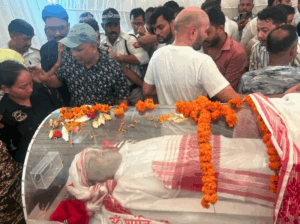
The farewell felt like a national festival tilted toward mourning. Assam declared three days of official mourning. Public events paused; liquor shops shuttered. His body, draped in the red-and-white gamosa, lay for public homage at the Sarusajai complex as crowds flowed through the night. He was cremated with state honors on 23 September at his Kamarkuchi estate; his sister Palme lit the pyre; Garima stood beside the fire with a family now larger than blood. Streets dimmed, candles bloomed, murals appeared, playlists trended. Colleagues—Pritam, Shaan, Papon, Vishal Dadlani—sent words and then themselves, because some respects are better paid in person. An old podcast clip resurfaced, where he’d said, half prophecy, half pride, “If I die here in Assam, the state will shut for seven days.” It wasn’t seven, not exactly, but time did slow to the pace of a funeral march.
His widow pledged to continue the foundation’s work and the care of the children they had taken in. Fans and institutions discussed archives, a museum wing at Srimanta Sankaradeva Kalakshetra, an award in his name, a statue, a street. In Jorhat, voices rose for a memorial. These are gestures of stone and plaque; the living memorial is the music. For many, he did what Bhupen Hazarika did for an earlier generation—brought young people back to their own culture by modernizing it without stripping its soul. He proved that a singer from the Northeast could be a national voice without abandoning home. He kept the “pure taste of Assamese music” on the tongue in a globalized world. He also gave courage: if he could say things loudly, perhaps others could, too.
He left behind lines that fans repeat like talismans. The playful boast—Assam is famous for tea, rhinos, and Zubeen—was less vanity than shorthand for how deeply he’d sunk into public memory. “I live like a king, and a king should not leave his kingdom,” he said, explaining why Assam remained base even when Mumbai beckoned. “I have no caste, no religion… I am Kanchenjunga,” he declared, taking a mountain as a metaphor for standing above narrow labels. And then the eerie one about Assam shutting for seven days—part bravado, part truth about how thoroughly he belonged to his people.
This is the shape of the story: a child of an artistic household; a teenager who chose studios over science; a singer who made languages porous; a composer who could scaffold feeling; an actor-director who chased bigger canvases; a philanthropist who treated fame as currency to be spent on others; a citizen who spoke, sometimes messily, almost always from the gut. If you listen closely, you can still hear him: in a Bihu night, in a protest chorus, in a hospital ward that needed beds, in a child who needed a family, and above all in the songs—so many songs—that keep his voice moving, river-like, through Assam and far beyond.