
Everything You Need to Know About Rajbongshi Kali Worship on Diwali
Introduction:
Across the Indian subcontinent and its global diaspora, the festival of Diwali, or Deepavali, illuminates the autumn night, symbolizing the universal triumph of light over darkness, good over evil, and knowledge over ignorance. It is a five-day celebration characterized by the lighting of earthen lamps (diyas), fireworks, family feasts, and the exchange of sweets. Yet, beneath this shared canopy of light, lies a profound theological divergence. In North and West India, the central ritual of Diwali night, performed on the Kartik Amavasya (the new moon of the Hindu month of Kartik), is Lakshmi Puja—the veneration of the goddess of wealth and prosperity. Devotees meticulously clean and decorate their homes, lighting lamps to welcome the golden-footed goddess, seeking her blessings for a fortunate year ahead.
In stark contrast, for the Hindus of Eastern India—including West Bengal, Odisha, Assam, and Bangladesh—this same dark night is dedicated to the worship of a vastly different deity: Kali, the formidable goddess of power (Shakti), destruction, and liberation. Here, the focus shifts from the gentle invitation of prosperity to the potent propitiation of divine power and the fierce annihilation of evil.
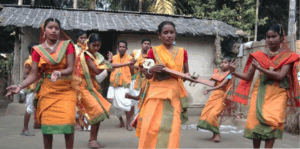
The Koch Rajbanshi people, an indigenous community whose ancestral lands span this very region of North Bengal and Lower Assam, present a compelling case study for understanding the deep-rooted historical, cultural, and cosmological reasons behind this choice. Their celebration of Diwali is not merely a regional variation but a profound expression of a unique syncretic identity, one forged at the confluence of tribal animism and Brahmanical Hinduism, royal history and social marginalization. This report argues that the Koch Rajbanshi focus on Kali Puja during Diwali is not an arbitrary substitution of one goddess for another. Rather, it is the culmination of their distinct socio-historical trajectory, a worldview that prioritizes protection from malevolent forces, and a sophisticated theological system that assigns distinct temporal and cosmic domains to different deities. Their choice is not “Kali instead of Lakshmi,” but a deliberate affirmation that the darkest night of the year is the appropriate time to engage with the divine as a force of formidable power, while the worship of prosperity is reserved for a different, more auspicious occasion.
The Pan-Indian Diwali Paradigm: The Veneration of Lakshmi
To comprehend the distinctiveness of the Koch Rajbanshi celebration, one must first understand the mainstream paradigm from which it diverges. For a vast number of Hindus, particularly in North and West India, Diwali is intrinsically linked with Lakshmi Puja. This ritual, performed on the third and most significant day of the five-day festival, is entirely devoted to the propitiation of Lakshmi, the goddess of wealth, fortune, prosperity, and the supreme goddess of the Vaishnavism tradition.
The theological premise of the ritual is that on the night of the Kartik Amavasya, Goddess Lakshmi roams the earth, seeking clean, well-lit, and welcoming homes to enter and bless with abundance for the year to come. Consequently, the preparations are meticulous. In the days leading up to the festival, devotees undertake a thorough cleaning, repairing, and decorating of their homes and businesses, making them suitable for a divine visit. Entrances are adorned with colorful rangoli designs, and small footprints are often drawn with rice flour and vermilion powder, symbolically guiding the goddess’s path into the home.
The mythological foundations of this celebration are deeply rooted in Vaishnava narratives. The most widely cited story is the return of Lord Rama, an avatar of Vishnu and Lakshmi’s divine consort, to his kingdom of Ayodhya after a 14-year exile and his victory over the demon king Ravana. The people of Ayodhya are said to have lit rows of earthen lamps (diyas) to illuminate his path and celebrate his return, a practice that continues to define the festival. Another prominent legend associated with Diwali is Lord Krishna’s defeat of the demon Narakasura, which freed 16,000 captive women and restored order to the world. Before his death, Narakasura requested a boon that his death be celebrated with colorful lights, a tradition observed as Naraka Chaturdashi, the day preceding the main Diwali puja. Both narratives underscore the festival’s core theme: the victory of righteousness (dharma) over evil (adharma).
The puja itself is a complex affair. It often involves the combined worship of five deities: Ganesha, the remover of obstacles, who is invoked at the start of any auspicious act; Goddess Lakshmi in her three forms of Mahalakshmi (wealth), Mahasaraswati (knowledge), and Mahakali (power); and Lord Kuber, the treasurer of the gods. An idol of the goddess is placed on a raised platform, bathed with panchamrita (a mixture of milk, curd, ghee, honey, and sugar), and adorned with finery. Offerings of sweets, puffed rice (murmura), batasha (sugar candy), fruits, and flowers, especially the lotus and marigold, are made amidst the chanting of Vedic mantras. As dusk falls, lamps are lit throughout the house, their twinkling lights piercing the darkness of the new moon night, creating a path for Lakshmi to find her way.
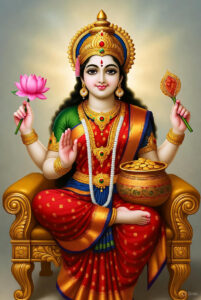
Beyond its spiritual dimensions, Lakshmi Puja on Diwali has a significant socio-economic aspect. The festival marks the end of the harvest season for many, making it a natural time to honor the goddess of prosperity. For the mercantile communities of West India, it marks the beginning of a new financial year, with the tradition of closing old account books and opening new ones, a practice known as Chopda Pujan. The days leading up to Diwali, particularly Dhanteras, are considered highly auspicious for purchasing gold, silver, and new utensils, acts believed to attract further wealth and good fortune. This intricate tapestry of myth, ritual, and commerce forms the dominant understanding of Diwali—a festival where light vanquishes darkness and the home is prepared for the arrival of material and spiritual prosperity embodied by Goddess Lakshmi.
The Koch Rajbanshi: A People Between Tribal Origins and Caste Aspirations
The cultural soil in which the Koch Rajbanshi celebration of Diwali is rooted is profoundly different from that of the northern and western plains. To understand their choice of deity requires an ethnographic journey into their complex and layered identity, a history marked by the transition from an indigenous tribal group to the rulers of a powerful kingdom, followed by a deliberate and strategic movement of social upliftment within the Hindu caste hierarchy.
The Koch Rajbanshi are an indigenous community of the Mongoloid racial stock, historically inhabiting the ancient kingdom of Kamarupa, which encompassed present-day North Bengal, Lower Assam, and parts of neighboring Bihar, Nepal, and Bangladesh. Ethnically, they are closely related to other Tibeto-Burman speaking groups of the region, such as the Bodo, Garo, and Mech peoples. For centuries, they existed as a collection of independent tribes, practicing slash-and-burn cultivation and living in close communion with nature.
This changed dramatically in the early 16th century. A charismatic tribal leader named Bisu, born of a Mech father and a Koch mother, successfully united the disparate tribes, defeated the ruling confederacy of local chieftains (Baro-Bhuyans), and established the formidable Koch Dynasty in 1515. Upon his coronation, he adopted the Hindu name Biswa Singha and became a great patron of Hinduism, initiating a process of cultural and religious transformation. The kingdom he founded, known as the Kamata Kingdom, became a major power in eastern India, reaching its zenith under his sons, Naranarayan and Chilarai. This period of sovereignty and royal power became the foundational memory for the community’s later social aspirations.
Centuries later, following the decline of their kingdom and under the socio-political pressures of British colonial rule and the surrounding caste Hindu society, the community found itself in a marginalized position. Caste Hindus often referred to them with the pejorative term mleccha (barbarian), subjecting them to ill-treatment and humiliation. In response, a powerful social movement for upliftment began in the late 19th century. Seeking to dissociate from their “tribal” identity and acquire a higher status within the Hindu varna system, a large section of the Koch people adopted a new name: “Rajbanshi,” literally meaning “of royal lineage”. This neologism was a direct claim of connection to the glorious Koch kings, who had styled themselves as Shiva-banshi (descendants of Shiva) or Rajbanshi.
This movement of Sanskritization was not merely nominal. Under the leadership of figures like Panchanan Barma, lakhs of people claimed the status of Bhanga Kshatriya (“broken” or provincial warriors) and later Rajbanshi Kshatriya, asserting their place as part of the Hindu warrior caste. This involved the mass adoption of Brahmanical customs: wearing the sacred thread (Upanayana), adopting gotra names, and abandoning practices deemed non-Hindu, such as the rearing of pigs and consumption of liquor. This transformation was so successful that while the community was recorded as “Koch” in official censuses until 1901, they successfully lobbied to be recognized as “Rajbanshi Kshatriya” thereafter.
This deliberate choice of a Kshatriya identity is of paramount importance. It was not an arbitrary selection but a conscious alignment with the martial and royal ethos of their ancestors. The Kshatriya dharma is centered on power, governance, protection of the people, and righteous warfare. This self-conception as a community of royal and martial heritage creates a powerful ideological resonance with deities who embody these very qualities. The fierce, demon-slaying, and protective goddess Kali aligns perfectly with this claimed Kshatriya identity. In contrast, Goddess Lakshmi, while universally revered, is primarily associated with wealth, commerce, and fortune—themes more closely aligned with the Vaishya (merchant) varna. Thus, the very foundation of the Rajbanshi social identity movement predisposed the community towards a theological framework where a goddess of power would hold a place of particular significance. This historical journey did not erase their indigenous roots but rather layered a Sanskritic identity atop them, creating a unique cultural synthesis that continues to define them today, as reflected in their varied official statuses as Scheduled Caste (SC), Scheduled Tribe (ST), or Other Backward Classes (OBC) in different states.
The Syncretic Cosmos of the Koch Rajbanshi
The religious world of the Koch Rajbanshi is not a simple monolith of adopted Hinduism. It is a vibrant and complex tapestry woven from threads of ancient animistic belief, indigenous deities, and the powerful currents of Shaivism and Shaktism that have long characterized the religious landscape of eastern India. Their Hinduism is a syncretic creation, one that has absorbed and reinterpreted Brahmanical deities through the lens of a pre-existing tribal cosmology. Understanding this cosmos is key to understanding the cultural logic behind their celebration of Kali Puja.
The foundational layer of their belief system is animism—the conviction that natural objects, phenomena, and the universe itself possess a spiritual essence. Primitively, the Koch were animists who lived in close proximity to nature, worshipping it with profound devotion. This legacy endures in their worship of gods based on natural forces like water, rain (Hudum Deo), and the forest, and in their belief in a world populated by a host of spirits and demigods, both benevolent and malevolent, known as Deo or Pattani.
When the Koch began to adopt Hinduism under their kings, they were drawn not primarily to the Vaishnavism prevalent in other parts of India, but to the Tantrik-Shaivism and Shaktism that resonated with their existing beliefs. This resulted in a pantheon where pan-Indian gods coexist with powerful local deities.
A crucial framework for understanding this pantheon is a functional duality. The Koch belief system can be broadly divided into two categories: rituals and deities that encourage ‘growth’ and fertility, and those that focus on the ‘restriction’ of negative elements and provide protection. While ‘growth’ deities like Hudum Deo (the rain god) are celebrated, a significant portion of their ritual life is dedicated to the propitiation of powerful, often fearsome, protective deities who ward off evil, disease, and misfortune.
The Primacy of Shakti: Kali and the Koch Rajbanshi Worldview
The deep resonance between the Koch Rajbanshi cosmology and the goddess Kali is not merely a matter of thematic similarity; it is manifested in direct mythological links and central ritual practices. The community’s veneration of Kali is not just an adoption of a Puranic goddess but a dynamic process of theological translation, where indigenous beliefs are integrated into and elevated by a Sanskritic framework. This is most evident in the remarkable relationship between the indigenous spirit Mashan and Goddess Kali, and in the centrality of Kali in the community’s most significant folk rituals.
The Mashan-Kali Nexus: Sanskritizing a Spirit of Fear
The most compelling evidence for Kali’s deep integration into the Koch Rajbanshi worldview lies in her connection to Mashan, the most powerful and feared evil spirit in their society. Mashan is a demigod of the shamshan (cremation ground), a terrible-looking entity with a huge body, wide eyes, and shaggy hair, who is believed to cause disease, possess people, and bring death. He is worshipped not out of devotion but out of fear, in a propitiatory manner to ward off his malevolent influence and ensure the well-being of the family and land.
This indigenous spirit of the cremation ground finds a powerful and direct parallel in Goddess Kali. In Shakta and Tantric traditions, Kali’s domain is also the cremation ground. Her fiercest forms, such as Shamshan Kali (Kali of the Cremation Ground), dwell there amidst ghosts and spirits, symbolizing her absolute dominion over death, time, and dissolution. She is the ultimate reality that presides over the transformation of life into death and back again.
The connection is not merely symbolic; it is cemented in local mythology. In a stunning act of syncretism, myths prevalent in North Bengal—the heartland of the Rajbanshi—explicitly state that Mashan is the child of Maa Kali and Dharmaraja, or that various Mashans were born from the drops of sweat that fell from Kali’s body as she danced in ecstasy. The taxonomy of spirits even includes a specific type known as Kalir Mashan (Kali’s Mashan). This mythological link is a classic example of how a powerful local deity is absorbed into the family of a major Puranic god, thereby granting the local belief a place and legitimacy within the “great tradition” of Hinduism.
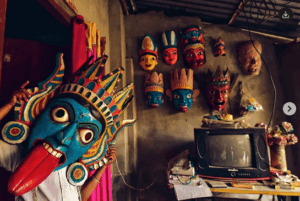
This theological fusion is performed and made tangible in the community’s ritual life. The Gomira dance, a ritualistic masked performance also known as Mukha Nach, is central to Rajbanshi folk religion. It is performed to appease village deities and ward off evil forces. Significantly, the repertoire of sacred wooden masks used in this dance includes those of Samsan Kali and, explicitly, Masan Kali. In some instances, the dance is performed at a Masan Kali Mela (fair), ritually demonstrating that for the community, the two are inextricably linked.
This Mashan-Kali nexus represents a masterful act of cultural negotiation and theological translation. During their Sanskritization movement, the Koch Rajbanshi were faced with the challenge of reconciling their “tribal” beliefs with the Brahmanical Hinduism they sought to adopt. By identifying their most potent and feared indigenous spirit with the pan-Indian Mahadevi (Great Goddess) Kali, they achieved two goals simultaneously. First, they validated their ancestral worldview, affirming that the power they had always revered as Mashan was real and potent. Second, they legitimized this belief within a Sanskritic framework, worshipping that same power in its supreme, “higher” form as Kali. Therefore, when the Koch Rajbanshi worship Kali, particularly in her fierce, cremation-ground forms, they are not abandoning their indigenous beliefs; they are performing their adopted Hindu identity while simultaneously venerating a power that has been central to their cosmos for centuries.
Ritual Expressions of Kali Worship
Beyond the implicit theology of the Mashan-Kali nexus, the goddess’s primacy is explicitly demonstrated in major Koch Rajbanshi community rituals that are not directly related to Diwali.
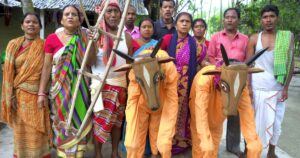
One of the most significant of these is the Baas Puja (Bamboo Worship). This is a major ceremony performed for the general welfare, health, and prosperity of the entire village. The ritual involves decorating long bamboo poles with colored cloth and tufts of animal hair, which are then held by young men called Basuwa who dance in a magnificent festive aura. The central deities worshipped in this puja are explicitly identified as either Lord Shiva or his consort, Goddess Kali. The ceremony uses masks of Sardar Baba (a form of Shiva) and Maa Kali and requires the ritual sacrifice of a goat, pigeons, and a hen—offerings characteristic of Shakta worship. Some sources note that in certain regions, the Baas Puja is understood and celebrated directly as a form of Shakti Puja or Kali Puja.
The aforementioned Mukha Nach or Gomira dance provides further evidence. This powerful, non-verbal performance is a ritual aimed at appeasing the principal village deity, often identified as Devi Chandi or Adi Shakti (primordial power)—both names for the Great Goddess in her various manifestations—to ensure her blessings for cultivation and to drive away evil forces. The dance, which can involve acrobatic feats, often narrates mythological stories through the movements of the masked performers. As noted, the masks frequently represent fearsome forms of the goddess, such as Kali, Chamunda, and Narasinghi (a lion-headed feminine form). The performance of this dance is a core part of other rituals, such as the Rekkha Kali Puja (Protective Kali Puja), directly linking this ancient folk art to the explicit worship of Kali.
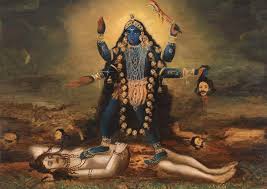
The centrality of Kali in these foundational community rituals, which are concerned with the fundamental well-being and protection of the village, demonstrates that her role in the Koch Rajbanshi worldview is not limited to a single festival night. She is a primary deity whose power is invoked for the most critical aspects of community life.
Reinterpreting Diwali: From ‘Garuwasi Pabni’ to Kali Puja
Synthesizing the historical, cultural, and cosmological threads, the Koch Rajbanshi celebration of Kali Puja on Diwali emerges as a deeply logical and coherent expression of their identity. For them, the darkest night of the year, the Kartik Amavasya, is not primarily a time for welcoming material wealth, but a potent moment for a necessary and powerful engagement with the divine forces of destruction, protection, and transformation embodied by Kali.
The very name of the festival in the Rajbanshi language suggests a distinct conceptualization. Alongside the pan-Indian terms Diwali and Dipawali, the festival is also known by indigenous names such as Garuwasi or Garuwasi Pabni. The use of a local vernacular term points to a tradition that, while part of the broader Diwali complex, has its own unique history and cultural significance, rather than being a simple import.
The timing of the festival on the Amavasya is theologically critical. While in Vaishnava traditions the darkness of the new moon is something to be overcome by the light of diyas welcoming Lakshmi, in Shakta and Tantric thought, the Amavasya is the most powerful and auspicious time for the worship of Kali. It is a time of immense spiritual potency, when the veil between worlds is thin. It is a night for confronting darkness, not merely dispelling it; for acknowledging the power of dissolution as a prerequisite for creation. By dedicating this night to Kali, the Koch Rajbanshi align themselves with a theological tradition that sees the darkest night not as a void to be filled with light, but as the very source of power and the appropriate setting for the worship of the Dark Mother.
Furthermore, the universal Diwali theme of the victory of good over evil resonates far more directly with Kali’s primary function than with Lakshmi’s. For a community whose cosmology is so deeply concerned with protection from malevolent spirits like Mashan and Deo, the deity who most actively and violently enacts this victory is Kali, the slayer of demons like Raktabija and Shumbha-Nishumbha. The popular Diwali story of Krishna’s defeat of the demon Narakasura is a narrative of divine intervention to destroy a tyrannical evil—a perfect mythological parallel to Kali’s cosmic role. She is the ultimate protector, and propitiating her on this night is a powerful ritual act to ensure the community’s safety from all negative forces.
The final and most definitive piece of evidence for this deliberate theological choice is the existence of a separate and distinct festival for the worship of Lakshmi. In Bengal, Assam, and Odisha, the primary celebration of the goddess of wealth is the Kojagari Lakshmi Puja, also known as Kojagori Lokkhi Pujo. This festival takes place not on the dark Amavasya of Kartik, but on the bright, auspicious full moon night (Purnima) of the preceding month, Ashwin, five days after the conclusion of Durga Puja. This is a harvest festival, celebrated when the moon is believed to be showering the earth with nectar (Amrit Varsha), and it is dedicated to abundance, prosperity, and household well-being. The name Kojagari derives from the Sanskrit Ko Jagarti? (“Who is awake?”), as it is believed Lakshmi descends to bless those who are keeping a vigil for her on this sacred night.
The Koch Rajbanshi cultural sphere, therefore, has not rejected Lakshmi; it has honored her with her own dedicated festival on a night thematically suited to her nature—the brilliant, benevolent full moon. This temporal separation constitutes a clear theological statement: the bright Purnima is for Lakshmi and the celebration of growth and prosperity. The dark Amavasya is for Kali and the propitiation of power and protection. Their Diwali is different because their calendar and their cosmos make a clear distinction between the goddess you invite into your home and the goddess you invoke to destroy the demons lurking in the dark.