
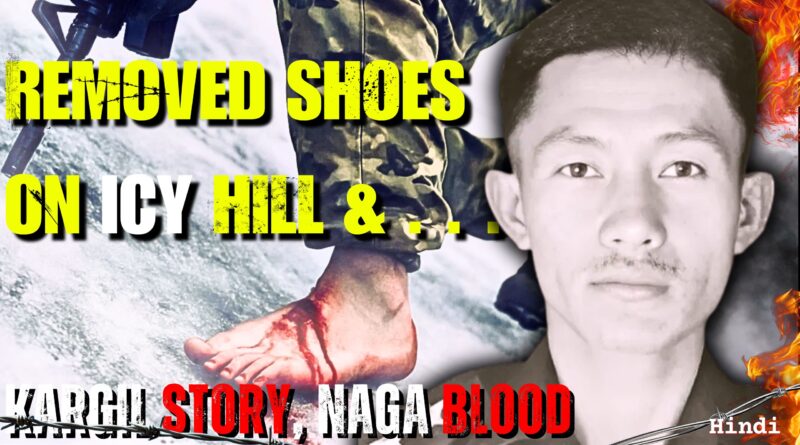
“Nimbu Saab”- Story of Captain Neikezhakuo Kenguruse
India’s military history is filled with countless tales of extraordinary courage. But among those legends, some rise above even the bravest—stories so selfless and surreal, they feel almost mythical. The story of Captain Neikezhakuo Kenguruse, fondly known as “Nimbu Saab” by his men, is one such tale. It begins in the peaceful hills of Nagaland, is forged on the icy cliffs of Kargil, and now echoes in the hearts of millions.
A Son of the Hills
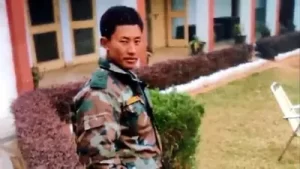
Born on 1st July 1974 in Nerhema village, nestled in Nagaland’s Kohima district, Neikezhakuo grew up in a simple, close-knit community. Surrounded by nature, he was raised on values of discipline, humility, and service. His father, a schoolteacher, instilled in him a love for education. Neikezhakuo excelled in both academics and extracurricular pursuits.
He completed his schooling at St. Xavier School, Jalukie, and later earned a degree in History from Kohima Science College, Jotsoma. Before joining the Army, he briefly served as a teacher at Government High School, Kohima—a quiet reflection of his commitment to his roots. But a greater calling stirred within him—a calling to serve not just his village, but his nation.
Becoming a Warrior
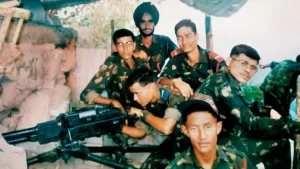
In 1996, Neikezhakuo joined the Indian Military Academy (IMA) in Dehradun. Two years later, in December 1998, he was commissioned into the 2nd Battalion of the Rajputana Rifles, one of the most decorated infantry regiments in the Indian Army.
As an officer, he quickly gained the respect of his men. Calm, thoughtful, yet fiercely courageous, he led by example. During high-altitude postings, he would distribute lemon powder to his troops to keep them hydrated—a simple act that earned him the affectionate nickname: “Nimbu Saab.”
The Call of Kargil
Barely six months after his commissioning, war broke out. In the summer of 1999, Pakistani soldiers and infiltrators occupied Indian peaks in the Kargil sector of Jammu & Kashmir, sparking one of the most intense high-altitude conflicts in modern military history.
Captain Kenguruse was deployed to the Drass sector, one of the most heavily defended and fiercely contested zones. There, he was assigned a mission of unimaginable danger: lead a Ghatak Platoon, an elite assault team, to capture a strategic peak at an altitude of 16,000 feet.
The task was perilous. The enemy had fortified the summit with three machine gun bunkers, giving them height, visibility, and lethal advantage. The terrain was punishing—steep, icy, and near-vertical. And to make matters worse, Captain Kenguruse was already suffering from a leg injury sustained in an earlier operation.
Yet, when volunteers were called for this mission, he stepped forward without hesitation.
The Barefoot Climb into Legend
On the night of 28 June 1999, under freezing winds and faint moonlight, Captain Kenguruse led his platoon up the cliff face. The higher they climbed, the more treacherous it became. As they neared the final ascent—just below the enemy position—their rubber-soled boots began slipping on the frost-coated rocks.
At this critical moment, Captain Kenguruse made a decision that would echo through history. He removed his boots.
Injured, barefoot, and bleeding, he began climbing the near-vertical, jagged cliff with nothing but his bare hands and feet, carrying grenades, a khukri, and his rifle. Every step scraped his skin. His toes froze. His breath fogged the air. But he didn’t stop.
He scaled the cliff like a shadow in the night—silent, swift, and unrelenting. Most men wouldn’t have made it. But Captain Kenguruse wasn’t climbing for glory. He was climbing for India.
The Hand-to-Hand Battle
Upon reaching the summit, he was face-to-face with the first enemy bunker. Without a second’s delay, he hurled a grenade into it, instantly neutralizing the position.
But the danger was far from over. More enemy soldiers emerged from the adjacent bunkers, opening fire and charging forward. Captain Kenguruse charged right back.
He unsheathed his khukri, the traditional curved blade used in close combat. In the pitch dark, amid the snow and smoke, he engaged in fierce hand-to-hand combat, his blade flashing between shouts and gunfire.
He killed two enemy soldiers with his khukri, slicing through their defense with brutal precision and unmatched resolve. These soldiers had every advantage—numbers, cover, position. But they didn’t have his courage.
A third soldier, advancing with a rifle, was taken down by Captain Kenguruse’s gunfire, even as his body ached with exhaustion and blood loss. His solo assault had broken the enemy line. His platoon, inspired and unblocked, surged up the cliff behind him and secured the peak.
The Final Bullet
But just as he turned to coordinate the final mop-up, a Pakistani sniper’s bullet struck him in the head. Captain Neikezhakuo Kenguruse collapsed instantly—atop the very peak he had just won, the summit soaked in blood and victory. He had completed the mission. The enemy was defeated. The Indian flag would rise. But he would never return.
Legacy Etched in Stone
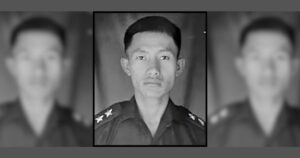
For his extraordinary bravery, Captain Kenguruse was posthumously awarded the Maha Vir Chakra, India’s second-highest wartime gallantry award. The official citation recognized his “supreme sacrifice and indomitable courage”, but even those words feel inadequate in describing the scale of what he achieved.
He is remembered not just as a soldier but as a symbol of India’s unity in diversity—a Naga warrior, fighting and falling for his country in the icy north.
In 2018, the Captain Kenguruse Memorial Football Ground was inaugurated in Kohima in his honor—a living tribute where the youth of Nagaland now play beneath his name. His story is taught in military academies, told in Nagaland schools, and echoed at every Kargil memorial.
A Naga Son, An Indian Legend

Captain Neikezhakuo Kenguruse’s life is not just a tale of war. It is the story of limitless courage, of a young man from a quiet village who climbed into history—barefoot, bleeding, and blazing with bravery.
He reminds us that real heroes do not wear capes. They wear conviction. He reminds us that in the face of death, a true soldier thinks not of retreat, but of duty.
Today, as the cold winds whisper through the cliffs of Drass, and as children in Nagaland grow up hearing his name, the legend of “Nimbu Saab” lives on. Not just in medals or statues—but in every Indian heart that beats for sacrifice, unity, and service.