
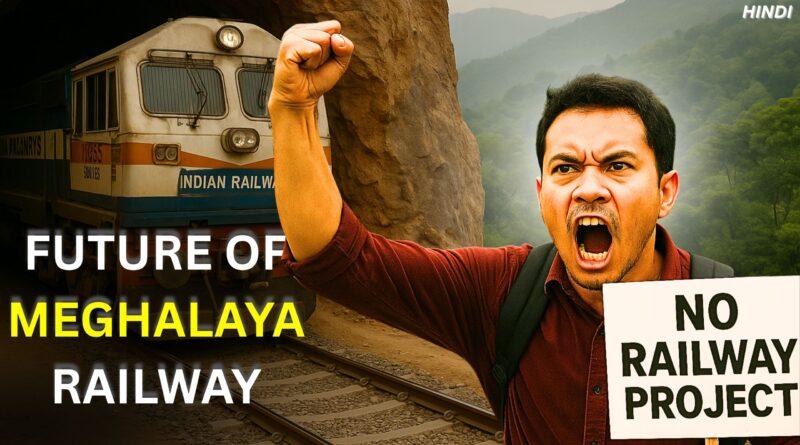
Meghalaya’s Railway Dilemma: Can Development Arrive Without Eroding Identity?
The Government of India is pushing forward with an ambitious plan: to connect all Eight Northeastern states by rail by 2030. While many welcome this as a long-overdue step toward inclusion and development, Meghalaya has raised a red flag.
In the heart of Northeast India lies Meghalaya — a land of clouds, forests, and fiercely proud indigenous communities. It’s a state where culture runs deeper than rivers, and identity is not just personal — it’s collective. But today, a quiet tension grips these hills.
Protests have erupted, led by the Khasi Students’ Union. They argue that without protective legal frameworks, the introduction of railway lines will flood the state with outsiders, threaten local customs, and erode tribal land rights. On the other hand, railway supporters point to immense benefits — cheaper goods, better healthcare access, tourism growth, and agricultural expansion.
This is not a simple story of for and against. It’s a complex negotiation between progress and preservation… development and dignity. And the question that lingers through the hills of Meghalaya is this — can trains roll in without rolling over what makes this land so unique?
The Debate on Tracks: Shillong at a Crossroads
Shillong, the hill-station capital of Meghalaya, has always been a place of clouds, calm, and culture. But today, a different kind of fog has settled over these pine-covered hills — a fog of debate. One question runs through drawing rooms, student assemblies, and government offices alike: Should Meghalaya be connected to the Indian railway network?
At first glance, the answer might seem obvious. Trains bring development. They bring opportunity. They reduce isolation, cut travel time, and open up entire regions to trade and tourism. For decades, the people of Meghalaya have faced challenges due to lack of railway infrastructure. Goods cost more here. Students travel for hours to reach Guwahati. Patients are forced to rely on crowded buses for treatment in other states. In a land where even basic commodities must travel long, winding roads, a railway line promises relief — faster transport, cheaper logistics, better access to education, healthcare, and markets.
In rural areas, where farmers grow oranges, betel leaves, turmeric, and pineapples, the train could be a lifeline — connecting their produce directly to markets across Assam and Bengal. In towns like Nongpoh and Byrnihat, small businesses could expand, tourism could boom, and local employment could rise. The state could finally plug itself into India’s economic highway.
The Indian government certainly believes so. Under its Act East Policy, it has set a target: by 2030, all eight northeastern states should be connected to the Indian railway network. And progress has been impressive. Arunachal Pradesh got its rail link in 2015. In Manipur, trains reached Khongsang in 2022, and the line to Imphal is under construction. Mizoram’s Bairabi to Sairang line, connecting Aizawl, was completed in 2024. Nagaland’s Dimapur-Zubza project is moving steadily. Tripura has functional broad-gauge lines up to Sabroom. Assam is the best connected of them all.
Meghalaya, however, remains a noticeable gap on that map. Apart from a small station in Mendipathar in the North Garo Hills — operational since 2014 — the rest of the state remains cut off. The much-discussed Tetelia–Byrnihat–Shillong line, meant to bring the railway to the capital city, has remained stuck due to local opposition.
The Voices of Opposition: Fear of Demographic Shift
And that opposition isn’t small. It’s loud. It’s organised. And it’s deeply emotional.
Leading the resistance is the Khasi Students’ Union — one of the most influential voices in Meghalaya’s socio-political landscape. Their concern is simple, but strong: if trains come, outsiders will follow. Without the Inner Line Permit — or ILP — to regulate entry of non-tribals, they fear the state will be flooded with migrants. The fear isn’t theoretical. It’s built on the example of Tripura — where tribal people became minorities in their own land due to unchecked migration. It’s shaped by decades of struggle in Assam over the National Register of Citizens, illegal immigration, and identity politics.
For the KSU and many others, the railway is not just about transport. It’s about demographic survival. They worry that land will be taken — sold, grabbed, or encroached. That job markets will be overwhelmed by outsiders. That the delicate cultural and linguistic balance of Meghalaya — especially its matrilineal traditions and tribal land rights — will be irreversibly altered.
At the heart of their argument lies one demand: implement the Inner Line Permit. Let the railway come only after legal protections are put in place to regulate who enters, who settles, and who can buy land. As of now, ILP is implemented in Nagaland, Mizoram, and Arunachal Pradesh. But despite multiple protests, memorandums, and even Assembly resolutions, Meghalaya has not yet been granted ILP by the central government.
The result? A stalemate. The railway line between Tetelia in Assam and Byrnihat on the Meghalaya border is nearly complete. But the construction work on the Meghalaya side — especially the line to Shillong — has not progressed since 2017, when protestors forced a halt. Work remains stalled. Tempers remain high.
Meanwhile, state governments have tried to walk a delicate tightrope. While some political leaders have supported the railway, others — including sitting chief ministers — have repeatedly asked the Centre to grant ILP before restarting the project. But with no clarity from Delhi, the project remains suspended in uncertainty.
Environmental concerns have also added to the complexity. Meghalaya is not just hilly — it’s fragile. Landslides are frequent. Sacred groves, living root bridges, and traditional village forest lands are tightly interwoven into the state’s cultural and ecological identity. Locals argue that railway tunnels and bridges may disturb underground water systems, damage forests, or trigger geological instability. In a state that prides itself on sustainable living, development without ecological safeguards is seen as unacceptable.
A Difficult Crossroads: Progress or Preservation?
So now, Meghalaya stands at a difficult crossroads.
On one hand, a railway line promises inclusion, opportunity, and modern infrastructure. It offers a ticket to economic upliftment, better governance, faster access, and new connections — both within India and with Southeast Asia. It aligns with India’s Look East vision. And for many — especially the younger generation — that connectivity is long overdue.
But on the other hand, the threat is equally real. Of identity loss. Of demographic displacement. Of the silent extinction of tribal control over land, culture, and custom. For the elders and for student unions, this isn’t development — it’s danger. It’s an irreversible risk that no compensation can undo.
Some propose a middle path — phased implementation of the railway with parallel introduction of ILP, robust land laws, a powerful migration control board, and public consultation at every step. Others argue for localized train services — not long-distance express trains that would bring migrants, but regional connectivity focused on internal travel.
What everyone agrees on is this: the decision cannot be one-sided. The Centre must not push a policy without the full confidence and participation of the people. Meghalaya is not rejecting India. It’s asking India to listen. It’s asking that development be participatory — not imposed.
Because trust, once broken, is not easily rebuilt.
For now, the tracks to Shillong remain incomplete. On maps, the line ends abruptly at the Assam border. On the ground, it ends in silence. But that silence speaks volumes. It says: “We welcome progress. But not at the cost of who we are.”
Because you can build tracks across hills. You can cut tunnels through rock. But you cannot lay a railway over fear.
If India truly wants the Northeast to rise — it must first make sure its people don’t feel left behind. And in Meghalaya, that begins not with the sound of an engine — but with the simple act… of listening.
Conclusion: A National Question
The story of Meghalaya and the railway is not just about tracks and tunnels. It’s a mirror to a larger national question — how do we bring development to diverse regions without damaging their roots? How do we ensure that economic growth does not come at the expense of cultural extinction?
Meghalaya is not asking to be left out. It’s asking to be respected, understood, and included — on its own terms.
Because the value of progress is not in how fast we build… But in how wisely we listen.
The train to Shillong may come one day. But for it to arrive with dignity, it must first stop — at dialogue, at trust, and at justice.