
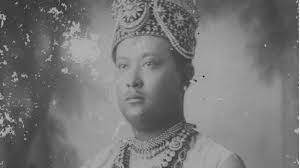
The Dual Status Kings: How the Manikya Dynasty Ruled Hills and Plains
The Manikya Dynasty: A Millennial Legacy of State Formation, Cultural Synthesis, and Modernity in Tripura
Abstract
The Manikya dynasty, ruling the Kingdom of Tripura for over five centuries, represents a singular case study in the geopolitical and cultural history of North East India. From its mytho-historical origins in the 15th century to its integration into the Indian Union in 1949, the dynasty navigated a complex trajectory involving the consolidation of tribal chieftaincies, the Sanskritization of court culture, intermittent warfare with the Bengal Sultanate and the Mughal Empire, and a nuanced “dual status” existence under British colonial paramountcy. This report provides an exhaustive analysis of the dynasty’s political evolution, administrative structures, architectural innovations, and its profound demographic transformation following the Partition of India. It further examines the dynasty’s unique literary patronage, particularly its symbiotic relationship with Nobel laureate Rabindranath Tagore, and the lasting legacy of the “Tribeg” architectural style.
1. Historiographical Framework and Origins
1.1 The Rajmala: Chronicle as Statecraft
The historiography of the Manikya dynasty is anchored in the Rajmala, the royal chronicle of Tripura. Commissioned initially by Dharma Manikya I in the early 15th century (circa 1431–1462), this text is not merely a genealogical record but a sophisticated instrument of legitimacy. It was composed in Bengali verse by the royal priest (Chantai) Durlabhendra and Brahmin scholars Baneswar and Sukreswar.1
The Rajmala is structured into lahars or volumes, updated successively by subsequent monarchs to ensure continuity. It serves as the oldest specimen of Bengali composition in the region, reflecting the court’s early orientation toward Bengali culture despite the dynasty’s Tibeto-Burman ethnic roots.1 The reliability of the Rajmala has been a subject of scholarly debate. While 19th-century analysts like the Rev. James Long acknowledged its value in recording the “laws, manners, and customs” of the hill people, modern historians differentiate between the earlier mythological sections—which claim descent from the Lunar Dynasty (Chandravamsa) of the Mahabharata—and the later historical sections beginning with the 15th century, which are corroborated by numismatic and epigraphic evidence.
1.2 Mythological Lineage and the “Manikya” Title
The dynasty claims an unbroken lineage of 185 kings, tracing its ancestry to Druhyu, the son of Emperor Yayati of the Lunar Race, and further back to the Puranic traditions.6 This genealogical construction served a vital sociological function: it facilitated the integration of the indigenous Tripuri (Tipra) tribes into the broader Hindu caste hierarchy (Kshatriyaization).
The transition from the traditional tribal title “Fa” (meaning “father” or “headman” in Kokborok) to the Sanskritized “Manikya” marks the crystallization of the state. While tradition lists Maha Manikya as an early adopter, historical consensus identifies Ratna Fa (later Ratna Manikya I) as the pivotal figure. According to the Rajmala, Ratna Fa sought asylum at the court of the Bengal Sultan (likely Ruknuddin Barbak Shah) after being displaced by his siblings. Upon regaining his throne with Bengali military assistance in the mid-15th century, he formally adopted the title “Manikya,” a suffix that became hereditary for all subsequent rulers until the dynasty’s end in 1947.
1.3 Etymology and Geo-Ethnic Context
The name “Tripura” itself is contested terrain. While Sanskrit scholars attribute it to the legendary King Tripur (46th descendant of Chandra) or the deity Tripurasundari, linguistic anthropologists suggest a Bodo-Kachari origin. The Kokborok compound Twi (water) and Pra (near/confluence) likely refers to the “land near the water,” a plausible etymology given the kingdom’s historical extension into the riverine plains of the Meghna and Surma basins.7 This dual etymology mirrors the kingdom’s dual identity: an indigenous tribal core in the hills and a Sanskritized, wet-rice agrarian culture in the plains.
2. The Medieval Consolidation (1400–1600)
The period between the 15th and 16th centuries constitutes the “Imperial Phase” of the Manikya dynasty. During this era, the kingdom functioned as a sovereign power capable of challenging the hegemony of the Bengal Sultanate and the Arakanese Kingdom.
2.1 Ratna Manikya I (c. 1464–1488): The Reformer
Ratna Manikya I is credited with the structural transformation of the tribal chieftaincy into a settled monarchy. His exile in Bengal exposed him to the administrative and military systems of the Sultanate, which he replicated in Tripura.
- Administrative Reform: He reorganized the administrative machinery, introducing Persian, Bengali, and Sanskrit titles for officials.
- Demographic Engineering: He is recorded as the first king to settle 4,000 Bengali families in Tripura to develop wet-rice cultivation and man the administration, initiating a demographic trend that would have centuries-long consequences.11
- Numismatics: He introduced the first silver coinage of the dynasty, modeled on the weight standard of the Bengal Sultans but bearing Sanskrit legends and Hindu iconography. Notably, he initiated the tradition of inscribing the Queen’s name alongside the King’s, a practice indicating the high status of royal women in Tripuri society.
2.2 Dhanya Manikya (c. 1490–1515): The Warrior-Builder
Dhanya Manikya’s reign represents the zenith of military expansion.
- Territorial Expansion: He consolidated control over the plains of Comilla, Sylhet, and Chittagong. His forces successfully repelled the invasions of Sultan Alauddin Husain Shah of Bengal, securing Tripura’s independence against a superior power.12
- Religious Patronage: A devout Shakti worshipper, he constructed the Tripura Sundari Temple (Matabari) in Udaipur in 1501 AD. This temple, one of the 51 Shakti Peethas, became the spiritual nerve center of the kingdom, binding the diverse tribal populations through a shared religious focal point.
2.3 Vijaya Manikya II (c. 1532–1563): The Naval Power
Vijaya Manikya II’s reign is often cited as the apogee of the dynasty’s power. Recognizing the riverine geography of the region, he developed a formidable navy, which allowed him to project power into the Padma and Meghna deltaic regions.
- Iconography: His coins reflect a sophisticated theological worldview, featuring the Ardhanarishvara motif (half-Shiva, half-Parvati) and the Viswa-Rupa icon, symbolizing the king’s role as a preserver of cosmic order.7
- Conflict with Rivals: He successfully navigated the collapse of the Bengal Sultanate and the rise of the Suri dynasty, maintaining Tripura’s sovereignty while neighboring kingdoms fell.
2.4 Amar Manikya (c. 1577–1586) and the Arakanese Threat
The late 16th century brought a new threat from the east: the Arakanese (Mogs). Amar Manikya, initially a successful ruler who excavated the expansive Amar Sagar lake, faced a devastating invasion by the Arakanese forces. The sacking of the capital Udaipur and the subsequent suicide of the King marked the end of the era of absolute expansion and the beginning of a defensive phase against rising imperial powers.
3. The Mughal Interlude and the “Dual Status” Anomaly (1600–1761)
The 17th century witnessed the inexorable expansion of the Mughal Empire into the northeast. The Manikya kings were forced to navigate a precarious existence between independence in the hills and submission in the plains.
3.1 Mughal Conquests and Tribute
The Mughals, under Jahangir and later Aurangzeb, launched repeated expeditions to subdue Tripura, which controlled the lucrative elephant capture grounds and the strategic routes to Chittagong.
- Loss of Sovereignty: Kings like Yashodhar Manikya (1600s) and Govinda Manikya (1660s) faced overwhelming Mughal military pressure. The kingdom was compelled to pay tribute (peshkash) in the form of elephants and ivory.
- Mughal Politics in Agartala: The Mughal governors of Bengal often intervened in succession disputes, supporting rival claimants to the throne in exchange for revenue concessions. This weakened the central authority of the dynasty and fostered factionalism.
3.2 The Formation of Chakla Roshnabad (1733)
The definitive structural change occurred in 1733, when the Nawab of Bengal, Shuja-ud-Din Muhammad Khan, fully annexed the fertile plains of the kingdom—comprising the districts of Tippera, Noakhali, and parts of Sylhet.
- Administrative Partition: This territory was organized into a revenue division named Chakla Roshnabad (“Land of Light”).
- The Zamindari Compromise: The Manikya ruler was not stripped of these lands entirely but was reduced to the status of a Zamindar (landholder). This created a unique “Dual Status”:
- Independent Raja: In the Hill Tippera region (modern Tripura state), the King remained a sovereign ruler, exercising criminal and civil jurisdiction.
- Zamindar: In Chakla Roshnabad (now in Bangladesh), he was a subject of the Nawab (and later the British), paying annual revenue and subject to the laws of the Bengal province.
This bifurcation was economically critical: the revenue from the fertile Chakla Roshnabad estate far exceeded the income from the hill subjects (who practiced shifting Jhum cultivation). Consequently, the Manikya kings became economically dependent on a territory where they held no sovereign power, a vulnerability that the British would later exploit.
4. The Colonial Era: Protectorate and Legal Entanglements (1761–1947)
4.1 The Arrival of the British (1761)
The transition from Mughal to British suzerainty was marked by the expedition of 1761. The British East India Company (EIC), acting on behalf of the puppet Nawab Mir Qasim, launched an attack on Krishna Manikya. Realizing the asymmetry of power, the King surrendered without a major fight.
- The Leeke Residency: The British appointed Ralph Leeke as the first Resident in 1761. His primary mandate was to ensure the regular collection of revenue from Chakla Roshnabad. For the next century, the British viewed Tripura primarily through the lens of revenue, often treating the Raja merely as a recalcitrant Zamindar.
4.2 Legal Recognition and Paramountcy (1809)
The status of the “Hill Tippera” remained ambiguous until 1809, when the British government formally recognized the Raja’s title to the hills as a sovereign state, distinct from his zamindari in the plains.
- Protectorate Status: Tripura became a “Princely State” with a 13-gun salute. However, the “Dual Status” continued to plague the dynasty. Succession disputes were frequently adjudicated in British courts (like the Sadar Dewani Adalat), which treated the throne as a property dispute attached to the zamindari. This meant that British colonial law effectively determined the succession of an independent kingdom.12
- Territorial Integrity: The British defined the boundaries of the state, separating the “Excluded Area” of the hills from the Regulation Districts of Bengal. While this preserved the indigenous demographic of the hills temporarily, it also isolated the state from the economic infrastructure developing in the plains.8
5. The Modernization Paradigm (1862–1947)
The late 19th century ushered in a period of “Enlightened Despotism” where four successive monarchs utilized the stability of the Pax Britannica to modernize the state’s administration, judiciary, and culture.
5.1 Maharaja Birchandra Manikya (1862–1896): The Architect of Modernity
Birchandra Manikya is often compared to Emperor Meiji of Japan for his role in modernizing a feudal state.
- Administrative Reforms: He abolished domestic slavery in 1877 and reorganized the state administration on the British Bengal model. He established a modern budget system, separated the police from the judiciary, and codified the civil and criminal laws of the state.
- Cultural Renaissance: A polymath, poet, and photographer, Birchandra initiated the dynasty’s association with Rabindranath Tagore. Recognizing the young poet’s genius in Bhagna Hriday, he extended royal patronage that would last for three generations.
5.2 Maharaja Radha Kishore Manikya (1896–1909)
Radha Kishore focused on institution-building and welfare.
- Health and Education: He established the Victoria Memorial Hospital (VM Hospital) and patronized the Jagannath College in Dhaka. His support for scientific research was notable; he provided crucial financial backing to scientist Jagadish Chandra Bose when colonial funding was unavailable.
- Fiscal Management: Despite the heavy costs of modernization and philanthropy (which often strained the treasury), he maintained the distinct identity of the state against British pressure to merge the administration with Assam.
5.3 Maharaja Birendra Kishore Manikya (1909–1923)
Birendra Kishore continued the trajectory of reform with a focus on education and the arts.
- Civil Service: He formalized the Tripura Civil Service, recruiting educated Bengalis to run the bureaucracy, further deepening the cultural synthesis between Tripuri royalty and Bengali intelligentsia.
- Artistic Legacy: He was a painter of immense talent, and his reign saw the proliferation of the “Company School” style of painting within the royal court.
5.4 Maharaja Bir Bikram Kishore Manikya (1923–1947): The Visionary
The last ruling monarch, Bir Bikram Kishore, is revered as the father of modern Tripura. His reign coincided with the turbulent years of World War II and the Indian independence movement.
- The Master Plan: He conceived the Master Plan for Agartala, transforming it into a planned city with zoning for residential, commercial, and palace areas. He constructed the Ujjayanta Palace grounds (finishing touches and landscaping) and built the Neermahal (Water Palace), a unique blend of Hindu and Islamic architecture in the middle of Rudrasagar Lake.15
- Vidyapattan Scheme: In 1937, he launched the Vidyapattan scheme, envisioning a university town. He laid the foundation for the Maharaja Bir Bikram College (MBB College), aiming to bring higher education to the state.26
- Tribal Reserves: Foreseeing the demographic pressure from Bengali immigration, he issued the famous Tribal Reserve Order of 1943. This reserved vast tracts of land in the interior specifically for the indigenous five tribes, a protective measure that remains a cornerstone of tribal rights discourse in Tripura today.24
- Aviation: He established the first airport at Singherbill (Agartala), linking the state to the global air network, which proved vital during the Burma Campaign of WWII and the later Partition crisis.28
6. The Cultural Nexus: Rabindranath Tagore and the Manikyas
The relationship between the Manikya dynasty and Rabindranath Tagore is unique in the annals of Indian princely states. It was not merely a patron-client relationship but a deep intellectual and emotional bond spanning over sixty years.
6.1 Literary Inspiration and Output
Tagore visited Agartala seven times, and the royal family’s history provided the thematic bedrock for some of his most significant works.
- Plays and Novels: The novel Rajarshi (The Sage King) and the play Visarjan (Sacrifice) are based on the life of Govinda Manikya (1660–1676). The central conflict in Visarjan—between the humane King Govinda, who bans animal sacrifice, and the orthodox priest Raghupati—reflects the historical tension between Vaishnavism and Shakta Tantrism in the Tripura court.29
- Songs: Tagore composed several songs during his stays in Agartala and the hill station of Shillong (where the Tripura kings had a summer residence). The serene landscape of Tripura inspired his nature poetry.32
6.2 Institutional Support
The Manikya kings were among the earliest and most consistent financial backers of Tagore’s educational experiment at Santiniketan.
- Visva-Bharati: From Birchandra to Bir Bikram, the dynasty provided annual grants to Visva-Bharati University. Even when the state treasury was stressed, the grant to the poet was rarely discontinued. In return, Tagore sent teachers to Agartala to improve the state’s educational pedagogy.23
- Recognition: It was Birchandra Manikya who first hailed Tagore as a “Great Poet” (Kabi Guru) after reading his early work Bhagna Hriday, at a time when Bengali critics were dismissive of the young author. This royal validation was crucial for Tagore’s early confidence.22
7. Art, Architecture, and Numismatics
7.1 The “Tribeg” Architectural Style
The Manikyas developed a distinct school of temple architecture known as the Tribeg style. This style is a syncretic marvel, blending three distinct architectural traditions:
- Buddhist Stupa: The finials and the rounded, hump-like structures atop the temples.
- Hindu Nagara: The verticality and the shikhara concepts.
- Islamic Bengal: The most dominant influence, characterized by the Do-chala or Char-chala (curved Bengali hut) roofs and the use of the dome.
Key Structural Features:
- The Stupa-Sirsha-Char-Chala: A unique hybrid where a Stupa-like finial crowns a Char-chala roof.
- Internal Structure: Unlike traditional Hindu temples with pillar halls (mandapas), Tripura temples often feature a unified interior space without pillars, using thick walls and corbelled arches to support the dome—a technique borrowed from the Sultanate architecture of Gaur and Pandua.9
Prominent Examples:
- Tripura Sundari Temple (Udaipur): Built in 1501, it features a Kurma-prishtha (tortoise-back) base and is the finest surviving example of the style.
- Bhubaneswari Temple: Located on the bank of the Gomati, immortalized in Visarjan.
- Gunabati Group: A cluster of temples dating to the 17th century showing the evolution of the style.13
7.2 Numismatic History
The coinage of the Manikya dynasty is a vital primary source, offering an unbroken record from the 15th to the 20th century.
- Standard: The coins were minted in silver, adhering to the weight standard of the Bengal Tanka (approx 10.6 grams), facilitating trade with the plains.
- Language: While the script was Bengali, the language was exclusively Sanskrit, asserting the Aryan credentials of the dynasty.
- The Queen’s Name: A hallmark of Manikya coinage is the inscription of the Queen’s name (e.g., Srimati Lakshmi-Maha-Devi) alongside the King’s. This is exceedingly rare in Indian numismatics and highlights the political significance of royal marriages and the status of the Mahadevi.
- Iconography: The “Lion” (vehicle of Durga) and the “Trident” (Shiva) were standard obverse motifs. However, innovative designs appeared, such as the Ardhanarishvara and flute-playing Krishna during the Vaishnava phases of the dynasty.
8. The Partition, Demographic Collapse, and Merger (1947–1949)
The end of the dynasty was precipitated by the cataclysmic events of 1947. The partition of India severed Tripura from its economic lifeline (Chakla Roshnabad) and triggered a demographic upheaval that would forever alter the state.
8.1 The Accession Crisis
Maharaja Bir Bikram died in May 1947, leaving his minor son, Kirit Bikram Kishore Manikya, as the heir. A Council of Regency was formed, headed by the Queen Mother, Maharani Kanchan Prabha Devi.
- Instrument of Accession: On August 13, 1947, the Maharani signed the Instrument of Accession, transferring external affairs, defense, and communications to the Indian Dominion. However, internal administration remained with the Regency.12
- Loss of Chakla Roshnabad: With the partition of Bengal, the zamindari of Chakla Roshnabad—the primary source of the royal family’s income—fell to East Pakistan. This economic blow made the independent survival of the state untenable.19
8.2 The Refugee Influx and Demographic Inversion
Tripura, bordering East Pakistan on three sides, became a sanctuary for Hindu refugees fleeing communal violence. The Regency administration, driven by humanitarian concerns and historical ties to Bengali culture, welcomed the refugees.
- The Numbers: The demographic shift was swift and total.
- In 1941, the tribal population was 53.16%, constituting a majority.
- By 1951, it dropped to 37.23%.
- By 1961, it fell further to 31.50%.
- Conversely, the non-tribal (mostly Bengali) population surged from 46% to nearly 70% in two decades.
- Impact: This inversion marginalized the indigenous Tripuris in the political and economic spheres of their own homeland, laying the groundwork for the ethnic insurgency that would erupt in the 1980s under groups like the TNV.
8.3 The Tripura Merger Agreement (1949)
Facing administrative collapse, internal intrigue, and the overwhelming refugee burden, Maharani Kanchan Prabha Devi negotiated the final merger.
- The Agreement: Signed on September 9, 1949, in New Delhi.
- Provisions: The Regent ceded “full and exclusive authority” to the Government of India.
- Integration: On October 15, 1949, Tripura officially became a Part ‘C’ State of the Indian Union, administered by a Chief Commissioner. The Manikya dynasty’s political rule formally ended, though the personal privileges and titles were retained until the abolition of privy purses in 1971.