
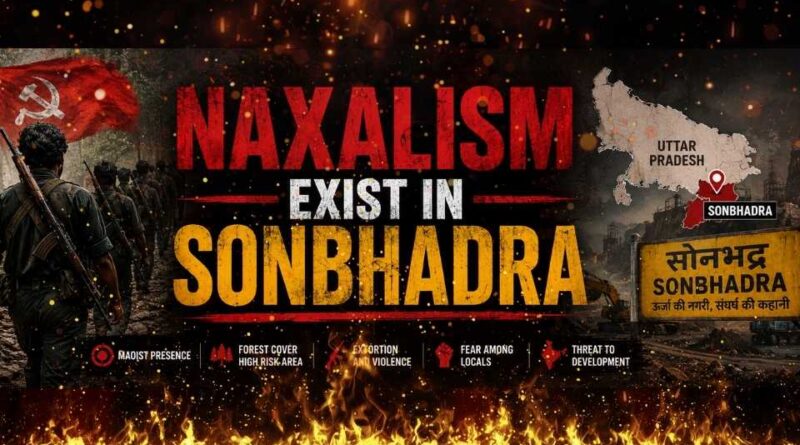
Sonbhadra: The UP District That Was Once a Naxalite Stronghold
Whenever the term “Naxalism” or Left-Wing Extremism is mentioned, the states that typically come to mind are Chhattisgarh, Jharkhand, or Bihar. But did you know that a district in Uttar Pradesh was also deeply affected by Naxalism?
This is a district defined by dense forests, rugged mountains, billions of rupees in mineral wealth, and massive power plants. Yet, there was a time when fear ruled many of its remote pockets, and people spoke not of development, but of survival and conflict.
This is the story of Sonbhadra. And believe it or not, this isn’t just a story about Naxalism—it is a story of poverty, systemic anger, a fight against the odds, and ultimately, an inspiring transformation.
Surrounded by Four States: The Geography of Sonbhadra
Located in the southeastern part of Uttar Pradesh, Sonbhadra holds a unique geographical distinction: it is the only district in India that shares its borders with four different states:
-
Bihar
-
Jharkhand
-
Madhya Pradesh
-
Chhattisgarh
This unique geography is a crucial part of its story. The Naxalite influence spilled over into Sonbhadra from the very states it shares its borders with. However, geography and dense jungles were not the only reasons the insurgency took root; a deep socio-economic discontent was brewing beneath the surface.
Abundant Resources vs. Lack of Development
Sonbhadra is widely known as the “Energy Capital of Uttar Pradesh.” In terms of natural resources, it is one of the richest districts in the country, but historically, the lives of its indigenous and local populations reflected the exact opposite.
This stark paradox can be understood through the reality of that era:
This extreme inequality slowly sowed the seeds of anger, resentment, and alienation among the local population.
The Entry of Naxalism: Why Did Locals Support It?
The Naxalite movement originated in 1967 in the village of Naxalbari, West Bengal. What started as an uprising for the rights of poor farmers and tribals eventually morphed into an armed rebellion. By the 1980s and 1990s, this ideology had seeped into the hilly and forested terrains of Sonbhadra.
But why did the locals start listening to the Naxalites? The reasons were painfully clear:
-
Extreme Poverty: People lacked the most basic means of survival.
-
Unemployment: Despite the presence of massive industries, locals were denied meaningful employment opportunities.
-
Land and Forest Disputes: Tribal communities felt robbed of their traditional rights to the forests and their land.
-
Administrative Neglect: When people feel the system is deaf to their suffering, they are easily drawn to anyone promising change—even if that change comes through the barrel of a gun.
“An armed insurgency only finds ground when there is deep-seated public resentment against the system. In Sonbhadra, the Naxalites weaponized this very discontent.”
The Shadow of Fear and Stalled Development
The most devastating impact of Naxalism was borne by the common people. An atmosphere of fear gripped several parts of the district. The pace of development ground to a halt. Due to severe security threats, new infrastructure projects were stalled, and private investment dried up.
The administration faced new, deadly challenges every day. In this ongoing crossfire, the biggest losers were impoverished families who simply wanted a peaceful and better life.
The Turning Point: The “Security + Development” Model
Over time, the government and administration realized a fundamental truth: you cannot eradicate an insurgency using only police and paramilitary forces. To defeat Naxalism, the root causes feeding the rebellion had to be destroyed.
This led to the implementation of a dual-pronged strategy: Security + Development.
-
A massive network of all-weather roads was laid down, penetrating the deepest, most inaccessible jungles.
-
New schools, healthcare centers, and telecom towers were established.
-
Employment and welfare schemes were aggressively rolled out for local youth.
-
Simultaneously, the security apparatus was strengthened and made more accountable.
As the light of development finally reached deep into the forests, the shadow of Naxalism naturally began to fade.
Sonbhadra Today: From Conflict to Prosperity
The Sonbhadra of today is drastically different from the terrifying days of the 1990s. It has firmly established itself as one of the most vital industrial and energy hubs in Uttar Pradesh. The fear of Left-Wing Extremism is now largely a thing of the past.
The story of Sonbhadra teaches us a profound lesson: When education reaches the masses, when employment is generated, and when development touches the last person in line, real change is inevitable. The future of any region is not determined by bullets, but by providing equal opportunities to its people.
Posted By: Ananya Sharma